How Do Automated Stations Compare to Robotic Kiosks?
Automated beverage equipment falls into three categories: traditional vending, robotic kiosks, and compact automated blending stations. Each differs in cost, footprint, freshness, and scalability.
The automated food and beverage equipment market has expanded significantly over the past five years, giving operators more choices than ever for self-service food programs. But the proliferation of options has also created confusion. When an operator searches for "automated smoothie machine" or "self-service beverage station," the results include everything from a $2,000 vending machine to a $150,000 robotic kiosk. These are fundamentally different categories of equipment with different economics, operational requirements, and customer experiences.
Understanding the distinctions between these categories is essential for making the right investment. This post defines the three primary categories of automated beverage equipment, compares them across the criteria that matter most to operators, and provides a framework for evaluating which category fits a given operation.
What Are the Three Categories of Automated Beverage Equipment?
Traditional Vending Machines
Traditional vending machines dispense pre-made, shelf-stable products. In the beverage category, this includes bottled smoothies, juice boxes, protein shakes, and ready-to-drink health beverages. The machine stores sealed products at refrigerated temperatures and dispenses them when the customer makes a selection and pays. No preparation, blending, or assembly occurs inside the machine.
The advantages of vending are simplicity and low cost. Machines typically cost $3,000 to $8,000 to purchase, require only a standard electrical outlet (no water or drain connections), and can be placed almost anywhere. The disadvantages are product quality limitations (pre-made products contain preservatives, added sugars, and stabilizers to achieve shelf stability) and the perception gap: consumers increasingly view vending machines as a last resort rather than a preferred option.
Robotic Kiosks
Robotic kiosks use robotic arms, automated dispensing systems, or multi-station assembly lines to prepare food and beverages from scratch. These systems can produce a wide variety of products (smoothies, bowls, salads, sandwiches) with impressive technological capabilities. Robotic arms pour ingredients, blend products, and dispense finished items with minimal human involvement.
The capital investment is substantial, typically ranging from $100,000 to $250,000 or more per unit. The footprint is large, often requiring 80 to 200 square feet of dedicated floor space plus utility infrastructure. Maintenance complexity is high because robotic systems have many moving parts, sensors, and calibration requirements. Throughput can be impressive (20 to 40 items per hour depending on the system), but downtime for maintenance and calibration reduces effective availability. These systems are best suited for high-traffic, high-visibility locations where the technology spectacle itself draws customers.
Compact Automated Blending Stations
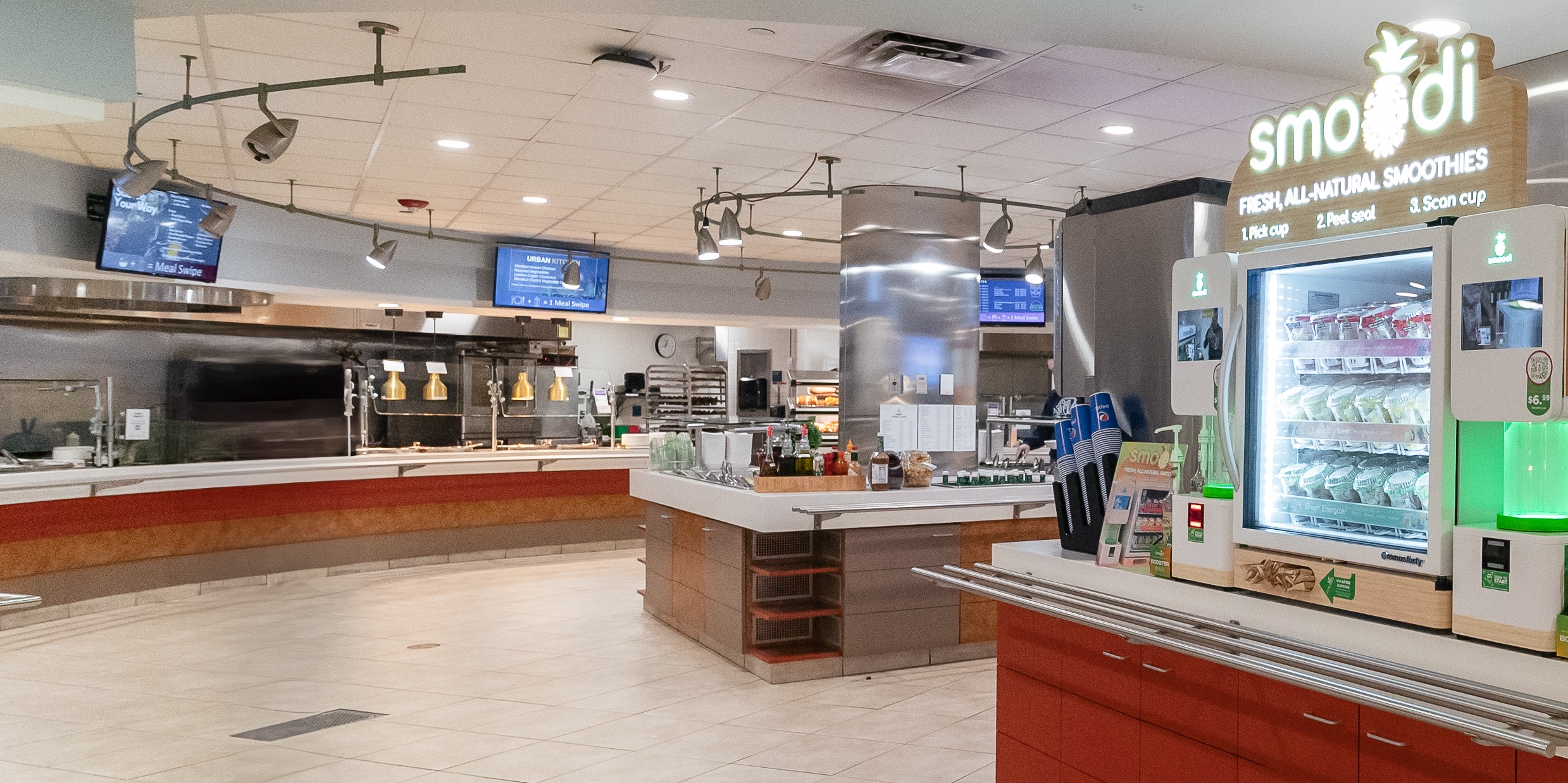
Compact automated blending stations occupy the middle ground. They focus on a single task (blending a smoothie, for example) and execute it with minimal complexity. Rather than using robotic arms and multi-ingredient dispensing, they use pre-portioned ingredients (such as IQF fruit cups) that are loaded by the customer or operator and blended on demand. The equipment is self-contained, requires a small footprint (approximately 40 inches of floor space), and connects to standard utilities.
The capital investment is significantly lower than robotic kiosks: operational leases start at $299 per month, and purchase pricing begins at $14,999. The product is fresh (blended on demand from whole-fruit ingredients with no syrups, concentrates, or artificial ingredients), and the machine self-cleans between every use. Maintenance requirements are minimal compared to robotic systems because there are fewer moving parts and no robotic arm calibration. Throughput for a single machine is approximately 30 servings per hour, and multiple machines can be installed side by side in the same footprint as a single robotic kiosk, blending simultaneously to scale capacity linearly.
How Do They Compare on Cost?
Cost is often the primary evaluation criterion for operators, and the three categories differ dramatically.
- Traditional vending: $3,000 to $8,000 purchase price. Low operating costs (electricity, restocking). No water or drain connections required.
- Robotic kiosks: $100,000 to $250,000+ purchase price. Significant operating costs including specialized maintenance, parts replacement, and technical support contracts. Often requires dedicated utilities and custom installation.
- Compact automated stations: $299 to $499 per month operational lease, or $14,999 purchase price. Moderate operating costs (ingredient cups, standard utilities). Self-cleaning reduces maintenance labor to near zero.
For an operator testing the automated beverage concept at a single location, the risk profiles are fundamentally different. A vending machine commits $5,000. A compact station on a 12-month lease commits $6,000 over the year. A robotic kiosk commits $100,000 or more before a single customer is served.
How Do They Compare on Product Quality and Freshness?
Product quality is where the categories diverge most sharply. Traditional vending dispenses products that were manufactured days, weeks, or months ago. Even "healthy" bottled smoothies contain preservatives and stabilizers that extend shelf life at the expense of taste and nutritional integrity. Consumers can taste the difference between a pre-made bottled smoothie and one blended fresh from whole fruit.
Robotic kiosks and compact automated stations both produce fresh products on demand. The difference is complexity: robotic kiosks often work with multiple loose ingredients (individual fruits, liquids, powders, ice) that require calibrated dispensing and create more variables for quality inconsistency. Compact stations using pre-portioned ingredients (such as Smoodi's IQF fruit cups blended with water only) eliminate portioning variability entirely. Every serving uses the same cup, the same amount of water, and the same blending cycle. The result is identical product quality at every location, every time.
What Does Scalability Look Like for Each Category?
Scalability is the criterion that most clearly separates the three categories for operators with multiple locations or plans to expand.
Vending machines scale easily because they are simple, cheap, and standardized. However, they scale a commodity product that competes on price rather than quality, and consumer perception of vending is declining in most demographics.
Robotic kiosks scale with difficulty. Each unit requires significant capital, specialized installation, dedicated technical support, and ongoing maintenance. A hospital network or university system that wants to deploy across 20 locations faces a multi-million-dollar investment and a complex support infrastructure. The technology is impressive at a flagship location but operationally heavy at scale.
Compact automated stations scale efficiently. Smoodi's model illustrates this: identical IQF fruit cups distributed nationally through Dot Foods produce identical products at every location. The operational lease model ($299 to $499 per month) eliminates capital barriers to expansion. Self-cleaning removes training variance across sites. An operator can deploy at one location, evaluate results over 60 to 90 days, and expand to additional sites without increasing headcount or operational complexity. Multiple machines can be installed side by side at high-volume locations, scaling throughput without expanding footprint.
Which Category Fits Your Operation?
The right category depends on the operator's priorities. If the goal is the lowest possible investment with minimal product differentiation, traditional vending may suffice. If the goal is a technology showcase at a single flagship location with significant budget, a robotic kiosk delivers visual impact. If the goal is a fresh, high-quality product that scales across multiple locations with minimal operational complexity, a compact automated station is the most practical choice.
Smoodi operates in more than 300 locations across the United States, with over 2 million smoothies served. The company was founded at Harvard Innovation Labs. The machine blends IQF fruit cups with water in under 60 seconds, self-cleans between every use, and occupies approximately 40 inches of floor space. The booster bar offers protein powder, collagen, and functional supplements for additional revenue per serving.
"The investment into smoodi has been phenomenal. We broke even in the first couple of weeks."
— Linda Thacker, Director of Dining Services, Maryville University
To compare options for your operation, visit getsmoodi.com/get-started. To calculate the financial projections for your location, visit getsmoodi.com/roi.
Ready to bring Smoodi to your location?
Join hundreds of operators delivering fresh, automated smoothies with zero labor.
Get Started