How Can Food Amenities Help Fill Commercial Spaces?
Commercial property managers compete on amenity quality to attract tenants. A zero-labor self-service food station adds wellness value without the cost of operating a staffed cafe.
Commercial real estate faces a tenant retention challenge that has intensified since the widespread adoption of hybrid work. Office vacancy rates remain elevated across most major markets, and property managers are competing on amenity quality to attract and retain tenants. The properties that offer curated, wellness-forward amenities consistently outperform their peers in occupancy rates and lease renewals.
Food and beverage amenities have emerged as a key differentiator, particularly for Class B and C buildings that cannot compete with Class A properties on architectural design or prime locations. A building that offers convenient, healthy food options in its common areas provides a daily benefit that tenants experience repeatedly, reinforcing their satisfaction with the property in a way that a renovated lobby or new carpet cannot match.
Why Do Traditional Food Programs Fail in Office Buildings?
The fundamental challenge for office building food programs is that most commercial properties lack the daily population to support a staffed food operation. A Class B office building with 100 to 500 daily occupants cannot generate enough food revenue to cover the cost of a barista, a prep cook, or even a part-time cafe attendant. The economics only work in large Class A towers with thousands of daily workers, and even those properties have seen foot traffic decline as hybrid schedules reduce in-office days to three or four per week.
Vending machines have been the default solution for decades, but they offer exactly the wrong product for today's tenant expectations. Chips, candy, and sugary sodas signal that the building operator is filling a checkbox rather than investing in tenant wellness. The contrast between a property manager who markets "state-of-the-art wellness amenities" and a break room with a 1990s vending machine does not go unnoticed by prospective tenants touring the building.
The cost of tenant turnover makes this gap expensive. Industry data suggests that replacing a commercial tenant costs the equivalent of six to nine months of rent when accounting for vacancy, broker commissions, build-out incentives, and lost income. A single lease non-renewal in a mid-rise building can cost hundreds of thousands of dollars. Investments that improve tenant satisfaction and reduce turnover pay for themselves quickly relative to the cost of finding a replacement tenant.
How Does a Self-Service Station Change the Equation?
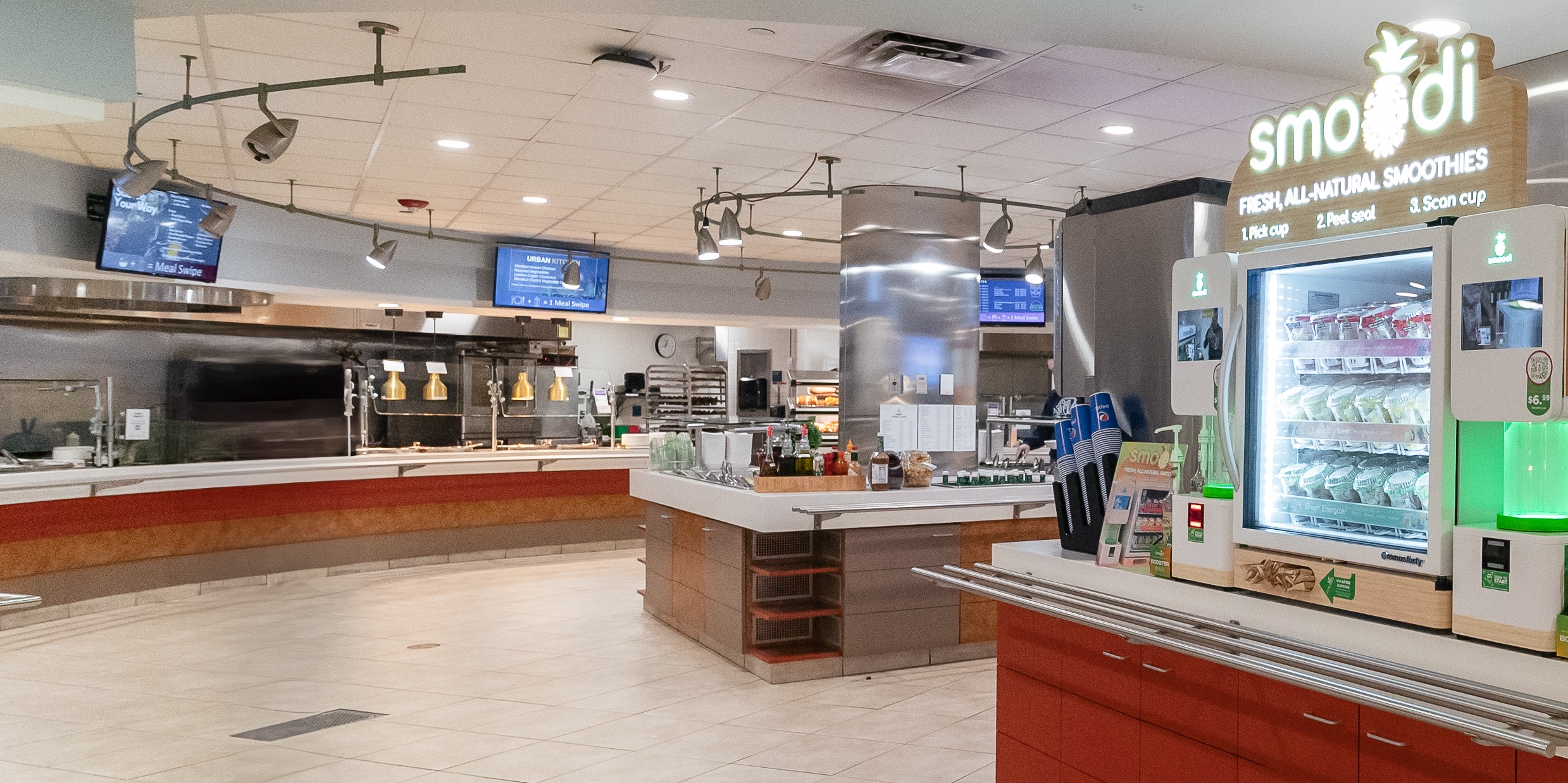
A self-service automated smoothie station provides the wellness amenity value of a staffed food program without the labor cost that makes traditional food programs unviable in mid-sized buildings. The station requires no dedicated staff, operates continuously during building hours, and self-cleans between every use. It sits in a lobby, common area, tenant lounge, or shared kitchen zone and provides a healthy, fresh beverage option that tenants can access in under 60 seconds.
"We were looking for ways to give our employees healthier options - smoodi was the answer. It tastes great, our team loves it."
— Eric Rose, President & COO, Shoreham Bank
The compact footprint of approximately 40 inches of floor space fits building environments where a full food counter would be impractical. A corner of the lobby, a niche in the fitness center, or a section of the shared tenant lounge is sufficient. For buildings with multiple floors, a station on the ground floor or in the parking level lobby provides access to all tenants without requiring elevator trips to a dedicated food floor.
How Does the Financial Model Work for Property Managers?
Smoodi's operational lease starts at $299 per month for a 48-month term, scaling to $499 per month for a 12-month term. The purchase option is $14,999. For a property manager, the lease model provides a predictable monthly expense that can be allocated to the common area maintenance (CAM) budget, factored into operating expenses, or offered as a building amenity funded by management.
The cost comparison to traditional food service alternatives is straightforward. A part-time cafe attendant costs $1,500 to $2,500 per month in wages before benefits, payroll taxes, and management overhead. A self-service smoothie station at $299 to $499 per month provides a food amenity at a fraction of that cost, with zero management burden, zero HR liability, and zero absenteeism.
Revenue from smoothie sales flows to the building operator (or tenant, depending on how the property structures the arrangement). Some buildings absorb the lease cost as a common area amenity and offer smoothies as a complimentary perk to differentiate the property. Others pass the station through as a revenue-generating amenity where tenants and their employees purchase smoothies. Either model works within standard commercial property management frameworks.
What Placement Strategies Work in Commercial Buildings?
- Ground floor lobby: highest visibility, accessible to all tenants, reinforces the building's wellness positioning during tours and tenant visits
- Tenant lounge or common area: social spaces where employees gather for informal meetings and breaks, creating foot traffic that drives usage
- Building fitness center: post-workout nutrition is a natural complement to the gym amenity that most competitive buildings already offer
- Shared kitchen or break room on high-occupancy floors: convenient access during the workday without requiring a trip to the lobby
- Conference center or meeting area: healthy refreshment option for building-hosted events and all-hands meetings
For buildings with 100 to 300 daily occupants, a single station in the lobby or common area provides sufficient coverage. For larger properties with 500 or more occupants, a second station on a high-traffic floor ensures that the amenity is accessible without requiring everyone to visit the lobby.
How Does This Affect Tenant Marketing and Leasing?
The leasing value of a wellness food amenity extends beyond current tenant retention. Prospective tenants who tour the building see a modern, health-forward environment that signals investment in the tenant experience. Brokers who represent the property can point to a specific, tangible amenity that differentiates the building from competitors in the same submarket and price range.
For Class B buildings competing against Class A properties on price, amenity quality is the lever that justifies the tenant's decision to choose the less expensive option. A building that offers a fitness center, a tenant lounge, and a self-service smoothie station presents a wellness package that many Class A buildings do not match, particularly in suburban markets where on-site food options are limited.
IQF (individually quick frozen) fruit cups are blended with water only. No syrups, concentrates, or artificial ingredients. The booster bar provides protein powder, collagen, and functional supplements. IQF cups have a shelf life of up to two years, distributed nationally through Dot Foods, ensuring consistent supply regardless of location. Smoodi operates in more than 300 locations across the United States, with over 2 million smoothies served. The company was founded at Harvard Innovation Labs.
For property managers, REIT operators, and building owners interested in adding a zero-labor wellness amenity to their property, visit getsmoodi.com/get-started to learn about building deployment options. To evaluate the financial impact, visit getsmoodi.com/roi.
Ready to bring Smoodi to your location?
Join hundreds of operators delivering fresh, automated smoothies with zero labor.
Get Started