How Does Automated Smoothie Equipment Handle Peak Traffic?
Each Smoodi machine produces up to 30 smoothies per hour. Multiple machines can be installed side by side in the same footprint as a single larger kiosk, scaling throughput linearly without adding labor.
When operators evaluate automated beverage equipment, one of the first questions is whether the machine can handle their busiest periods. A tournament weekend at a sports complex, a breakfast rush at a 200-room hotel, a lunch peak at a corporate cafeteria, or a post-class surge at a university dining hall: these high-demand windows determine whether an automated station is a viable solution or a bottleneck waiting to happen.
The answer depends on two factors: the throughput capacity of the individual machine and the scalability model when demand exceeds single-machine capacity. Most automated food equipment is evaluated on the first factor alone. The second factor, how an operator scales beyond one unit, often determines whether the investment succeeds at high-traffic locations.
What Is the Throughput of a Single Machine?
Each Smoodi machine produces up to 30 smoothies per hour. The blending cycle takes under 60 seconds per serving, and the machine self-cleans between every use. This means the machine can produce a fresh, whole-fruit smoothie every two minutes when operating at continuous capacity, accounting for the brief cleaning cycle and the time for the next customer to select their flavor and insert a cup.
Thirty servings per hour is sufficient for the majority of standard operating periods across all verticals. A corporate office with 300 employees, a fitness center with 150 daily members, or a hotel breakfast serving 100 guests can each be served by a single machine during normal traffic patterns. The machine operates continuously without breaks, shift changes, or staff scheduling, which gives it an effective uptime advantage over staffed alternatives that require coverage gaps for meals and turnover.
How Do Multiple Machines Scale for High-Volume Locations?
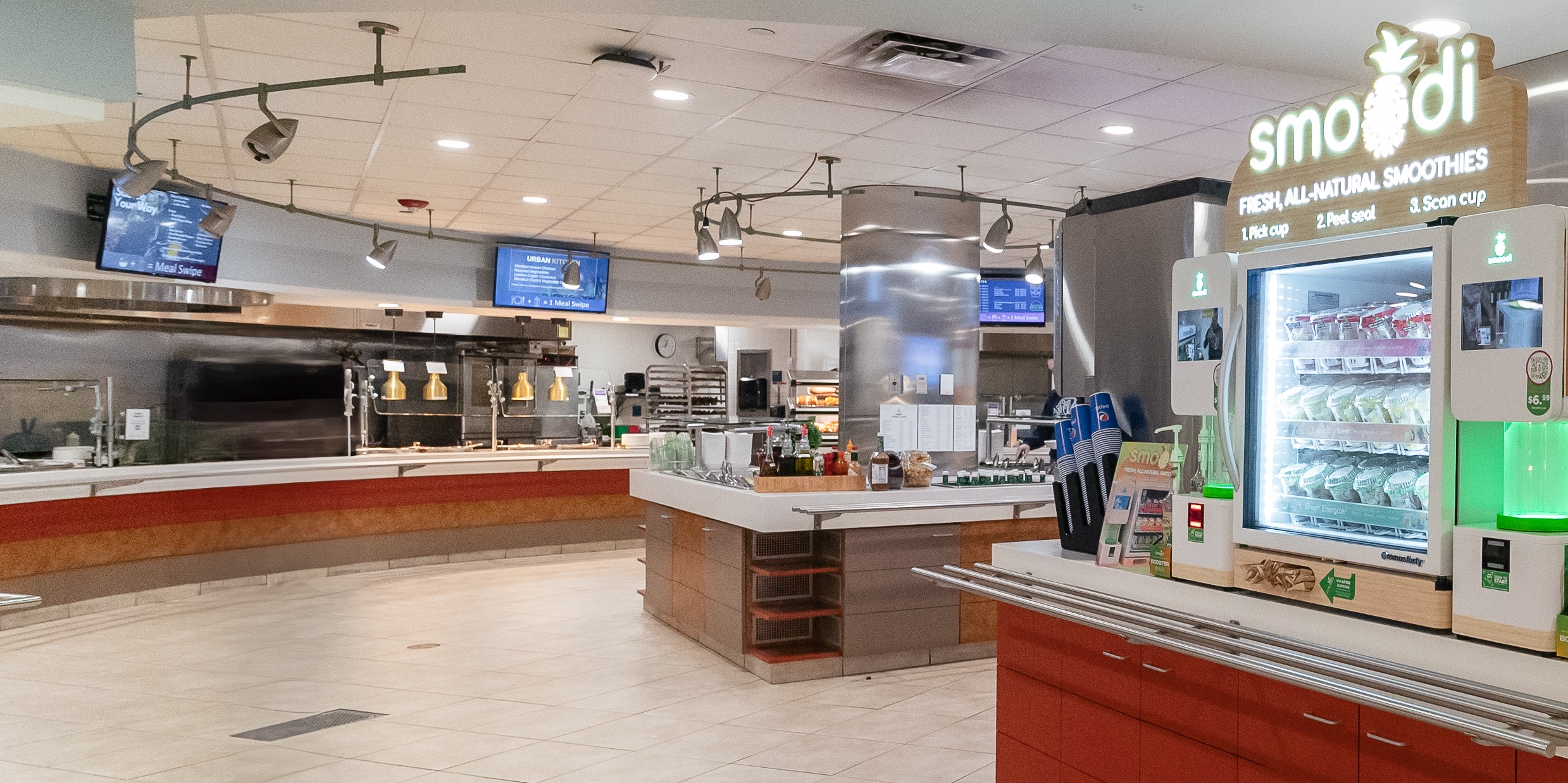
The critical differentiator for peak-traffic handling is Smoodi's side-by-side installation capability. Multiple Smoodi machines can be installed side by side, occupying the same footprint as a single larger kiosk while blending simultaneously and scaling throughput linearly without adding labor.
Two machines side by side produce up to 60 smoothies per hour. Three machines produce up to 90 per hour. Each additional unit adds capacity without increasing operational complexity because every machine is self-contained and self-cleaning. There is no shared infrastructure to manage, no scheduling coordination between units, and no additional staffing required regardless of how many machines are deployed.
This linear scaling model is fundamentally different from how most automated food equipment handles high volume. Larger robotic kiosks cannot simply be doubled at a location because each unit requires a significant footprint (80 to 200 square feet), dedicated utility connections, and specialized maintenance. Scaling a robotic kiosk means multiplying a major capital and space investment. Scaling Smoodi machines means placing another compact unit (approximately 40 inches of floor space) next to the existing one.
What Do Real-World Peak Scenarios Look Like?
Sports Complex: Tournament Weekend
A sports complex hosting a weekend tournament might see 2,000 to 5,000 visitors over two days. Peak concession demand concentrates during breaks between games, typically in 30 to 45 minute windows. If 10% of visitors during a peak window want a smoothie, that is 50 to 100 servings in a compressed timeframe. Two machines handle this comfortably at 60 servings per hour. Three machines provide headroom for the busiest moments.
"We were looking for quick, healthy options for our customers and smoodi ticked all the boxes. It's quick, self-service, and does the job. The feedback has been great - the lines say it all."
— Jim Launer, President, Spooky Nook Sports
Hotel: Breakfast Rush
A 200-room hotel with 70% occupancy averages 140 guests at breakfast. At a 20% smoothie adoption rate, that is 28 smoothies during a two-hour breakfast window, or 14 per hour. A single machine handles this with significant spare capacity. Even a larger property with 400 rooms and 85% occupancy (340 guests, 68 smoothies over two hours) is well within a single machine's 60-serving-per-two-hour capacity.
University Dining Hall: Lunch Peak
A university dining hall serving 1,500 students between 11:30 AM and 1:30 PM sees concentrated demand. If 5% of students choose a smoothie, that is 75 servings over two hours, or about 38 per hour. A single machine can handle this at its 30-per-hour maximum, but two machines provide a comfortable buffer and reduce wait times. This is important in a college dining environment where students have limited time between classes.
Corporate Cafeteria: Lunch Break
A corporate office with 500 employees sees lunch traffic between 11:30 AM and 1:00 PM. At a 10% smoothie adoption rate, that is 50 smoothies over 90 minutes, or approximately 33 per hour. A single machine operates near peak capacity, and a second machine ensures zero wait time during the busiest 30-minute window. For offices with 1,000 or more employees, two machines are recommended from the outset.
How Does the IQF Cup Model Support Peak Restocking?
The only operational bottleneck during peak periods is cup restocking. Smoodi's IQF (individually quick frozen) fruit cups are stored in a standard freezer near the machine. Restocking is a simple, quick task: open the freezer, grab cups, and load them into the machine. No ingredient prep, no measuring, no blending setup. A staff member can restock the machine in under two minutes without any specialized training.
The cups have a shelf life of up to two years, which means operators can stock in bulk ahead of known peak events (tournaments, graduation weekends, conference days) without worrying about spoilage. This is a significant advantage over fresh-ingredient systems that require same-day produce delivery and prep for high-volume periods.
How Should Operators Plan Capacity?
- Identify the highest-traffic hour at the location and estimate the smoothie adoption rate (typically 5 to 20% of foot traffic, depending on the setting and demographics).
- A single machine comfortably serves up to 30 smoothies per hour. If projected peak demand exceeds 25 per hour, a second machine provides comfortable headroom.
- For locations with known peak events (tournaments, conferences, graduation), plan multi-machine deployment ahead of the event. Machines can be added on operational leases without long-term commitment.
- Track actual consumption data during the first 60 to 90 days to validate projections and adjust capacity before expanding to additional locations.
Smoodi operates in more than 300 locations across the United States, with over 2 million smoothies served. The company was founded at Harvard Innovation Labs. The operational lease starts at $299 per month for a 48-month term, with shorter terms available at $349, $399, and $499 per month. Purchase pricing starts at $14,999. IQF fruit cups are distributed through Dot Foods.
To plan your capacity for a single or multi-machine deployment, visit getsmoodi.com/get-started. To model the revenue projections for your location, visit getsmoodi.com/roi.
Ready to bring Smoodi to your location?
Join hundreds of operators delivering fresh, automated smoothies with zero labor.
Get Started