Can You Run Foodservice Without Kitchen Staff?
With a 73% annual turnover rate in foodservice and rising labor costs, operators are asking whether profitable food and beverage programs can run without traditional kitchen staff. Automated systems, simplified menus, and equipment-driven models are proving the answer is yes.
The foodservice industry faces a persistent and well-documented labor crisis. With an annual turnover rate of 73%, operators spend significant time and money recruiting, training, and replacing kitchen staff. Every departure disrupts service, increases costs, and chips away at the consistency customers expect. As a result, a growing number of operators are rethinking their approach entirely. Rather than fighting to fill positions that remain chronically vacant, they are investing in automated systems that reduce or eliminate the need for skilled kitchen labor.
The question is no longer theoretical. Automated assembly systems, self-service kiosks, and equipment-driven beverage programs are already delivering restaurant-level margins of 31.1% while cutting employee turnover by as much as 45%. These numbers suggest that removing kitchen complexity does not mean sacrificing profitability. In many cases, it improves it.
Why Are Operators Moving Away from Traditional Kitchen Models?
Traditional foodservice operations depend on a chain of skilled labor: prep cooks, line cooks, dishwashers, and supervisors. Each role requires training, scheduling, and oversight. When one link breaks (and in an industry with 73% turnover, links break constantly), the entire operation suffers. Orders slow down, quality drops, and customers leave dissatisfied.
Labor costs have also risen steadily across the United States, with minimum wage increases, overtime regulations, and benefits requirements adding pressure to already thin margins. For many operators, especially those running foodservice as a secondary offering (hotels, corporate offices, gyms, universities, convenience stores), staffing a full kitchen simply does not make financial sense.
This is why chefless and simplified kitchen models are gaining serious traction. By reducing the number of steps, skills, and staff members required to serve food and beverages, operators can maintain quality while dramatically lowering their operating costs. The fully automatic beverage machine market reflects this shift, growing steadily as operators move from labor-intensive to equipment-driven models. For a deeper look at the labor challenges driving this trend, read about foodservice labor shortage solutions at getsmoodi.com/blog.
What Does a Staffless Foodservice Program Actually Look Like?
A staffless or minimal-staff foodservice program replaces manual preparation with automated equipment that handles most or all of the work. In practice, this can range from automated coffee stations to robotic food assembly lines. The common thread is a reduction in the human labor required to produce and serve each item.
The most successful automated programs share several characteristics. They use pre-portioned ingredients to eliminate prep work. They rely on equipment that cleans itself between uses to remove the need for dedicated dishwashing staff. They offer a focused menu that does not require culinary training to execute. And they integrate into existing spaces without major construction or buildout.
Among all automated foodservice categories, smoothie stations represent the lowest-complexity entry point. There is no cooking involved, no hot surfaces to manage, no food safety risks associated with raw proteins, and no specialized ventilation requirements. For operators exploring automation for the first time, a smoothie program offers a low-risk way to test the model and generate revenue from day one.
How Do Automated Systems Deliver Restaurant-Level Margins?
The economics of automated foodservice are straightforward. When an operation eliminates the costs associated with hiring, training, scheduling, and retaining kitchen staff, those savings flow directly to the bottom line. Automated assembly systems have demonstrated the ability to achieve 31.1% margins, comparable to traditional restaurants, while operating with significantly fewer employees.
Lower turnover also contributes to margin improvement. Operations using simplified, equipment-driven models report up to 45% lower employee turnover compared to traditional kitchen environments. Fewer departures mean lower recruiting costs, less time spent on training, and more consistent service for customers.
- Elimination of prep labor reduces hourly wage expenses
- Self-cleaning equipment removes the need for dedicated cleaning staff
- Pre-portioned ingredients reduce waste and simplify inventory management
- Consistent automated output minimizes quality-related complaints and refunds
- Smaller footprint requirements lower rent and buildout costs
These margin improvements are not limited to large-scale operations. Even small venues like hotel lobbies, co-working spaces, and fitness centers can achieve strong returns because the fixed costs of an automated program are so much lower than those of a staffed kitchen.
What Makes Smoodi a Practical Choice for Staffless Foodservice?
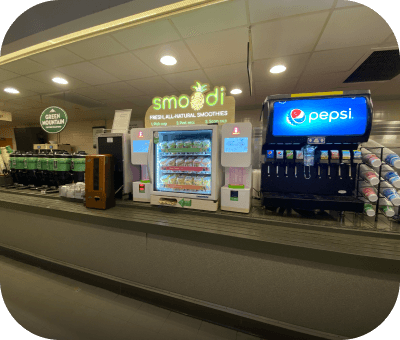
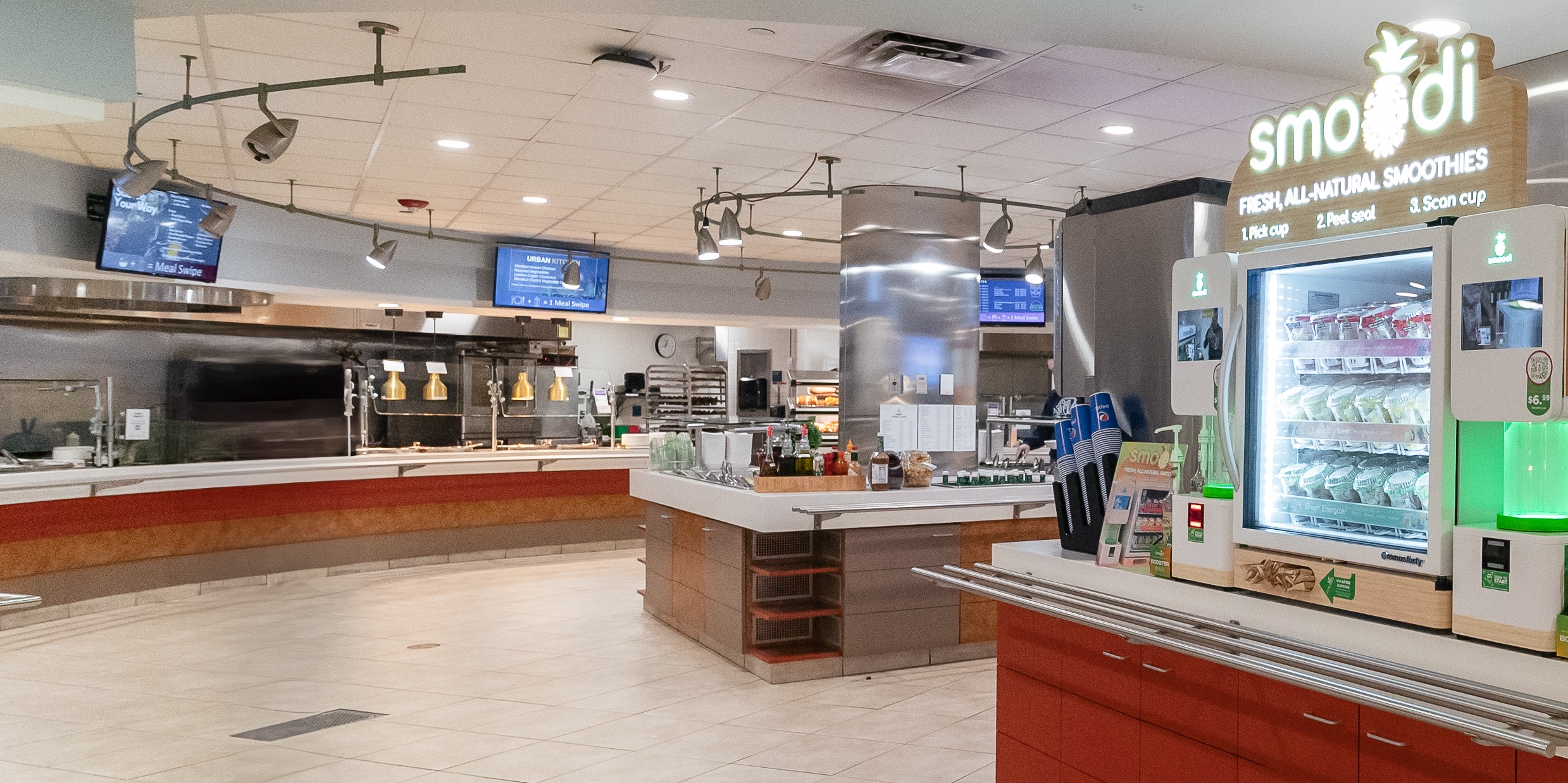
Smoodi provides one of the clearest examples of how automated foodservice works in practice. The company has deployed its compact, self-contained smoothie machines to more than 300 locations across the United States, serving over 2 million smoothies to date. Each machine blends a fresh smoothie in under 60 seconds and self-cleans between every use, requiring no dedicated staff to operate or maintain.
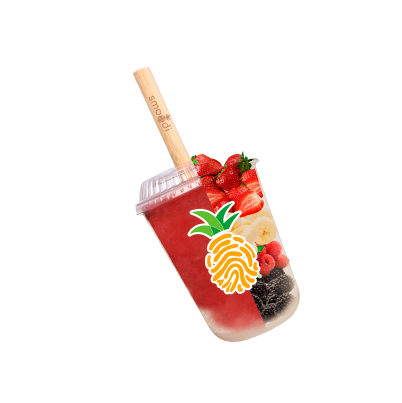
The system uses IQF (individually quick frozen) fruit cups blended with water only. There are no syrups, concentrates, or artificial ingredients involved. This simplicity is central to the model: because there is no cooking, no prep work, and no skilled labor required, any team member can manage the machine as part of their existing responsibilities. A front desk attendant, a store clerk, or a gym receptionist can restock cups and wipe down surfaces without any culinary background.
The fruit cups have a shelf life of up to 2 years, which eliminates the spoilage concerns that plague fresh ingredient programs. Distribution through Dot Foods, one of the largest foodservice redistributors in the country, ensures reliable and consistent supply. Operators can also offer protein powder, collagen, and other functional supplements through an integrated booster bar, expanding their menu without adding complexity.
"smoodi is hands down the number one perk at our headquarters. Fresh, healthy, and zero effort on our end."
— Katherine Berman, Workplace Experience Manager, Toast
How Small Is the Footprint, and What Are the Costs?
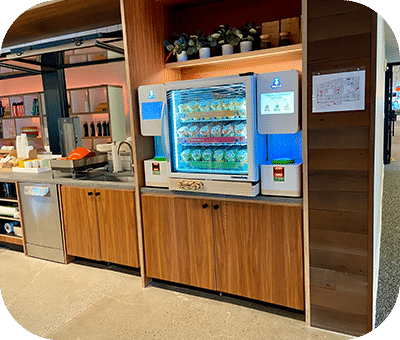
One of the most common barriers to adding foodservice is space. Traditional kitchen equipment requires square footage, ventilation, plumbing infrastructure, and dedicated electrical service. Smoodi machines require approximately 40 inches of floor space and a standard 120 VAC / 7A outlet. The compact design allows operators to place machines in lobbies, break rooms, retail floors, and other areas where a traditional kitchen would never fit.
The financial entry point is equally accessible. Smoodi offers operational lease programs starting at $299 per month for a 48-month term, with shorter terms available at $349, $399, and $499 per month for 36, 24, and 12 months respectively. For operators who prefer ownership, purchase pricing starts at $14,999. Under the lease model, Smoodi retains ownership of the machine and provides full service, further reducing the operational burden on the operator.
Operators pay for the lease and fruit cup costs, then keep the margin on every smoothie sold. There are no hidden fees, no revenue-sharing arrangements, and no complex franchise agreements. For a detailed cost breakdown and ROI projection, visit getsmoodi.com/roi.
Which Venues Benefit Most from Automated Smoothie Programs?
Automated smoothie programs work well in any environment where customers value convenience and health but where staffing a kitchen is impractical or cost-prohibitive. Some of the most successful Smoodi deployments operate in the following types of venues.
- Corporate offices and co-working spaces looking to offer employee wellness perks
- Hotels and hospitality properties adding grab-and-go breakfast options
- Gyms, fitness studios, and recreation centers serving post-workout nutrition
- Universities and student housing providing healthy, self-service options
- Convenience stores and grocery retailers expanding their fresh beverage selection
- Healthcare facilities offering patients and staff a nutritious alternative to vending machines
In each of these settings, the value proposition is the same: fresh, high-quality smoothies generated without the need for kitchen staff, extensive training, or ongoing labor management. The machine handles the work. Existing staff handle the restocking. Customers handle the ordering.
How Does This Model Handle High-Volume Demand?
A common concern with automated systems is throughput. Can a single machine keep up during peak periods? Smoodi addresses this directly through its modular design. Multiple machines can be installed side by side in the same footprint that a single large-format kiosk would occupy, allowing venues to blend multiple smoothies simultaneously. This approach scales capacity without scaling labor, which is precisely the advantage operators are looking for.
The self-cleaning function between each use also contributes to throughput. There is no downtime for manual cleaning, no risk of cross-contamination between flavors, and no need for a staff member to intervene between orders. The machine is ready for the next customer as soon as the previous smoothie is dispensed.
What Should Operators Consider Before Going Staffless?
Transitioning to an automated foodservice model requires thoughtful planning. Operators should evaluate their current labor costs, turnover rates, and menu complexity to determine where automation will have the greatest impact. Starting with a single automated station, such as a smoothie program, allows operators to test the model, gather customer feedback, and measure financial performance before expanding.
It is also important to choose equipment and supply partners that offer reliable distribution, straightforward pricing, and strong service support. Programs that depend on proprietary or hard-to-source ingredients create supply chain risk. Smoodi's partnership with Dot Foods and its use of IQF fruit cups with a 2-year shelf life address both of these concerns directly.
For operators exploring the broader trend of labor-free foodservice, the zero-labor foodservice model provides useful context on how fully automated programs perform in real-world settings. Visit getsmoodi.com/blog for detailed insights on lease program structures and ROI analysis.
Is Staffless Foodservice the Future?
The data strongly suggests that simplified, automated foodservice models will continue to grow. The combination of persistent labor shortages, rising wages, and advancing equipment technology creates a clear path toward operations that depend less on human labor and more on reliable systems. Operators who adopt these models early position themselves to capture margin improvements while their peers continue struggling with recruitment and retention.
Running a profitable foodservice program without kitchen staff is not a future concept. It is happening now, in hundreds of locations across the country, every day. The operators who have made the switch are not sacrificing quality or customer satisfaction. They are improving both, while spending less to do it.
To explore whether an automated smoothie program fits your operation, visit getsmoodi.com/get-started to schedule a demo and connect with the Smoodi team.
Ready to bring Smoodi to your location?
Join hundreds of operators delivering fresh, automated smoothies with zero labor.
Get Started