How Do You Choose the Right Commercial Smoothie Machine?
The commercial smoothie equipment market spans manual blenders to fully automated stations. This buyer's checklist covers the seven criteria every facility manager should evaluate before investing.
The commercial smoothie equipment market offers everything from countertop blenders to fully automated, self-cleaning machines. For facility managers, foodservice directors, and procurement teams evaluating their options, the variety can be overwhelming. A manual blender costs a few hundred dollars but requires a dedicated employee for every shift. A fully automated system eliminates labor entirely but represents a different kind of investment. The right choice depends on your facility's specific needs: how many smoothies you need to serve per day, how much labor you can allocate, what ingredient quality your customers expect, and how much space you have available.
This guide walks through the seven criteria that matter most when selecting commercial smoothie equipment. Whether you manage a university dining hall, hospital cafeteria, corporate office, fitness center, or hotel breakfast bar, these are the questions to answer before making a decision.
What Are the Main Types of Commercial Smoothie Equipment?
Commercial smoothie equipment falls into four general categories, each with distinct cost, labor, and operational profiles.
- Manual commercial blenders ($500 to $2,000 per unit): High-powered countertop blenders designed for commercial volume. They require a trained staff member to measure ingredients, blend, pour, and clean the equipment between every use. Best suited for staffed juice bars and restaurants with existing kitchen labor.
- Semi-automated machines ($8,000 to $14,000): Equipment that automates part of the blending process (such as timed blending cycles or built-in dispensing) but still requires staff to load ingredients and manage cleaning. Reduces labor per serving but does not eliminate it.
- Fully automated stations ($14,999 purchase or $299 to $499 per month operational lease): Self-contained machines that handle the entire process from ingredient loading to blending to cleaning. No staff involvement required. Customers interact directly with the machine.
- Robotic kiosks (varies widely, often $50,000 and above): Large-footprint robotic systems that custom-blend smoothies from multiple ingredient bins. They offer high customization but require more floor space (often 50 to 64 square feet) and more complex installation and maintenance.
Each category serves a different operational model. The key is matching the equipment type to your facility's labor availability, volume needs, and physical constraints.
What Labor Model Does Your Facility Need?
Labor is the single largest variable in the total cost of a smoothie program. A staffed smoothie bar requires at least one dedicated employee per shift. At an average fully loaded cost of $18 to $25 per hour (including wages, benefits, and payroll taxes), that translates to $35,000 to $50,000 per year for a single-shift operation. Multi-shift facilities double or triple that figure.
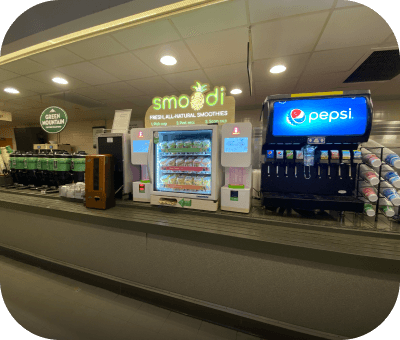
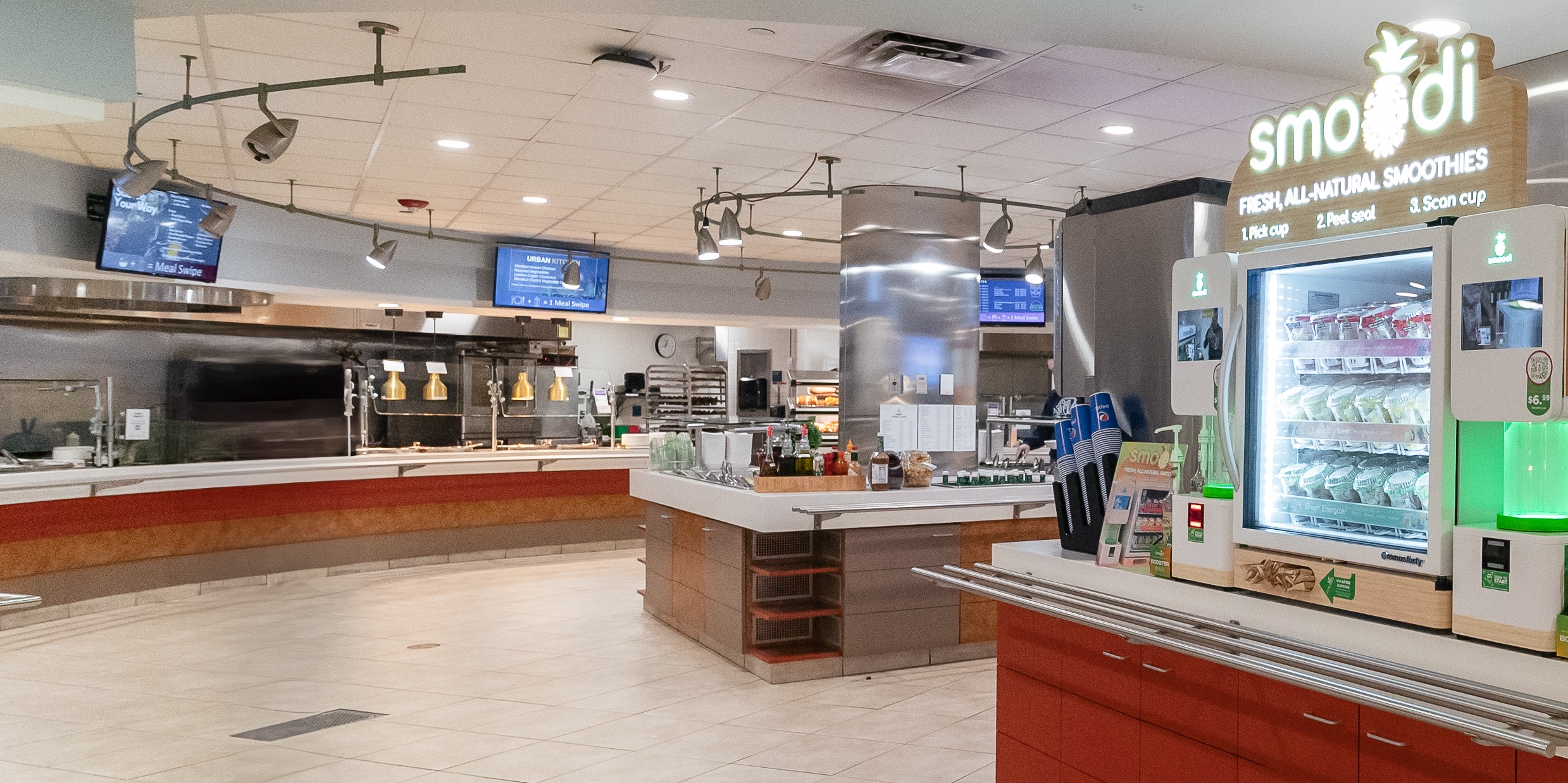
For facilities where labor is scarce, expensive, or better allocated elsewhere, a zero-labor automated system changes the economics entirely. Smoodi's automated smoothie machine requires no staff to operate. A customer selects a fruit cup, places it in the machine, and receives a fresh smoothie in under 60 seconds. The machine self-cleans between every use. No employee measures ingredients, operates a blender, or washes equipment. For university dining halls dealing with student worker turnover, hospitals running 24/7 cafeterias, or corporate offices without dedicated kitchen staff, zero-labor operation is not just a convenience. It is a practical requirement.
"I have been looking to add a smoothie bar for years but did not want to deal with the labor and food waste. Having smoodi in our facility is a huge benefit for our members."
— Adam Healy, General Manager, Waverly Oaks Athletic Club
How Much Throughput Does Your Location Require?
Throughput matters most during peak service periods. A university dining hall during the lunch rush, a hospital cafeteria at shift change, or a gym lobby at 6:00 AM all experience concentrated demand windows where customers expect fast service.
Manual blenders typically produce one smoothie every two to three minutes, including prep and cleanup. Semi-automated machines reduce that to roughly 90 seconds. Fully automated stations like Smoodi blend a smoothie in under 60 seconds, including the automatic cleaning cycle that runs between every serving. For high-volume locations, Smoodi's compact design (approximately 40 inches of floor space) allows operators to install multiple machines side by side in the same footprint that a single robotic kiosk would occupy. Two machines running simultaneously double throughput without doubling labor, because both require zero staff involvement.
What Ingredient Quality Should You Expect?
Not all commercial smoothie machines use the same type of ingredients, and the difference matters for both nutrition and customer perception.
- Fresh fruit: Highest perceived quality but shortest shelf life (three to seven days). Requires refrigerated storage, daily prep, and careful inventory management. Spoilage rates in manual smoothie programs can reach 15 to 25 percent of ingredient cost.
- Purees and concentrates: Lower cost per serving but often contain added sugars, preservatives, or artificial flavors. Shelf life varies. Some customers view these as processed or lower quality.
- IQF (individually quick frozen) whole fruit: Flash-frozen within hours of harvest, locking in nutrients at peak ripeness. Studies show IQF fruit can retain significantly more vitamins than fresh fruit transported and stored for several days. Shelf life of up to two years with zero spoilage risk.
Smoodi uses IQF whole fruit cups blended with water only. There are no syrups, concentrates, added sugars, or artificial ingredients. Each cup is individually sealed at manufacturing and remains sealed until the moment a customer inserts it into the machine. This approach delivers whole-fruit nutrition with the operational simplicity of a shelf-stable product.
What Is the Total Cost of Ownership?
The sticker price of equipment is only one component of total cost. A complete evaluation should include equipment cost (purchase or lease), labor, ingredients, maintenance, waste, and utilities.
A manual blender costs $500 to $2,000 upfront but adds $35,000 to $50,000 per year in labor for a single shift. Over three years, the total cost of a staffed smoothie bar (including equipment, labor, ingredients, maintenance, and waste) can exceed $150,000. A fully automated system with no labor cost and near-zero ingredient waste often delivers a lower total cost of ownership despite a higher equipment price.
Smoodi offers two acquisition models. An operational lease starts at $299 per month (48-month term), with Smoodi retaining ownership of the machine and providing full service and maintenance. Shorter terms are available at $349 per month (36 months), $399 per month (24 months), and $499 per month (12 months). Operators who prefer to own the equipment outright can purchase starting at $14,999. In both models, operators pay for the lease or purchase and the cost of fruit cups, and they keep the margin on every smoothie sold.
What Installation Requirements Should You Expect?
Installation complexity varies significantly across equipment types. Manual blenders need only an electrical outlet and counter space. Semi-automated and fully automated systems may require water connections, drainage, and specific electrical circuits. Robotic kiosks often require dedicated plumbing, three-phase electrical, HVAC considerations, and professional installation over multiple days.
Smoodi's installation requirements are comparable to a commercial ice machine or coffee brewer: a standard 120 VAC / 7A outlet (NEMA 5-15P with integrated GFCI), a 3/8 inch push-to-connect water inlet (50 to 80 PSI, filtered and potable), a 1/4 inch push-to-connect sanitizer inlet for the automatic cleaning system, and a 1 inch FNPT drain. The machine occupies approximately 40 inches of floor space. A licensed plumber can typically complete the installation in a single visit.
How Does Supply Chain and Distribution Work?
The reliability of your ingredient supply chain determines whether your smoothie program runs consistently or faces gaps. Fresh-fruit programs depend on regional produce distributors and seasonal availability. Programs using proprietary mixes may be tied to a single supplier with limited distribution reach.
Smoodi's fruit cups are distributed through Dot Foods, the largest food redistribution company in North America. Dot Foods serves all 50 states and works with thousands of foodservice distributors, making supply integration straightforward for facilities that already use Dot Foods-connected channels. The cups have a shelf life of up to two years, eliminating spoilage risk and simplifying inventory planning. Operators order based on projected weekly or monthly volume without pressure to use ingredients before they expire.
A Practical Evaluation Checklist
Before selecting commercial smoothie equipment, work through these criteria for your specific facility.
- Labor availability: Can you dedicate staff to operate a smoothie station, or do you need a zero-labor system?
- Daily volume: How many smoothies do you expect to serve during peak periods? Does the equipment handle that volume?
- Ingredient quality: Does the system use whole fruit, purees, or concentrates? Are there added sugars or artificial ingredients?
- Total cost: What is the three-year total cost including equipment, labor, ingredients, waste, and maintenance?
- Footprint: How much floor space is available? Can you install multiple units if needed?
- Installation: What utilities does the equipment require? Is your facility ready, or does it need modifications?
- Supply chain: How are ingredients sourced and distributed? What is the shelf life?
- Cleaning and food safety: Does the machine self-clean, or does staff need to sanitize it between uses?
- Scalability: If you operate multiple locations, can the equipment and supply chain scale consistently?
Smoodi operates in more than 300 locations across the United States and has served more than two million smoothies since its founding at Harvard Innovation Labs. The company supports deployments across universities, hospitals, corporate offices, fitness centers, hotels, airports, convenience stores, and senior living communities. To request a custom assessment for your facility, visit getsmoodi.com/get-started. To estimate the revenue potential of a smoothie program at your location, visit getsmoodi.com/roi.
Ready to bring Smoodi to your location?
Join hundreds of operators delivering fresh, automated smoothies with zero labor.
Get Started