What Food Amenities Help Coworking Spaces Win Members?
Coworking spaces compete on amenities to retain members. A self-service smoothie station adds a wellness perk without the staffing and food prep challenges.
The coworking industry continues to grow as hybrid work becomes the dominant employment model. Operators manage an increasingly competitive market where freelancers, remote workers, and distributed teams have abundant choice of where to spend their workdays. Switching costs are low: most coworking memberships operate on monthly terms, and a dissatisfied member can walk across the street to a competitor. In this environment, amenity quality is not a luxury. It is the primary tool for attracting and retaining members.
Food and beverage amenities rank among the top factors members consider when choosing a workspace, yet most coworking spaces offer little beyond a coffee machine and perhaps a communal snack basket. The gap between what members want and what operators provide represents both a challenge and an opportunity for spaces willing to invest in differentiation.
Why Are Food Amenities a Competitive Advantage for Coworking?
Coworking members evaluate their workspace experience holistically. The desk, the Wi-Fi, and the meeting rooms are table stakes. The factors that create emotional loyalty and reduce churn are the experiential elements: community events, design quality, and daily-use amenities like food and beverage. A member who enjoys a smoothie during their morning routine at the coworking space builds a habit loop tied to that specific location. Habit loops are the strongest retention mechanism in a subscription business.
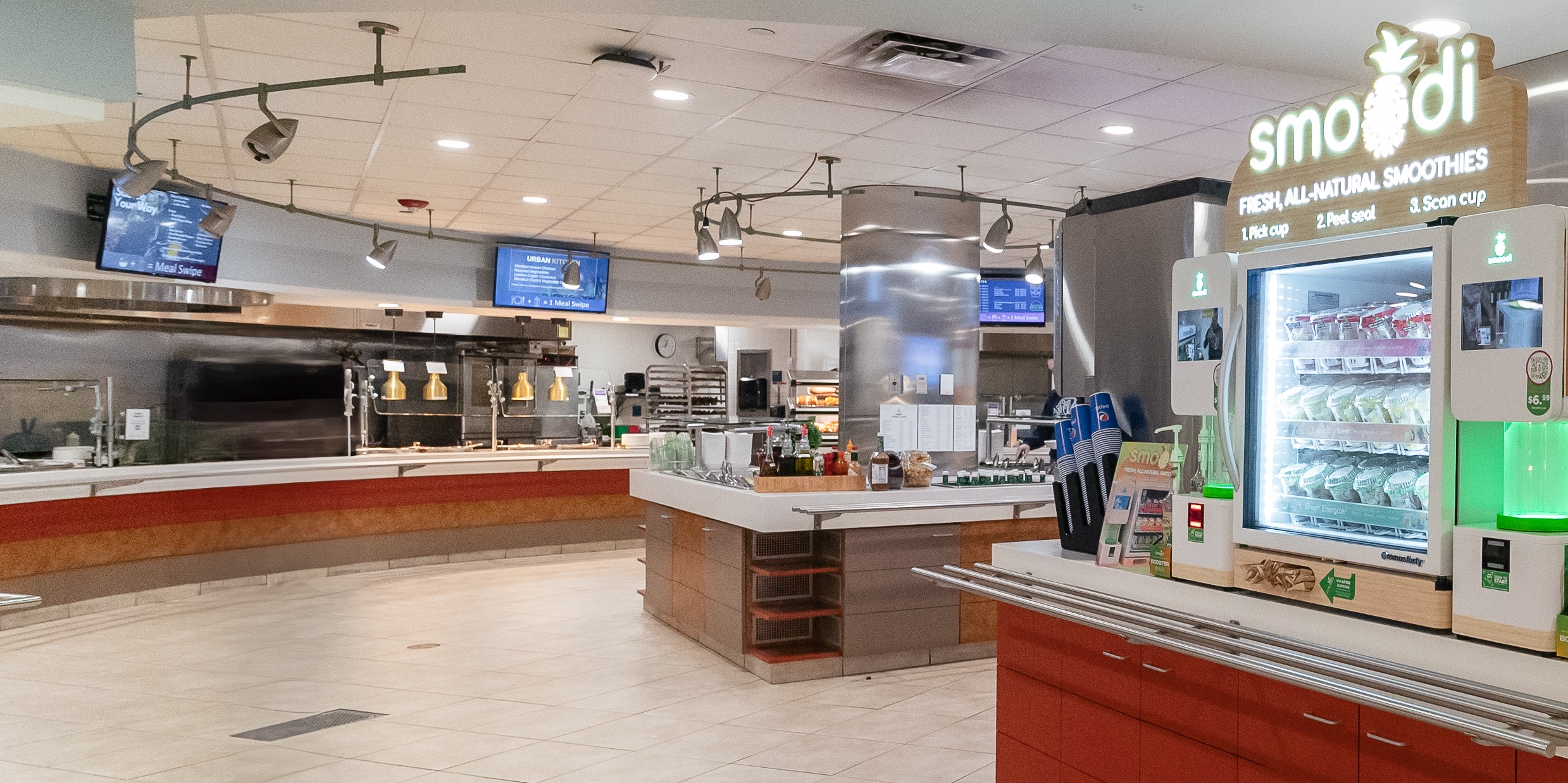
Food amenities also serve as visible signals of investment. When a prospective member tours a coworking space and sees a self-service smoothie station in the common area, it communicates that the operator invests in the member experience beyond the basics. This perception matters during the decision-making process, particularly when the prospect is comparing spaces at similar price points. The amenity does not need to be the deciding factor. It needs to be one of several factors that collectively tip the decision.
What Makes Coworking Food Programs Operationally Difficult?
Coworking spaces face unique operational constraints that make traditional food programs impractical. Staff are lean: community managers handle member relations, space management, event coordination, and front desk operations simultaneously. Adding food preparation to their responsibilities is not realistic without hiring dedicated food service staff, which most coworking budgets cannot support.
Kitchen facilities are typically shared and basic. A communal kitchenette with a microwave, refrigerator, and sink can support member-brought meals but cannot sustain a food preparation program. Upgrading to a commercial kitchen requires significant construction investment that the space's lease terms may not justify.
Demand variability adds another layer of difficulty. Coworking occupancy fluctuates daily and seasonally. A space with 200 memberships may see 80 people on Monday and 40 on Friday. Food programs that rely on fresh ingredients face waste on low-traffic days and shortages on busy ones. Staffing a food station becomes even more problematic when the daily headcount is unpredictable.
How Does a Self-Service Smoothie Station Solve These Challenges?
An automated smoothie station eliminates every operational barrier that makes food programs difficult for coworking spaces. The self-service model requires zero dedicated staff. Members interact with the touchscreen, select their smoothie, and receive a fresh product in under 60 seconds. The machine self-cleans between every use. No community manager time is spent on food preparation, cleaning, or inventory management beyond occasional restocking of the freezer with IQF fruit cups.
The compact footprint (approximately 40 inches of floor space) fits into the kitchenette area, common lounge, or near the entrance without consuming premium workspace. Installation requires a standard 120 VAC outlet, water connection, sanitizer inlet, and drain. No kitchen buildout, no hood ventilation, no commercial kitchen permit.
IQF fruit cups with a shelf life of up to two years eliminate waste from demand variability entirely. Whether 20 members or 100 members use the space on a given day, the frozen cups remain fresh until blended. There is no spoilage, no over-ordering, and no end-of-day waste. This is a fundamentally different economic model from any food program that relies on fresh, perishable ingredients.
The booster bar (protein powder, collagen, and functional supplements) positions the station as a wellness amenity rather than a basic refreshment option. Members working through lunch can add a protein booster for a more substantive option. Health-conscious members appreciate the whole-fruit, no-syrup, no-concentrate formulation. The product quality reinforces the premium positioning that most coworking spaces aim to project.
"smoodi is hands down the number one perk at our headquarters. Fresh, healthy, and zero effort on our end."
— Katherine Berman, Workplace Experience Manager, Toast
What Does the Operational Economics Look Like?
The financial model for a coworking smoothie station is straightforward. The operational lease starts at $299 per month for a 48-month term, scaling to $499 per month for a 12-month term. The purchase option is $14,999. For a coworking space charging $300 to $500 per month per membership, the smoothie station lease represents a fraction of a single membership's revenue.
Operators can factor the station cost into membership pricing (a small increase distributed across all members), offer smoothies as an included perk for premium membership tiers, or charge per smoothie as an additional revenue stream. Each model has trade-offs. Inclusion in membership pricing simplifies the member experience and increases the perceived value of the membership. Per-smoothie pricing generates direct revenue but adds a transactional element to the amenity experience.
Smoodi operates in more than 300 locations across the United States, with over 2 million smoothies served, including deployments in corporate offices and shared workspaces. The company was founded at Harvard Innovation Labs. IQF fruit cups are distributed nationally through Dot Foods.
How Can Operators Position This for Member Satisfaction?
The most effective positioning for a coworking smoothie station is as a wellness amenity that supports members' daily health and productivity. Communicate it during member onboarding, feature it in tour presentations for prospects, and highlight it in marketing materials. The station should be visible and accessible, not tucked away in a storage room. Place it where members naturally gather during breaks.
Track utilization and gather member feedback during the first 90 days. Usage data and positive member comments become retention arguments for lease renewals and expansion discussions. In a business model where member churn is the primary financial risk, any amenity that increases daily engagement and satisfaction has a measurable impact on lifetime member value.
For coworking operators interested in adding a zero-labor wellness amenity, visit getsmoodi.com/get-started to request a site evaluation. To calculate the financial impact for your space, visit getsmoodi.com/roi.
Ready to bring Smoodi to your location?
Join hundreds of operators delivering fresh, automated smoothies with zero labor.
Get Started