How Can Operators Meet ESG Goals with Automation?
ESG reporting in foodservice is shifting from aspirational statements to measurable outcomes. Automated, pre-portioned systems deliver the waste reduction, energy efficiency, and supply chain transparency that sustainability reporting demands.
Environmental, Social, and Governance (ESG) commitments in the foodservice industry have moved beyond mission statements and annual sustainability reports. Procurement teams, institutional buyers, and corporate clients now expect measurable data: specific waste reduction percentages, documented energy efficiency gains, and traceable supply chain certifications. For foodservice operators, the pressure to quantify sustainability performance is growing at the same time that labor shortages and cost inflation are squeezing margins.
Automated foodservice equipment offers a path that addresses both challenges simultaneously. By replacing manual processes with autonomous, pre-portioned, self-cleaning systems, operators can reduce waste, lower resource consumption, and generate the documentation that ESG reporting requires, all while reducing labor dependency and improving operational consistency.
What ESG Metrics Are Foodservice Operators Expected to Report?
The ESG landscape in foodservice has become increasingly specific. Institutional buyers and corporate clients are asking operators to report on a defined set of metrics rather than offering general sustainability narratives.
- Food waste reduction: percentage of food purchased that is discarded before or after service, measured by weight or cost. The U.S. foodservice industry wastes an estimated 22 to 33 billion pounds of food annually, and operators face growing pressure to demonstrate measurable reductions.
- Water efficiency: gallons consumed per serving or per meal, including preparation, cooking, and cleaning. Manual smoothie bars and juice stations use significant water for blender cleaning, produce washing, and station sanitization between servings.
- Energy consumption: kilowatt-hours per unit of food or beverage produced. Equipment efficiency ratings and automated duty cycles directly affect this metric.
- Supply chain transparency: documented sourcing, certifications (organic, fair trade, non-GMO), and distribution chain traceability. Institutional buyers increasingly require suppliers to demonstrate verifiable supply chain documentation.
- Packaging and single-use waste: volume of disposable packaging generated per serving, and whether materials are recyclable, compostable, or reusable.
These metrics are not optional for operators serving corporate campuses, healthcare systems, universities, and government facilities. RFPs and procurement evaluations now include sustainability scoring, and operators who cannot provide data lose contracts to those who can.
How Does Food Waste Impact ESG Performance?
Food waste is the single largest ESG liability for most foodservice operations. Traditional smoothie and juice bar programs are particularly wasteful because they rely on fresh produce with limited shelf life, manual portioning that leads to overuse, and batch preparation that creates end-of-day surplus.
A staffed smoothie bar purchasing fresh fruit faces multiple waste vectors. Produce that is not used before spoilage is discarded. Over-portioned ingredients in each blend increase per-serving waste. Batch-prepped ingredients that are not sold by closing are thrown away for food safety reasons. Cleaning processes for blenders, cutting boards, and prep surfaces consume additional water and produce wastewater.
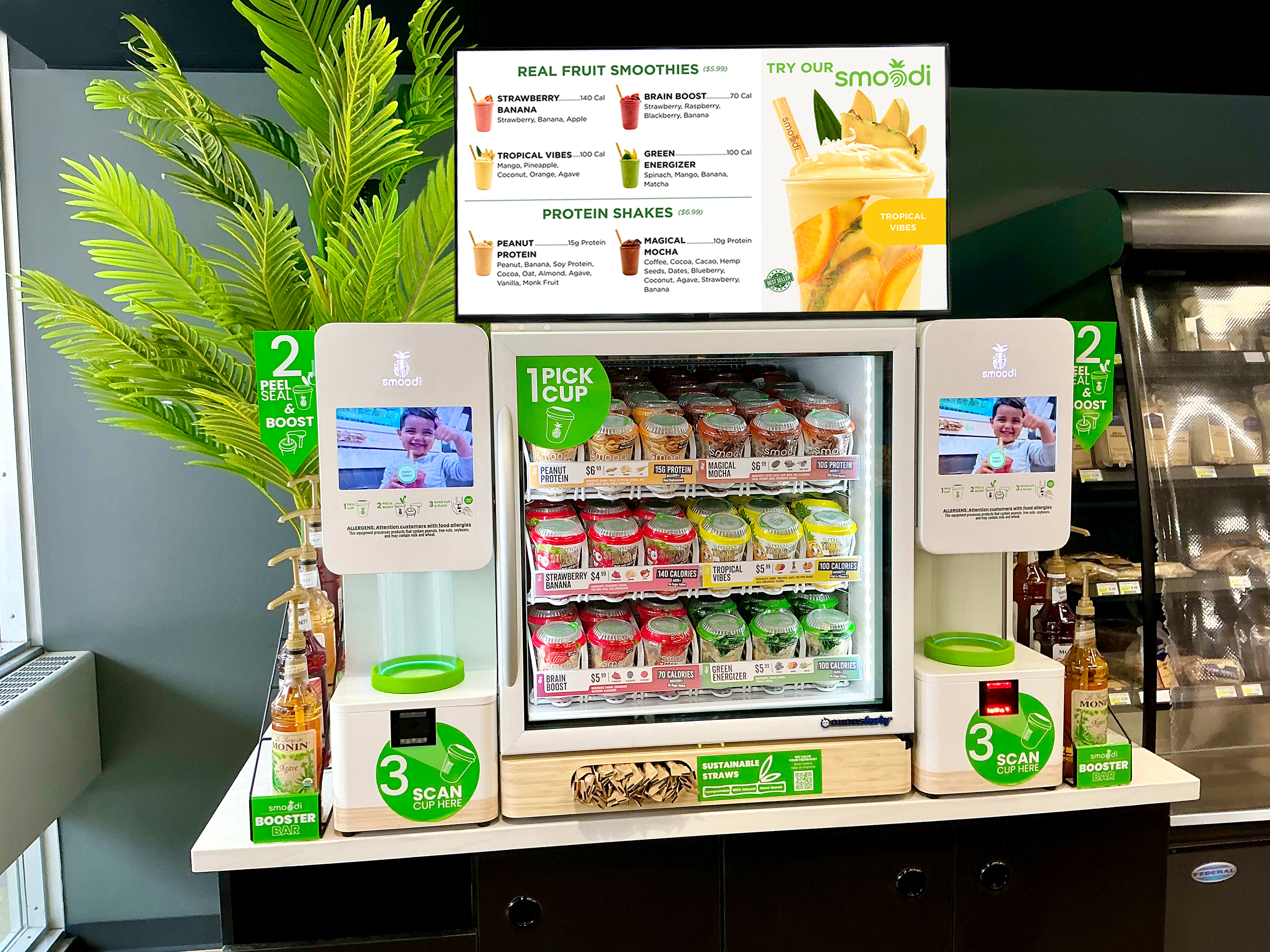
Pre-portioned, sealed systems eliminate nearly all of these waste vectors by design. When every serving is individually packaged with a precise ingredient quantity and a shelf life measured in years rather than days, the math changes entirely. There is no spoilage from unused produce. There is no over-portioning because each cup contains exactly one serving. There is no batch waste because each smoothie is made to order.
"The investment into smoodi has been phenomenal. We broke even in the first couple of weeks."
— Linda Thacker, Director of Dining Services, Maryville University
How Does Automated Equipment Reduce Water and Energy Use?
Manual smoothie preparation is water-intensive. Each blender pitcher needs rinsing or washing between uses to prevent cross-contamination and allergen transfer. Cutting boards and prep surfaces require sanitization. Produce must be washed before use. A busy smoothie bar may clean its blender 50 to 100 times per day, consuming gallons of water in the process.
Automated self-cleaning systems use precisely metered water and sanitizer cycles calibrated to the minimum effective volume. Smoodi's machine self-cleans between every use with an automated rinse cycle that uses a fraction of the water a manual wash would require. The cleaning is consistent every time, eliminating the variability of human cleaning practices, where thoroughness depends on staff training, time pressure, and supervision.
Energy efficiency follows a similar pattern. Manual smoothie operations require refrigeration for fresh produce storage, commercial blender motors running at high power for 30 to 60 seconds per blend, and heating elements or hot water systems for cleaning. An automated station consolidates these into a single, optimized duty cycle. The IQF fruit cups used in Smoodi machines are stored frozen and do not require separate refrigeration infrastructure because they are kept in the machine's integrated system.
Why Does Supply Chain Transparency Matter for ESG?
Supply chain documentation is an increasingly important component of ESG compliance, particularly for operators serving institutional clients. Corporate procurement teams want to know where ingredients come from, how they are processed, and whether the distribution chain meets specific sustainability or ethical sourcing standards.
Smoodi's fruit cups are made from IQF (individually quick frozen) whole fruit with no syrups, concentrates, or artificial ingredients. The IQF process locks in nutrition at the point of harvest, and the cups have a shelf life of up to two years. Distribution is handled through Dot Foods, the largest food redistribution company in North America, providing a documented, traceable supply chain from production to delivery. For operators completing ESG reporting, this documented chain of custody simplifies the sourcing transparency requirement.
Compare this to a traditional smoothie bar sourcing fresh fruit from multiple local vendors, seasonal suppliers, and wholesale markets. Documenting the origin, handling, and certifications of every banana, strawberry, and mango across multiple suppliers and shipments is a significant administrative burden. A single-source, pre-portioned system with consistent documentation reduces that burden to a single supplier relationship.
How Does Automation Generate ESG Documentation?
One of the underappreciated advantages of automated equipment is its ability to generate operational data automatically. A connected, IoT-enabled machine can track the number of servings produced, water and sanitizer usage per cycle, energy consumption patterns, and uptime versus downtime. This data feeds directly into the metrics that ESG reports require.
Manual operations depend on staff to log waste, estimate water usage, and track ingredient volumes. These estimates are inherently imprecise and time-consuming to compile. Automated systems produce the data as a byproduct of normal operation, making ESG reporting a documentation exercise rather than a data-gathering project.
What Does This Mean for Operators Evaluating Equipment?
For foodservice operators managing facilities where ESG performance affects procurement eligibility, tenant satisfaction, or regulatory compliance, the equipment selection decision now carries sustainability implications. Choosing automated, pre-portioned, self-cleaning systems over manual, labor-intensive alternatives is not just an operational efficiency decision. It is an ESG strategy decision.
Smoodi operates in more than 300 locations across the United States and has served more than two million smoothies. The machine occupies approximately 40 inches of floor space and requires a standard 120 VAC outlet, push-to-connect water and sanitizer inlets, and a drain connection. Operational leases start at $299 per month on a 48-month term, with options at $349 (36 months), $399 (24 months), and $499 (12 months). Purchase is available starting at $14,999.
Operators who need to demonstrate measurable sustainability improvements in their beverage programs will find that automated, pre-portioned systems deliver the outcomes and the data that ESG reporting requires. To explore how Smoodi fits into your facility's sustainability strategy, visit getsmoodi.com/get-started. To estimate the financial and operational impact, visit getsmoodi.com/roi.
Ready to bring Smoodi to your location?
Join hundreds of operators delivering fresh, automated smoothies with zero labor.
Get Started