What Solves the Foodservice Labor Shortage?
Foodservice turnover sits at 73% with no relief in sight. Here is how operators are using automation to maintain service quality without adding headcount.
The foodservice labor shortage is not a temporary disruption, it is a structural reality that operators must plan around rather than wait out. Annual turnover in foodservice runs at approximately 73 percent, hourly wages are rising in every major market, and the competition for reliable workers from gig platforms, logistics, and retail shows no sign of easing. For operators managing university dining halls, hospital cafeterias, corporate campuses, and hotel food and beverage programs, staffing every revenue-generating station with dedicated employees is increasingly unsustainable.
This article examines why the labor shortage persists, what it actually costs, and how automation, particularly in repeatable, high-frequency tasks like smoothie preparation, is helping operators maintain service quality and expand their offerings without expanding their headcount.
Why the Foodservice Labor Shortage Persists
The labor challenges facing foodservice operators predate the pandemic, but the post-2020 environment accelerated trends that were already underway. Hourly foodservice workers now have more employment alternatives than at any previous point. Gig economy platforms, warehouse logistics operations, and retail chains all compete for the same labor pool, often offering comparable or better pay with more flexible schedules.
The Bureau of Labor Statistics data confirms that foodservice and hospitality consistently post the highest quit rates of any industry sector. Workers leave not only for higher wages elsewhere but for roles that offer more predictable schedules, less physical strain, and clearer advancement paths. The result is a labor market where operators who depend on hourly staff for every customer-facing function are structurally exposed to chronic understaffing.
Immigration policy changes, an aging workforce, and declining interest among younger workers in traditional foodservice careers compound the problem further. Operators cannot solve this challenge through wage increases alone, competitors in other industries match those increases, maintaining the relative disadvantage.
The True Cost of Foodservice Turnover
Turnover costs extend well beyond the hourly wage of the departing employee. Each departure triggers a chain of expenses that most operators underestimate in their initial labor budgets.
- Recruiting costs: job postings, screening, interviews, and background checks cost $500 to $1,000 per hire in foodservice
- Onboarding and training: new employees require 2 to 4 weeks of training before reaching full productivity, during which their output is limited and a trainer's time is diverted from other responsibilities
- Productivity gap: even after initial training, new hires operate at 60 to 80 percent efficiency for their first 60 days, meaning the operation serves fewer customers or delivers inconsistent quality during the transition
- Management time: supervisors spend an estimated 10 to 15 hours per departure on paperwork, scheduling adjustments, and training coordination, time that has an opportunity cost in every other area of the operation
The all-in cost of replacing a single hourly foodservice employee is estimated at $1,500 to $2,000 per departure. At a 73 percent annual turnover rate, a ten-person team generates $10,000 to $15,000 in replacement costs per year before accounting for the service quality impact during transition periods. For operators running multiple locations, these figures multiply accordingly.
How Automation Addresses the Labor Gap
Automation in foodservice does not mean eliminating staff. It means deploying technology to handle specific, repeatable, high-frequency tasks autonomously, freeing existing employees to focus on work that requires human judgment, customer interaction, and problem-solving. The most effective automation targets tasks that are labor-intensive, prone to human error, and operate on a consistent cycle.
Smoothie preparation is a clear example. Blending a smoothie involves selecting ingredients, measuring portions, blending to a specific consistency, serving, and cleaning equipment between uses. Each of these steps follows an identical process every time. There is no creative decision-making, no customer interaction that requires empathy or adaptability, and no variation that benefits from human intuition. It is precisely the kind of task where automation delivers the most value.
Beyond smoothies, the broader foodservice automation category includes self-checkout kiosks, automated beverage dispensers, robotic food assembly, and smart inventory management systems. The common thread is that each removes a staffing dependency from a discrete function, allowing operators to reallocate those labor hours to areas where human presence adds measurable value.
Automated Smoothie Machines in Practice
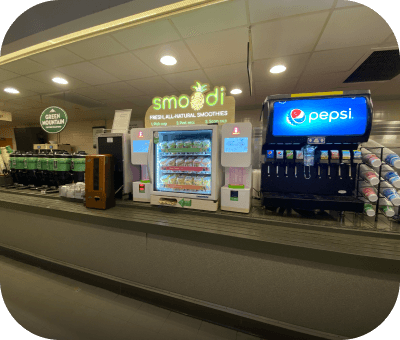
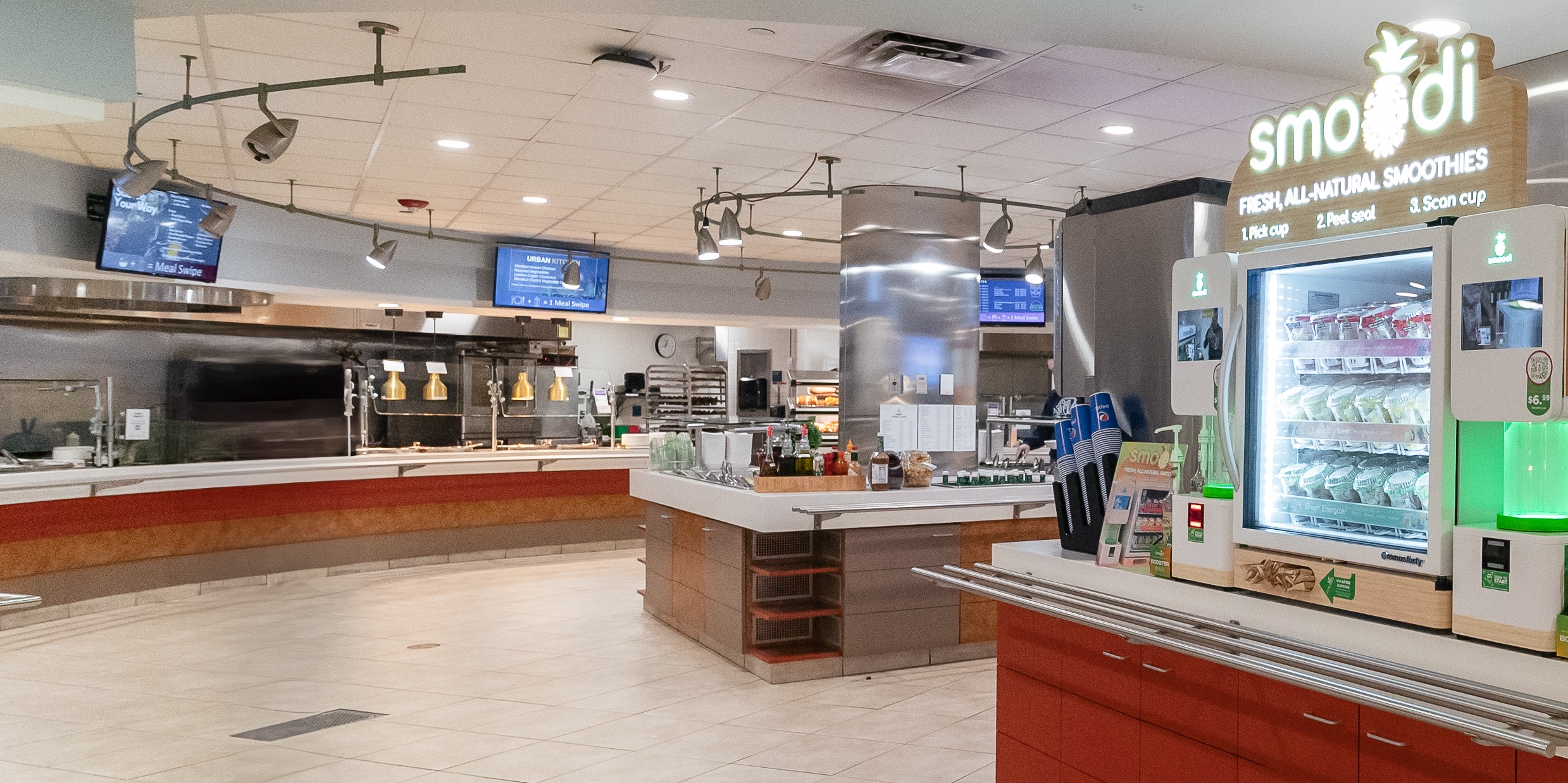
Smoodi operates automated smoothie machines in more than 300 locations across the United States, including universities, hospitals, gyms, corporate offices, and airports. The machine demonstrates what zero-labor foodservice looks like in a real operating environment.
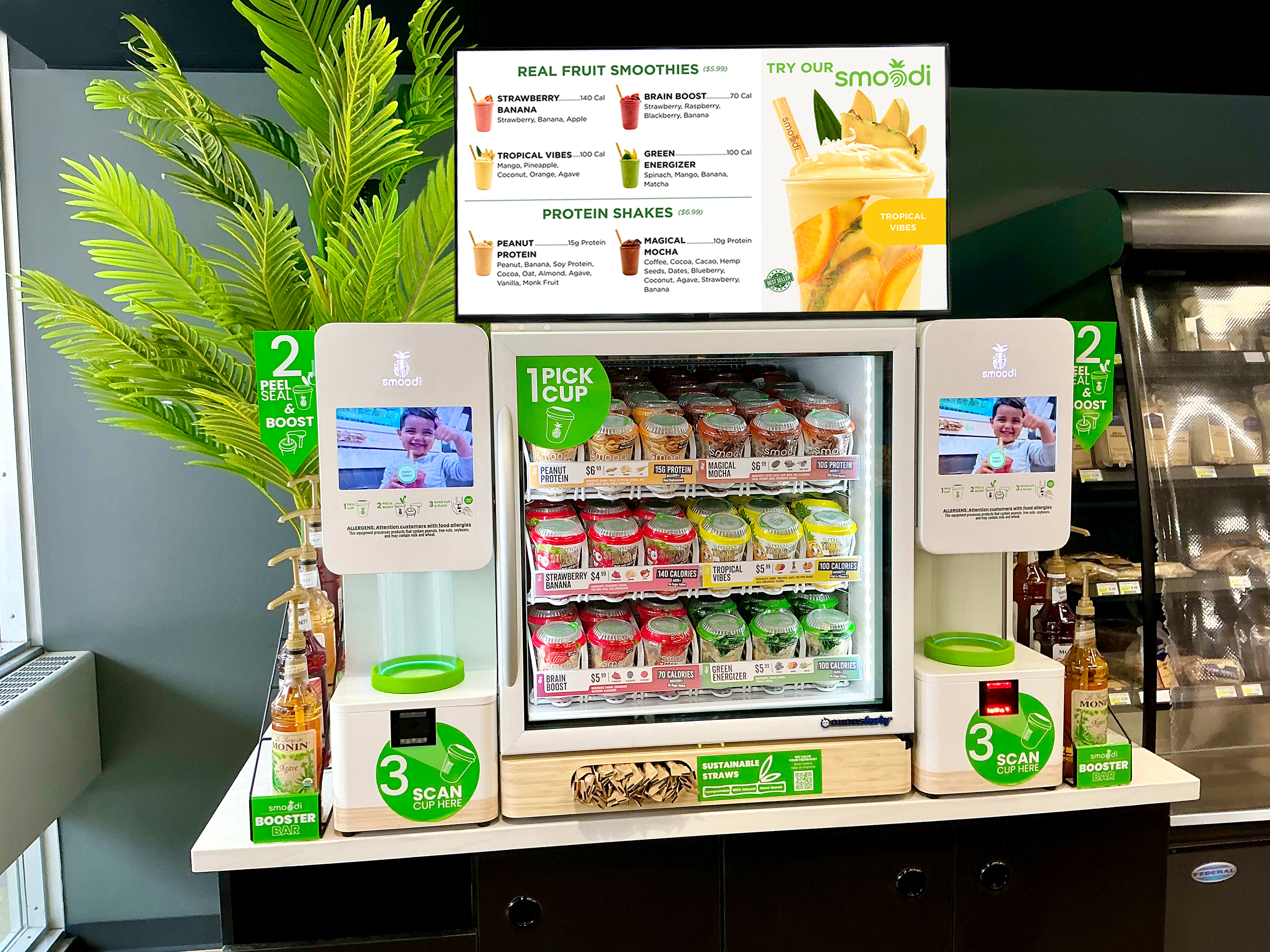
A customer selects a flavor on a touchscreen. The machine retrieves a pre-portioned IQF (individually quick frozen) fruit cup, blends a fresh smoothie in under 60 seconds, and dispenses it into a cup. The machine self-cleans between every use. No dedicated staff member is required to operate, supervise, or maintain the machine during service hours. One machine running 12 to 16 hours per day can serve hundreds of customers without a single labor hour allocated to the smoothie program.
The operational impact goes beyond labor savings. Smoodi's frozen fruit cups have a shelf life of up to two years, distributed through Dot Foods, eliminating the daily fresh-ingredient deliveries, prep work, and spoilage management that consume staff time in traditional smoothie programs. The machine also extends service hours into periods that would be impractical to staff, early mornings before kitchen shifts begin, late evenings after dining staff leave, and weekends when staffing is thinnest.
What Operators Report After Deployment
Facility operators who have deployed automated smoothie machines consistently report several outcomes beyond the expected labor savings.
Expanded Service Without Expanded Headcount
University dining directors have added smoothie programs in residence halls and student centers that would not have been feasible with a staffed model because the budget did not support additional hires. Hospital food and nutrition managers have placed machines in lobbies and staff break areas that previously had no food or beverage service at all. In each case, the machine created a new revenue stream that would not have existed under a labor-dependent model.
Consistent Quality Regardless of Staffing
Automated preparation eliminates the variability that comes with different employees blending different portions for different durations. Every smoothie is prepared to the same specification, which is particularly valued in healthcare settings where patients depend on consistent nutritional content and in corporate environments where the smoothie program is positioned as a wellness benefit.
Reduced Management Burden
Operators report that the automated smoothie program requires less management attention than any other food or beverage category in their operation. There is no scheduling, no training, no turnover to manage, no daily inventory counts, and no health department compliance documentation specific to the smoothie station. The management time freed up by eliminating these tasks is redirected to other priorities.
Building a Labor Strategy That Includes Automation
The operators seeing the strongest results from automation are not replacing their entire staff, they are strategically identifying which functions benefit most from human labor and which functions can be handled autonomously. Smoothie preparation, beverage dispensing, and self-service food stations are early and proven categories for this approach.
Smoodi's operational lease program makes this strategy accessible to operators who want to avoid a large upfront equipment purchase. The lease starts at $299 per month and includes full service coverage, with Smoodi retaining ownership of the equipment. A purchase option starting at $14,999 is also available. On the lease, there is no equipment depreciation risk and no maintenance burden on the operator.
For operators evaluating how automation fits into their staffing strategy, Smoodi's ROI calculator at getsmoodi.com/roi models the labor savings, revenue potential, and payback timeline for your specific location. To begin the conversation about deployment, visit getsmoodi.com/get-started.
Ready to bring Smoodi to your location?
Join hundreds of operators delivering fresh, automated smoothies with zero labor.
Get Started