Why Grocery Stores Are Adding Smoothie Stations
The North America smoothie market is growing at 9.86 percent CAGR. Grocery retailers are responding by adding self-service smoothie stations that generate high-margin revenue without dedicated staff.
Grocery retailers are in the middle of a strategic shift. The traditional model of selling packaged goods on shelves is giving way to a hybrid format that combines retail with foodservice, experience with convenience, and health-forward positioning with operational efficiency. One of the most visible expressions of this shift is the growing number of self-service food and beverage stations appearing in grocery stores across the country. Smoothie stations, in particular, are gaining traction because they combine several attributes that grocery operators value: high margin, minimal labor, compact footprint, and strong alignment with consumer health trends.
The North America smoothie market is growing at a 9.86 percent compound annual growth rate and is projected to reach $13.94 billion by 2034. Within grocery retail, the prepared food and fresh beverage category is expanding as stores invest in reasons for customers to visit in person rather than order online. A self-service smoothie station gives shoppers something they cannot get from a delivery app: a fresh, custom-blended smoothie made in under 60 seconds while they shop.
The Grocery Foodservice Opportunity
Grocery stores have been expanding their foodservice offerings for years, but the pace has accelerated since 2020. Prepared food sections, hot bars, salad bars, and in-store coffee stations are now standard features in mid-size and large grocery formats. The goal is straightforward: increase per-trip spending, extend dwell time, and give customers a reason to visit the physical store instead of ordering groceries online.
Smoothie stations fit this strategy because they occupy a category that most grocery stores do not yet serve well. The bottled smoothie aisle offers shelf-stable products with added sugars, preservatives, and pasteurization-related nutrient loss. The fresh juice bar (where it exists) requires dedicated staff, perishable inventory, and significant floor space. A self-service automated station fills the gap: fresh, whole-fruit smoothies made on demand, with no labor cost, no perishable waste, and a footprint of approximately 40 inches.
Why Shoppers Choose Fresh Over Bottled
Consumer preference data consistently shows that shoppers increasingly favor fresh, minimally processed options over their packaged equivalents. In the beverage category, this preference is particularly strong. Bottled smoothies typically contain added sugars, concentrates, and preservatives to extend shelf life. Many also undergo pasteurization, which degrades heat-sensitive vitamins and alters the flavor profile of the original fruit.
A smoothie blended on the spot from IQF (individually quick frozen) whole fruit and water is a fundamentally different product. The fruit is flash-frozen at peak ripeness, preserving its nutritional profile, color, and flavor. There are no syrups, concentrates, or artificial ingredients. The customer watches the smoothie being made (or in the case of a self-service station, makes it themselves) and receives it fresh. This transparency and freshness perception drives willingness to pay a premium over bottled alternatives.
Operational Advantages for Grocery Retailers
Grocery operators evaluate new in-store programs on several criteria: labor requirements, spoilage and waste, floor space efficiency, regulatory compliance, and gross margin. Automated smoothie stations score well across all five.
Zero Labor
A self-service smoothie station requires no dedicated staff. The customer inserts a frozen fruit cup, presses a button, and receives a blended smoothie in under 60 seconds. The machine self-cleans between every use. There is no blender to wash, no prep area to maintain, and no employee to schedule, train, or manage. For grocery stores that already struggle to staff deli counters and bakery departments, adding a revenue-generating category that requires zero incremental labor is a significant operational advantage.
Near-Zero Waste
Fresh-fruit programs in grocery settings generate substantial waste. Produce that is prepped for a juice bar or smoothie counter has a shelf life of hours to days. If customer demand is lower than projected on a given day, the prepped ingredients are discarded. In-store juice bars in grocery stores commonly report waste rates of 15 to 30 percent of prepped produce.
Frozen, pre-portioned fruit cups eliminate this waste entirely. Each cup has a shelf life of up to two years. The store orders based on projected weekly volume and stores the cups in a standard commercial freezer. If sales are slow one week, the inventory carries forward with no spoilage, no discounting, and no disposal cost.
Compact Footprint
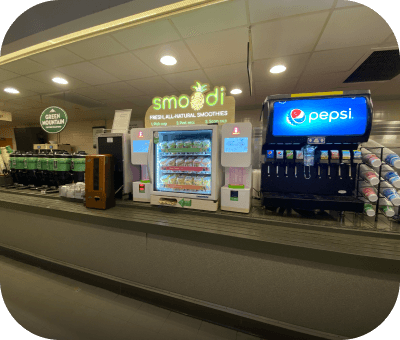
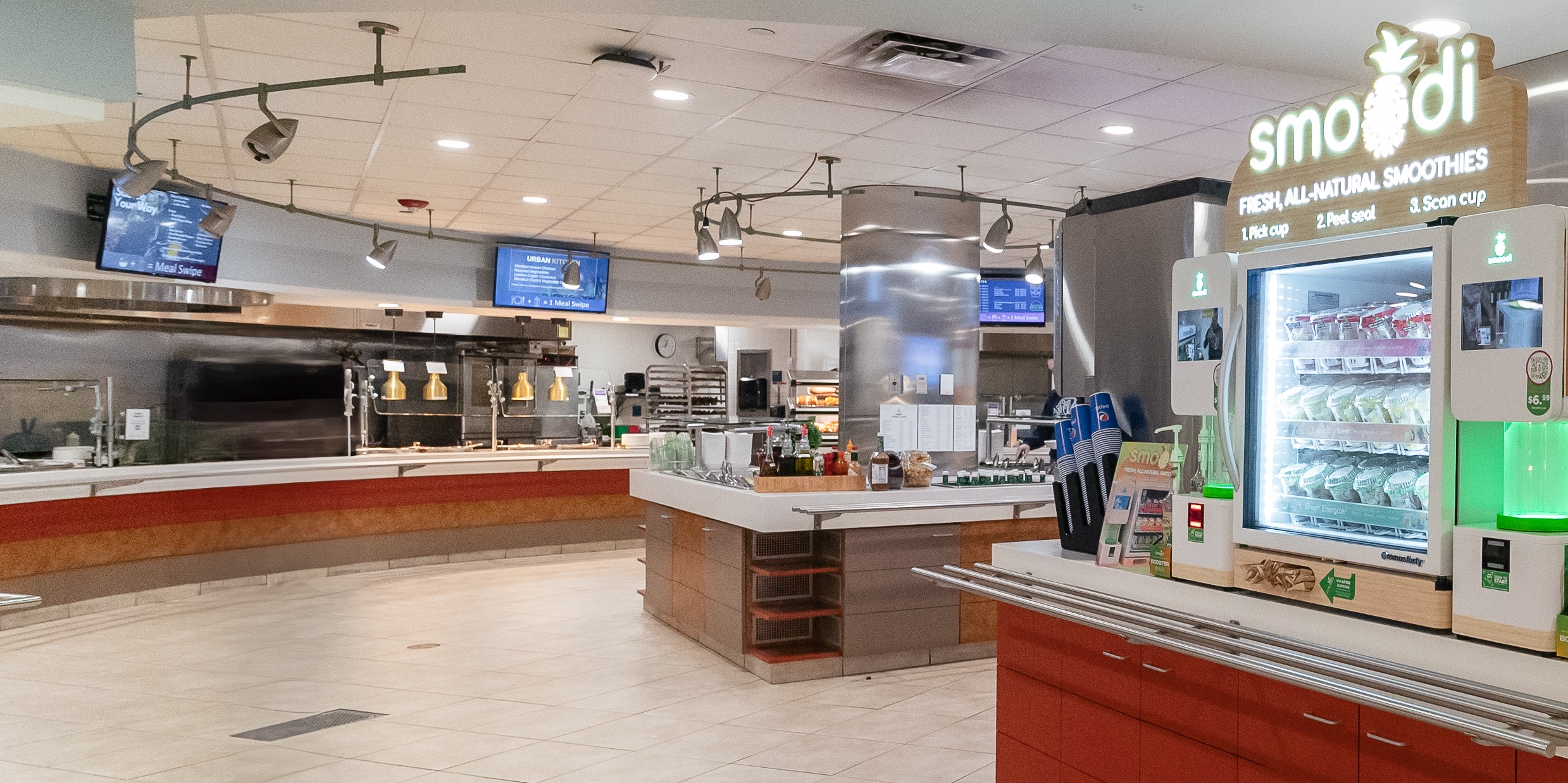
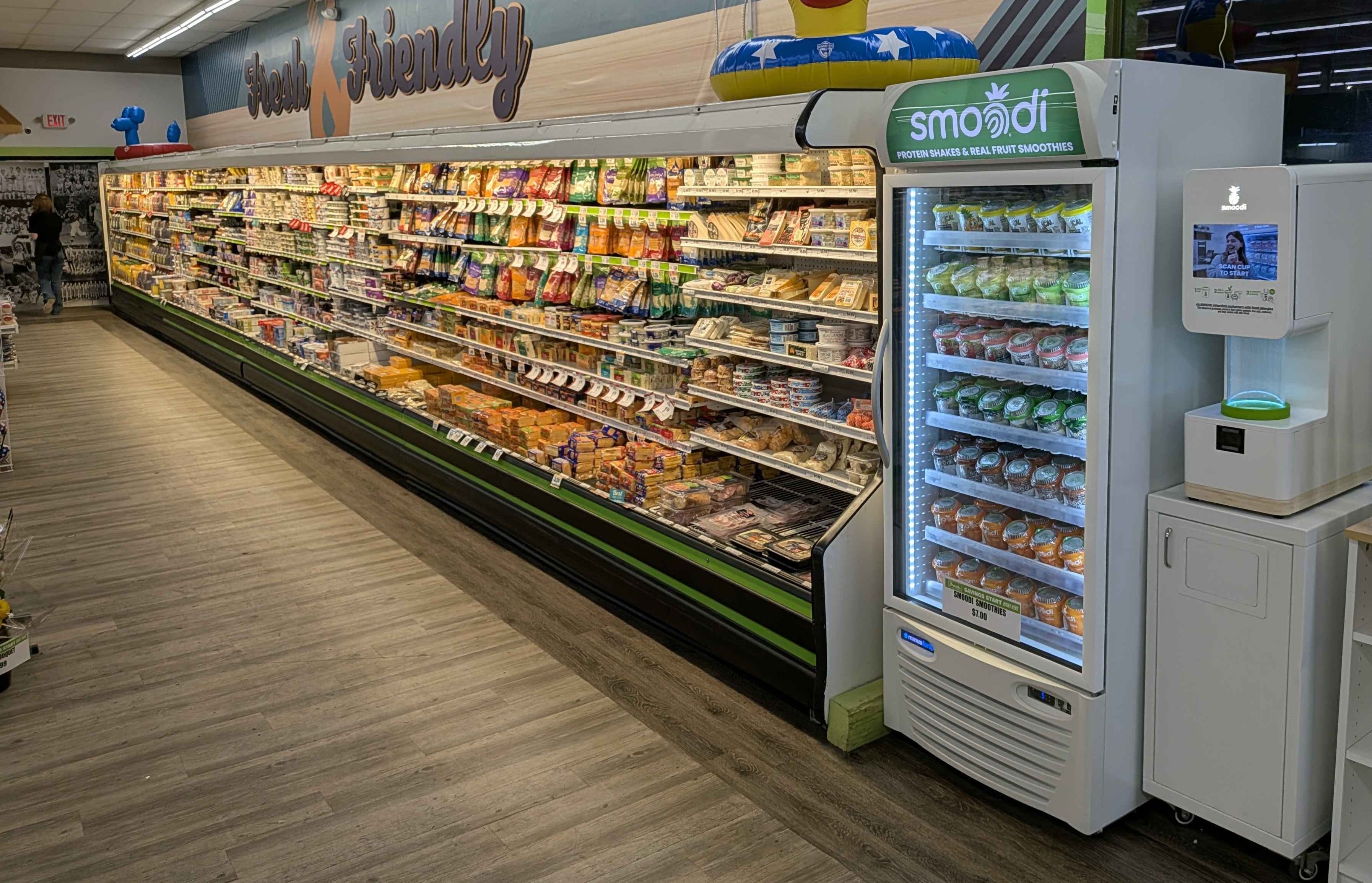
Floor space in a grocery store is allocated by revenue per square foot. An automated smoothie station occupies approximately 40 inches of linear space, comparable to a single checkout lane or a small endcap display. The machine can be positioned in the produce section (natural thematic alignment), near the deli or prepared foods area (capturing foodservice traffic), at the front of the store near checkout (impulse purchases), or near the pharmacy or wellness aisle (health-conscious shoppers).
Placement Strategies for Grocery Operators
The most effective in-store placement depends on the specific store layout and customer flow patterns, but successful grocery smoothie stations share common characteristics in their positioning.
- Produce section: Positions the smoothie station alongside the fresh fruit it contains, reinforcing the whole-fruit, natural ingredient message. Shoppers already in a health-conscious mindset in the produce aisle are the most likely to make an impulse smoothie purchase.
- Prepared foods or deli area: Captures lunchtime traffic from customers already buying a meal. A smoothie as an add-on to a deli sandwich increases average transaction value.
- Front of store or checkout area: High visibility and foot traffic. Every customer entering or leaving the store passes the station, maximizing awareness and impulse purchases.
- Pharmacy or wellness aisle: Appeals to health-focused shoppers who are already thinking about nutrition, supplements, and wellness products.
For high-traffic stores, multiple machines can be installed side by side, blending simultaneously to handle peak demand. Two machines together occupy roughly 80 inches (about 6.5 feet) of linear space while doubling throughput.
Competing with Online Grocery Through In-Store Experience
Grocery retailers face a structural challenge: online grocery delivery and curbside pickup have made it possible for customers to get their essentials without entering the store. The stores that thrive in this environment are the ones that offer something the delivery service cannot replicate. A fresh, made-to-order smoothie blended in under 60 seconds from whole fruit is an in-store-only experience. It cannot be delivered fresh, it cannot be replicated from a shelf-stable product, and it creates a sensory experience (seeing the fruit, hearing the blender, tasting it immediately) that reinforces the value of the physical shopping trip.
Retailers that position smoothie stations as part of a broader fresh, experiential in-store strategy are using foodservice to drive foot traffic that benefits the entire store. A customer who comes in for a smoothie walks past the produce, the deli, and the bakery. The smoothie station becomes a traffic generator that supports sales across multiple departments.
Supply Chain Integration Through Dot Foods
Grocery retailers that already work with Dot Foods or Dot Foods-connected distributors can integrate smoothie cup supply into their existing ordering process. Smoodi's IQF fruit cups are distributed through Dot Foods, the largest food redistribution company in North America. This means the cups arrive through the same distribution channels that supply the store's other foodservice and packaged goods, with no separate vendor relationship to manage.
For multi-location grocery operators, this distribution model supports consistent supply across all stores from a single ordering channel. A regional grocery chain with 20 locations can deploy smoothie stations at each store and coordinate inventory through their existing distributor, maintaining the same product availability and cup selection at every location.
The Margin Opportunity
Grocery retail margins on packaged goods are notoriously thin, typically ranging from 1 to 3 percent on many categories. Prepared food and beverage programs offer significantly higher margins because the value is in the freshness, convenience, and experience rather than the raw ingredient cost. A fresh-blended smoothie sold at a retail price of $5 to $8 generates a gross margin that substantially exceeds packaged beverage margins, with none of the labor cost that a staffed juice bar would require.
Smoodi's operational lease starts at $299 per month (48-month term), with options at $349, $399, and $499 per month for shorter terms. A purchase option is available starting at $14,999. Operators pay lease costs plus fruit cup costs and keep the margin on each smoothie sold. Smoodi retains ownership and provides full service and maintenance on leased machines.
Smoodi operates in more than 300 locations across the United States and has served more than two million smoothies. Founded at Harvard Innovation Labs, Smoodi supports deployments across grocery stores, convenience stores, universities, hospitals, corporate offices, fitness centers, and airports.
To explore how Smoodi fits into your grocery or retail environment, visit getsmoodi.com/get-started. To estimate the revenue potential for your store, visit getsmoodi.com/roi.
Ready to bring Smoodi to your location?
Join hundreds of operators delivering fresh, automated smoothies with zero labor.
Get Started