Why Are Apartments Adding Self-Service Food Stations?
Multifamily housing is borrowing from hospitality with lobby markets, cold brew taps, and smoothie stations. For property managers, the ROI is measured in lease renewals.
Multifamily housing is undergoing a quiet transformation in how it competes for residents. The amenity arms race that once centered on pools, fitness centers, and co-working spaces has expanded into food and beverage. Developers and property managers are installing cold brew taps in common areas, grab-and-go markets in lobbies, and self-service beverage stations near gyms and pools. KTGY and Multifamily Executive identify food and beverage integration as one of the top eight amenity trends shaping multifamily design in 2026.
The reason is straightforward: 92 percent of renters prioritize amenities when choosing where to live. Properties that invest in modern, lifestyle-oriented amenities see 15 to 20 percent higher lease renewal rates. And replacing a tenant who leaves costs six to nine months of lost rent (according to NMHC data). For property managers, a well-chosen food amenity is not an expense. It is a retention tool with measurable returns.
What Is Driving Food Amenities in Multifamily Housing?
Three trends are converging to push food and beverage into the multifamily amenity mix.
First, hospitality-inspired design is reshaping residential expectations. Renters who travel frequently and experience hotel-level food service expect a similar standard at home. Lobby coffee bars, curated snack markets, and beverage stations are becoming baseline features in Class A properties, not differentiators.
Second, health and wellness amenities are outperforming traditional perks in resident satisfaction surveys. Properties that offer wellness-oriented options (healthy food, fitness technology, recovery amenities) report stronger retention than those relying solely on traditional recreational amenities. A smoothie station positioned near the fitness center captures post-workout demand and reinforces the property's wellness brand.
Third, labor constraints are pushing property managers toward self-service formats. Staffing a juice bar or cafe in a residential lobby is expensive and operationally complex. Self-service stations that operate without dedicated staff eliminate the labor problem while still delivering the amenity experience residents value.
How Does a Self-Service Smoothie Station Fit Multifamily Properties?
A self-service smoothie station addresses several operational requirements that matter to property managers.
- Zero labor: The station operates entirely without staff. Residents interact directly with the machine, select a fruit cup, and receive a fresh smoothie. No property employee measures ingredients, operates equipment, or cleans up afterward.
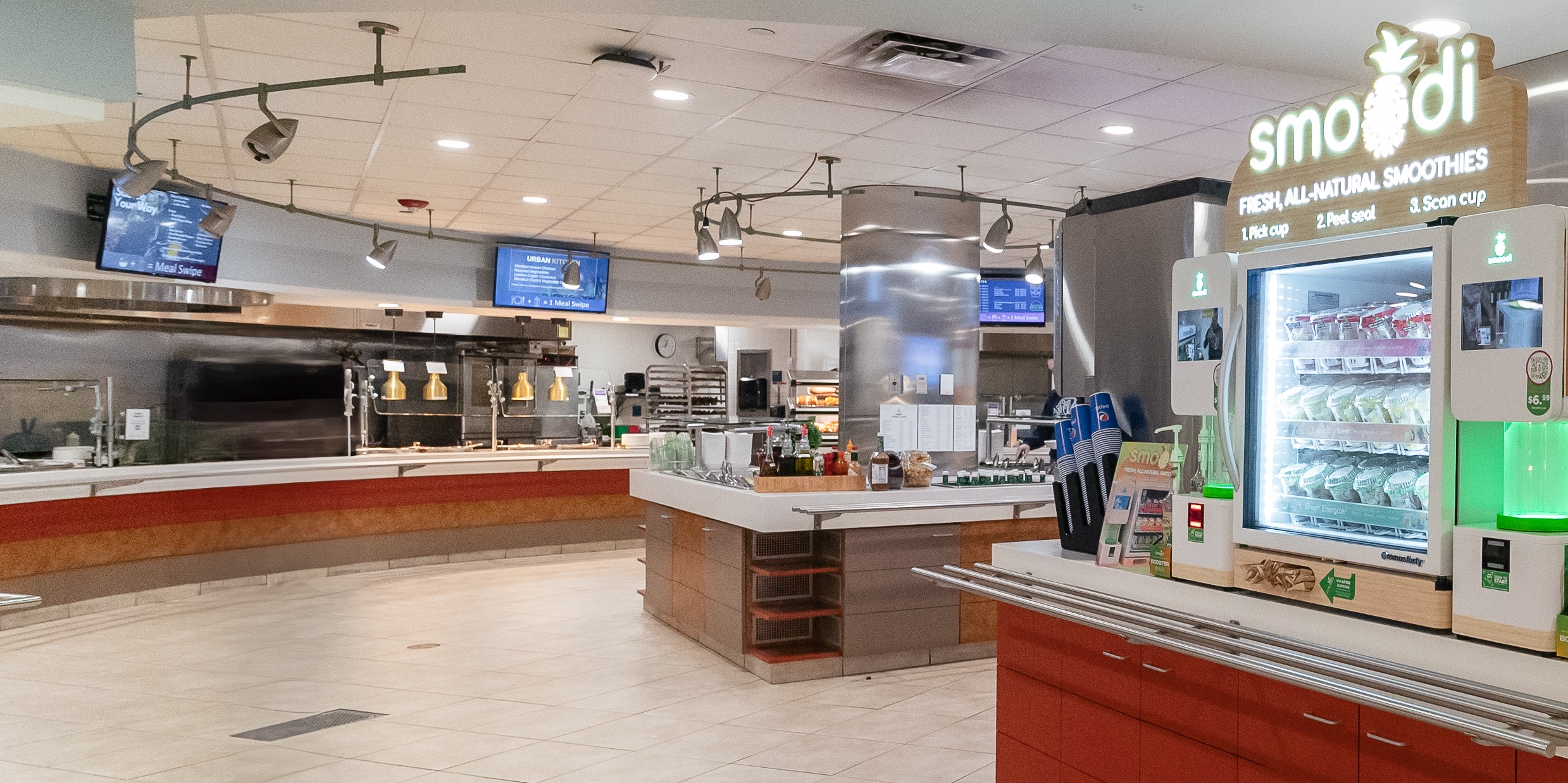
- Compact footprint: Smoodi's machine occupies approximately 40 inches of floor space. It fits comfortably in a fitness center alcove, a lobby corner, a pool house, or a co-working lounge without requiring a dedicated room or buildout.
- Self-cleaning operation: The machine runs an automatic cleaning cycle between every use. There is no manual cleaning schedule to manage, no health inspection concerns related to food handling, and no risk of a messy common area.
- Minimal infrastructure: Installation requires a standard 120 VAC / 7A outlet, push-to-connect water and sanitizer inlets, and a drain connection. For properties with existing water lines in the fitness center or lobby area, setup is typically completed in a single visit by a licensed plumber.
The operational simplicity matters because property managers are not foodservice operators. They do not have kitchen staff, food handling licenses, or the bandwidth to manage a food program alongside their core responsibilities of leasing, maintenance, and resident services. A Smoodi station runs independently once installed.
What Is the Financial Case for Property Managers?
The financial model for a multifamily smoothie station works on two levels: direct revenue and indirect retention value.
On the direct side, operators pay for the lease and the cost of fruit cups, and they keep the margin on every smoothie sold. An operational lease starts at $299 per month (48-month term), with Smoodi retaining ownership and providing full service and maintenance. Shorter terms are available at $349 per month (36 months), $399 per month (24 months), and $499 per month (12 months). Operators who prefer to own the equipment can purchase starting at $14,999. The fruit cups (IQF whole fruit blended with water only, no syrups or added sugars) have a shelf life of up to two years and are distributed through Dot Foods, simplifying procurement for properties that do not have existing foodservice supply chains.
On the retention side, the math is even more compelling. If a smoothie station contributes to even a modest increase in lease renewals, the avoided turnover costs (six to nine months of lost rent per departed tenant) far exceed the monthly equipment lease. A property with 200 units and an average monthly rent of $2,000 loses $12,000 to $18,000 every time a resident does not renew. Retaining even two additional residents per year covers the cost of the amenity several times over.
Where Should Properties Place Smoothie Stations?
Placement directly affects utilization. The most effective locations within a multifamily property are areas where residents already spend time and where a healthy beverage complements the activity.
- Fitness center: The highest-traffic location for a smoothie station in any residential property. Residents finishing a workout are primed for a healthy, protein-rich beverage. The booster bar (protein powder, collagen, and other functional supplements) adds value for fitness-oriented residents.
- Lobby or resident lounge: A visible, central location that every resident passes daily. The station serves as a constant reminder of the property's amenity investment and creates a casual social gathering point.
- Pool or outdoor amenity area: Seasonal demand peaks during warm months when residents want cold, refreshing beverages. A smoothie station near the pool captures impulse purchases and adds a premium feel to the outdoor experience.
- Co-working space or business center: Positioned as a productivity perk, the station serves residents working from home who want a quick, healthy break without leaving the building.
A Growing Trend Across Property Types
The food amenity trend is not limited to luxury high-rises. Student housing, senior living communities, corporate housing, and mixed-use developments are all integrating self-service food options. The common thread is a resident population that values convenience, health, and modern lifestyle experiences. Properties that add these amenities early establish a competitive position that is difficult for neighboring communities to replicate quickly.
Smoodi operates in more than 300 locations across the United States and has served more than two million smoothies since its founding at Harvard Innovation Labs. The company supports deployments across universities, hospitals, corporate offices, fitness centers, hotels, airports, convenience stores, and senior living communities. The same operational model that works in a hospital cafeteria or a university dining hall works in a residential property: zero labor, self-cleaning, IQF whole fruit with no added sugars, and an operational lease that starts at $299 per month.
To explore how a Smoodi station fits your property's amenity program, visit getsmoodi.com/get-started.
Ready to bring Smoodi to your location?
Join hundreds of operators delivering fresh, automated smoothies with zero labor.
Get Started