How Do Multi-Unit Operators Scale Healthy Beverage Programs?
Multi-unit operators need foodservice solutions that deliver consistent quality across every location without multiplying labor costs. Here is how automated smoothie stations scale across 5, 50, or 500 sites.
Multi-unit operators (hotel chains, hospital systems, university dining services, corporate campus managers, and convenience store networks) face a specific challenge when adding food and beverage programs: whatever works at one location needs to work identically at every location. Consistency across sites is not optional. A smoothie that tastes different at the downtown campus than it does at the suburban campus erodes the brand. Equipment that requires specialized staff at each site multiplies labor costs with every new deployment. A supply chain that works in one region but not another creates operational headaches that offset any revenue gains.
For operators managing five, fifty, or five hundred locations, the question is not whether a healthy beverage program generates demand (the data confirms it does), but whether the program can scale without introducing proportional complexity. Automated smoothie stations offer a structural answer to that question.
Why Is Consistency the Central Challenge for Multi-Unit Deployment?
In a staffed foodservice program, consistency depends on people. Every location needs staff who are trained on the same recipes, follow the same preparation procedures, maintain the same cleaning protocols, and deliver the same customer experience. Staff turnover in foodservice averages 73 percent annually. For a multi-unit operator running smoothie bars at 20 locations, that means continuously recruiting, hiring, and training new employees across every site, each of whom introduces variability into the product and service.
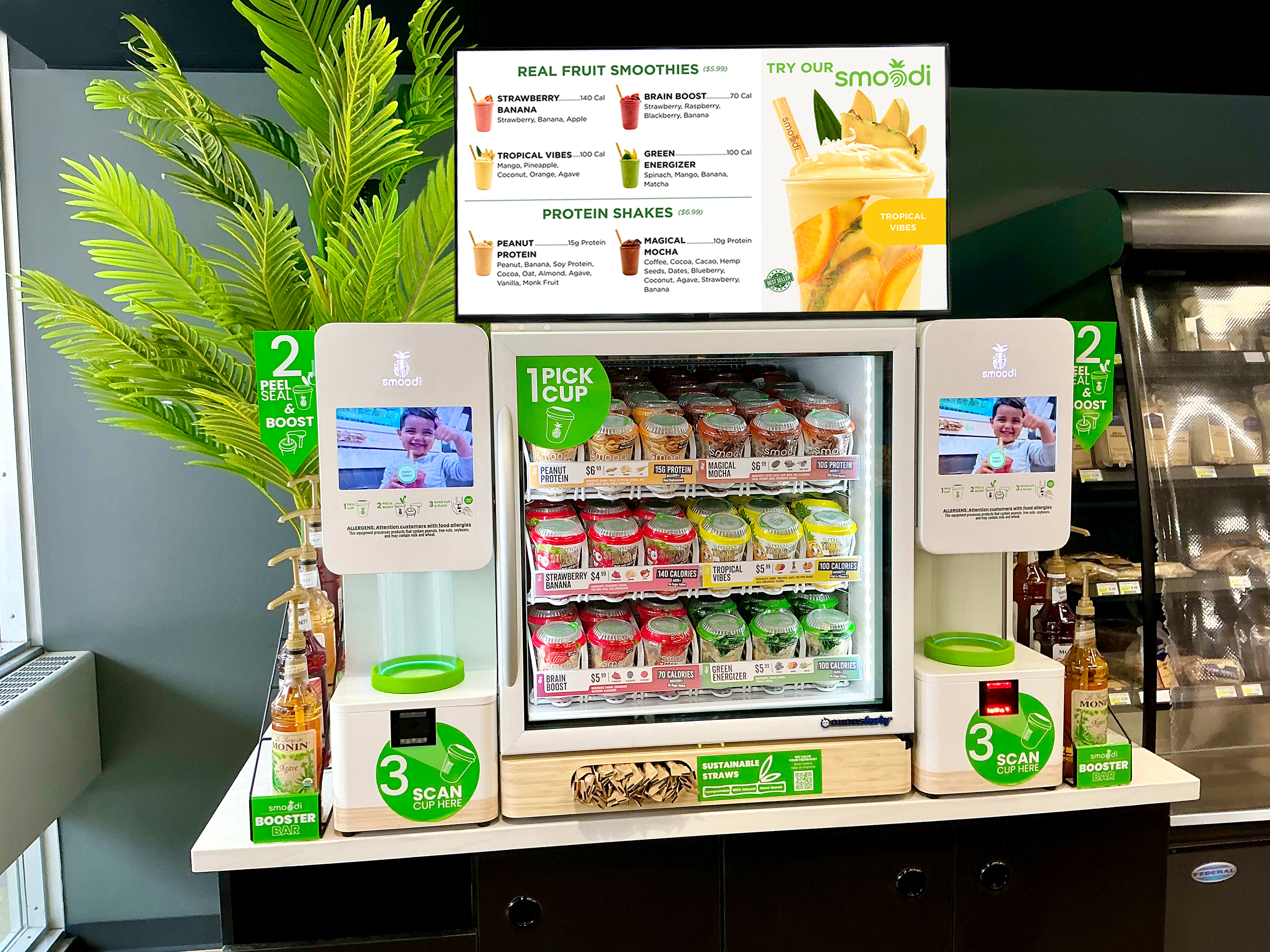
An automated system removes people from the consistency equation. Smoodi's machine blends the same recipe the same way every time: one pre-portioned IQF fruit cup, blended with water, in under 60 seconds. The machine self-cleans between every use. There is no recipe drift from a new hire who measures differently. There is no quality variation between locations. A smoothie served in a hospital cafeteria in Miami tastes identical to one served in a university dining hall in Boston, because the inputs (sealed fruit cup, water) and the process (automated blending, automated cleaning) are the same everywhere.
"We've had great success with smoodi across corporate offices and collegiate locations."
— Marcel Winokur, Director of Innovation, Aramark
What Operational Factors Matter When Scaling Across Locations?
Multi-unit operators should evaluate several operational factors before committing to a large-scale beverage program.
Standardized Installation
Every new site deployment requires equipment installation. If the installation process varies by location (different equipment configurations, different utility requirements, different contractor specifications), the rollout slows down and costs escalate.
Smoodi's installation requirements are identical at every location: a standard 120 VAC / 7A electrical outlet (NEMA 5-15P with integrated GFCI), a 3/8 inch push-to-connect water inlet (50 to 80 PSI, filtered and potable), a 1/4 inch push-to-connect sanitizer inlet, and a 1 inch FNPT drain. The machine occupies approximately 40 inches of floor space. A licensed plumber can complete the installation in a single visit. For a multi-unit operator rolling out 10 or 20 locations, the standardized spec sheet means the same instructions go to every plumber at every site.
Centralized Supply Chain
Ingredient sourcing across multiple locations is one of the most complex aspects of multi-unit foodservice. Fresh-produce programs require regional distribution agreements, seasonal adjustments, and careful coordination to ensure every location receives the same quality and quantity on the same schedule.
Smoodi's fruit cups are distributed through Dot Foods, the largest food redistribution company in North America. Dot Foods serves all 50 states and works with thousands of foodservice distributors. For multi-unit operators, this means a single supply chain solution covers every location regardless of geography. The cups have a shelf life of up to two years, so each site can stock several weeks of inventory without spoilage concerns. There is no daily produce delivery to coordinate across 20 sites. There is no regional price variation for seasonal fruit. The cost per cup is consistent, predictable, and scalable.
Zero Site-Level Labor
The most significant scaling advantage of an automated system is the absence of per-site labor costs. A staffed smoothie bar requires at least one employee per shift at each location. For a multi-unit operator with 15 locations running two shifts, that is 30 employee positions to recruit, train, schedule, and manage. At an average fully loaded cost of $18 to $25 per hour, the aggregate labor cost across 15 sites can exceed $500,000 per year.
Smoodi's machine operates with zero labor. No employee at any site prepares smoothies, cleans equipment, or manages the station. The machine is self-service for customers and self-cleaning after every use. For multi-unit operators, this means adding a smoothie program at a new location does not add a single headcount to the payroll.
How Does the Cost Structure Work Across Multiple Units?
Multi-unit operators evaluate programs on per-unit and aggregate economics. The per-unit cost structure for a Smoodi deployment is straightforward.
- Equipment: Operational lease starts at $299 per month (48-month term), with options at $349 (36 months), $399 (24 months), and $499 (12 months). Smoodi retains ownership and provides full service and maintenance. A purchase option is available starting at $14,999 per unit.
- Ingredients: IQF fruit cups, ordered through Dot Foods distribution. Per-cup cost is consistent regardless of volume or geography.
- Labor: Zero. No staff required at any location.
- Maintenance: Included in the lease. For purchased units, Smoodi provides service support.
- Waste: Near zero. Sealed cups with a two-year shelf life produce no spoilage. One cup equals one smoothie with no over-portioning.
For a 20-location deployment on a 36-month operational lease at $349 per month, the total equipment cost is $6,980 per month, or $83,760 per year. Compare that to staffing 20 smoothie bars at $35,000 to $50,000 per site per year in labor alone ($700,000 to $1,000,000 annually), and the cost advantage of automation is clear.
Can You Scale Capacity at Individual Locations?
Some locations generate enough demand to justify more than one machine. A busy university dining hall during lunch service or a hospital cafeteria at shift change may benefit from two or three machines running simultaneously. Smoodi's compact design (approximately 40 inches per machine) allows multiple units to be installed side by side in the same footprint that a single large-format kiosk would occupy. Two machines double throughput without any additional labor, because both operate autonomously.
This modular approach means operators can start with one machine at a new location, evaluate performance, and add capacity as demand warrants. There is no need to over-invest at the outset or commit to a large-footprint solution before demand is proven.
A Practical Approach to Multi-Unit Rollout
For multi-unit operators considering a healthy beverage program, a phased approach reduces risk and generates data to support expansion.
- Pilot phase: Deploy at two to five locations with different profiles (one corporate office, one university, one healthcare facility). Run for 60 to 90 days to establish baseline volume and operational patterns.
- Evaluate economics: Calculate per-unit revenue, margin, and customer feedback. Identify which location types generate the strongest demand.
- Scale phase: Expand to additional locations based on pilot results. Use the standardized installation spec and Dot Foods distribution to replicate the program quickly.
- Optimize: Add machines at high-traffic sites. Adjust cup inventory levels based on actual consumption data. Expand to new verticals within the portfolio.
Smoodi operates in more than 300 locations across the United States and has served more than two million smoothies since its founding at Harvard Innovation Labs. The company supports multi-unit deployments across universities, hospitals, corporate offices, fitness centers, hotels, airports, convenience stores, and entertainment venues. Smoodi's IQF fruit cups contain no syrups, concentrates, added sugars, or artificial ingredients, and the booster bar gives customers the option to add protein powder, collagen, and other functional supplements. To discuss a multi-site deployment, contact Smoodi's enterprise team at getsmoodi.com/get-started. To estimate the revenue potential across your portfolio, visit getsmoodi.com/roi.
Ready to bring Smoodi to your location?
Join hundreds of operators delivering fresh, automated smoothies with zero labor.
Get Started