How Is the Navy Expanding 24/7 Grab-and-Go Nutrition?
The Navy plans to equip 95% of shore-based galleys with grab-and-go stations by end of June 2026. This initiative validates the self-service, equipment-first nutrition model that civilian operators in healthcare, education, and corporate dining can adopt today.
Military dining is undergoing one of its most significant transformations in decades. In June 2026, the U.S. Navy announced that 95% of its shore-based galleys will have grab-and-go nutrition stations by the end of the month, with all stations operating open-to-close by year-end. The initiative signals a fundamental shift in how large institutions think about food access, and the lessons extend well beyond military installations.
For civilian operators in healthcare, higher education, corporate campuses, and hospitality, the Navy's approach validates a model that many have already begun adopting: distributed, self-service, equipment-first nutrition that meets people where they are, whenever they need it.
Why Is the Navy Prioritizing Grab-and-Go Stations Across Its Galleys?
Vice Adm. Scott Gray, commander of Navy Installations Command, has led the push to modernize how sailors access food on shore. The reasoning is straightforward. Sailors work irregular schedules, often rotating through shifts that do not align with traditional meal periods. A galley that serves breakfast from 0600 to 0800 and dinner from 1700 to 1900 leaves significant gaps for personnel who need nutrition outside those windows.
Grab-and-go stations solve this problem by making prepared food available throughout the day. Rather than requiring a fully staffed kitchen line for every meal period, these stations allow sailors to pick up quality meals and snacks on their own schedule. The Navy's goal of having every station operate open-to-close by the end of 2026 reflects a commitment to true 24/7 access.
The initiative also includes a training component. The Navy brought in instructors from the Culinary Institute of America to work with galley cooks, ensuring that grab-and-go options meet nutritional standards and taste expectations. This investment in quality underscores a key principle: convenience does not have to mean compromise.
How Does This Connect to the Broader Military Dining Transformation?
The Navy's grab-and-go expansion complements similar efforts across the Department of Defense. The Army's DINEX (Dining Excellence) initiative has been modernizing its own foodservice operations, focusing on quality, nutrition, and accessibility. Smoodi has written previously about how military dining programs are embracing automated, self-service solutions to meet the demands of modern service members. For more on this topic, read about military dining modernization at getsmoodi.com/blog.
Across branches, the pattern is consistent. Traditional cafeteria-style service, with its rigid hours, high labor requirements, and limited flexibility, is giving way to distributed models that put food access closer to the people who need it. The military's scale makes these transitions highly visible, but the underlying challenges are identical to those faced by civilian institutions.
What Can Civilian Operators Learn from the Navy's Approach?
Healthcare systems, universities, corporate campuses, and hospitality venues face the same core problem the Navy identified: people need access to quality nutrition outside of traditional meal windows, and staffing every service point around the clock is neither practical nor affordable.
Consider a hospital with nurses rotating through 12-hour overnight shifts. The cafeteria closes at 8 PM. Vending machines offer chips and candy bars. The gap between what staff need and what the facility provides is obvious, and it affects morale, retention, and health outcomes.
Or consider a university with students studying late into the night. The dining hall serves its last meal at 7 PM. Students turn to delivery apps or convenience stores for processed snacks. The institution has invested heavily in nutrition programs and wellness initiatives, but the infrastructure does not match the messaging.
The Navy's solution, building out grab-and-go stations that operate continuously with minimal staffing, offers a blueprint. Civilian operators can apply the same logic by investing in automated, self-service equipment that delivers consistent quality without requiring additional labor for every hour of operation.
Why Does the Equipment-First Model Work for 24/7 Operations?
The labor shortage in foodservice is not a temporary disruption. It is a structural reality. The industry has struggled to fill positions for years, and the challenge intensifies for operations that need coverage during overnight, weekend, and holiday shifts. Smoodi has explored the labor shortage's impact on foodservice in depth at getsmoodi.com/blog.
An equipment-first approach addresses this directly. When a machine can prepare and serve a product without a dedicated operator, the facility gains flexibility. It can offer foodservice during hours that would otherwise be dark, without adding headcount. It can maintain consistency regardless of who is (or is not) on shift. And it can scale by adding units rather than hiring and training additional staff.
This is precisely the model the Navy is validating at scale. And it is the model that Smoodi has been building for civilian operators across the country.
How Does Smoodi Fit Into the 24/7 Nutrition Model?
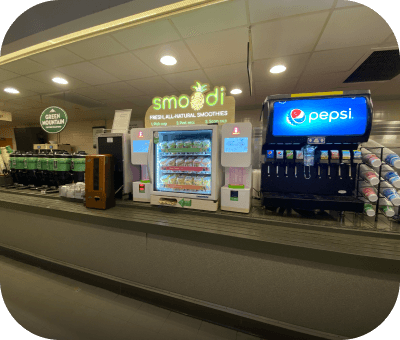
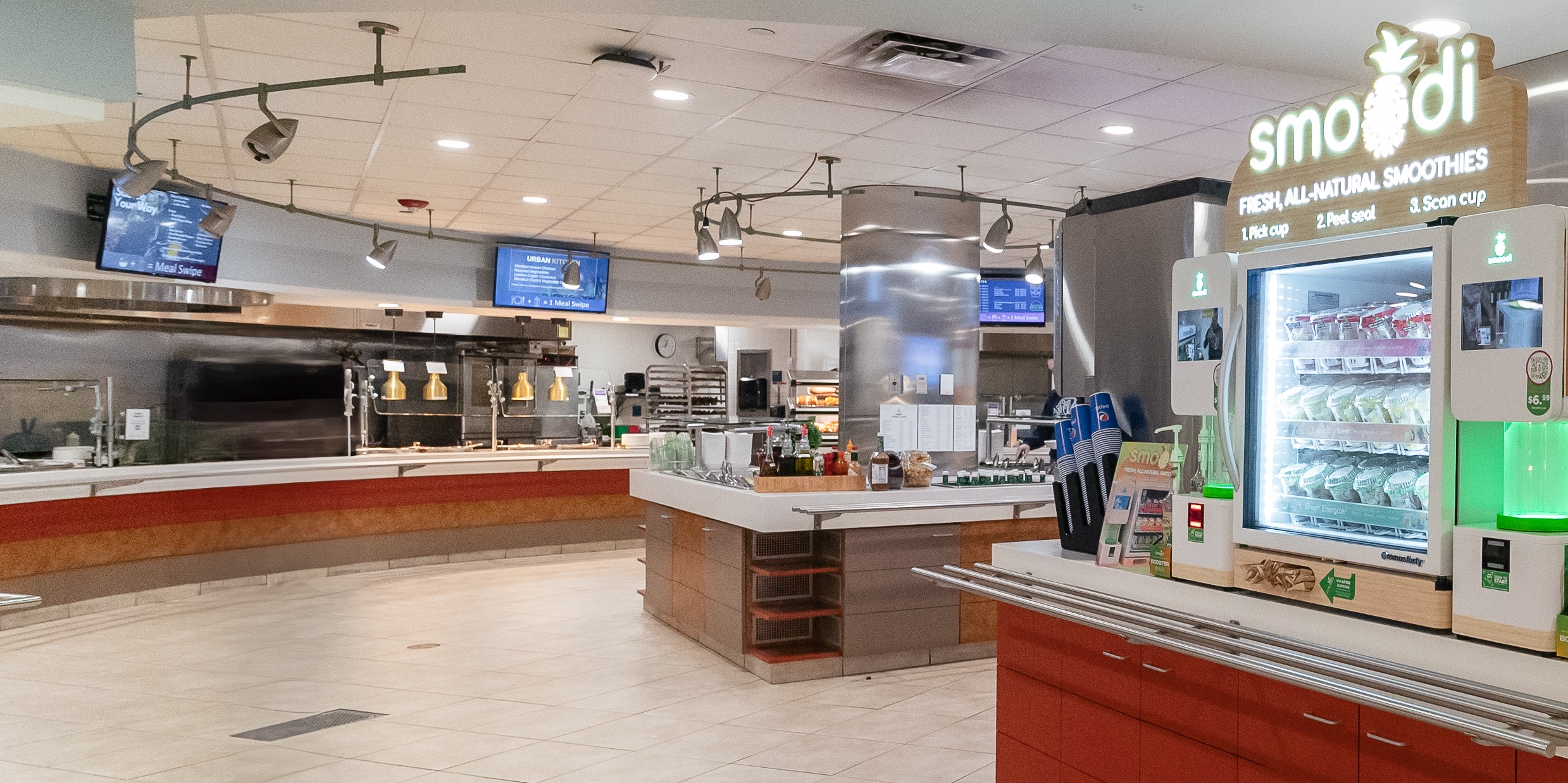
Smoodi's automated smoothie machines are purpose-built for the kind of distributed, self-service operation the Navy is scaling. With more than 300 locations across the United States and over 2 million smoothies served, Smoodi has proven the model in hospitals, universities, corporate offices, hotels, and fitness centers.
Each Smoodi machine blends a smoothie in under 60 seconds and self-cleans between every use. It requires no dedicated operator. A single unit needs approximately 40 inches of floor space, a standard 120 VAC / 7A outlet, a push-to-connect water inlet, a sanitizer inlet, and a drain. For facilities that need higher throughput, multiple machines can be installed side by side, blending simultaneously in the same footprint that a single large-format kiosk would occupy.
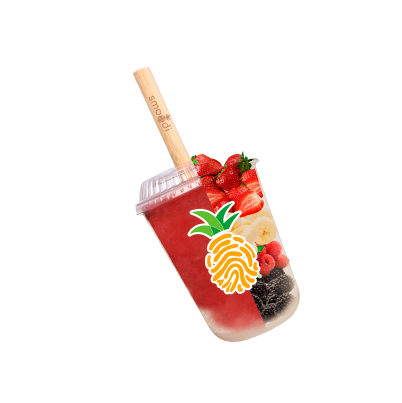
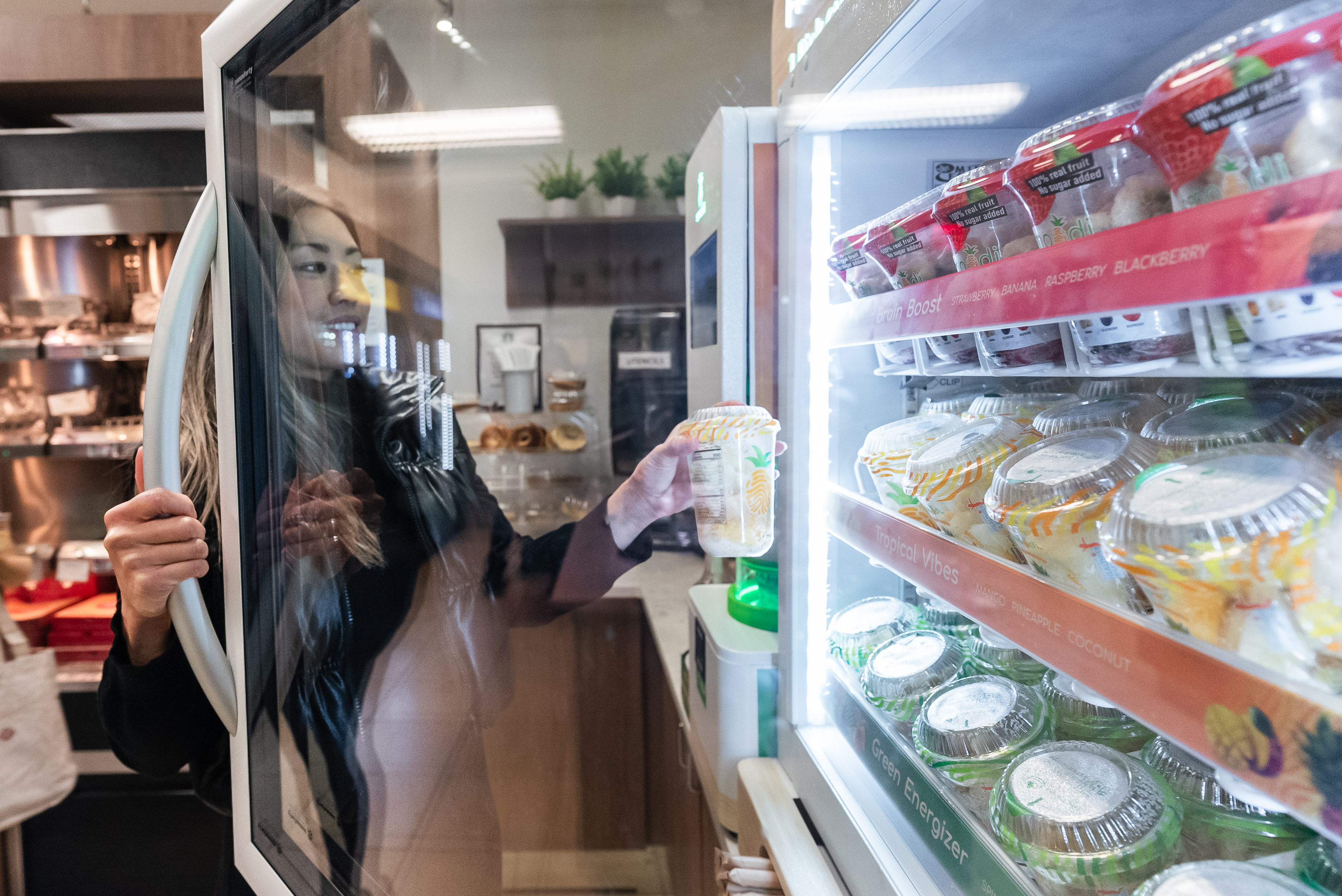
The ingredients are IQF (individually quick frozen) fruit cups blended with water only. There are no syrups, concentrates, or artificial ingredients. The cups have a shelf life of up to two years, which simplifies inventory management and reduces waste. Distribution runs through Dot Foods, providing reliable national supply chain coverage.
For operators who want to offer functional nutrition beyond fruit, Smoodi's booster bar allows guests to add protein powder, collagen, and other supplements to their smoothie. This makes the machine relevant not just as a snack option but as a genuine nutrition station, exactly the kind of offering the Navy's initiative is designed to provide.
What Do Operators Say About Zero-Labor Smoothie Service?
"It's been a day and a half and we've sold over 1,000 pieces. It's been great. Install was very fast. Our guys love it."
— Hector Ortiz, Food Service Operations Manager, Baptist Health
Results like these illustrate why the equipment-first model works. Baptist Health did not need to hire blender operators or restructure kitchen schedules. The machine went in, started serving, and generated immediate volume. That same dynamic plays out across Smoodi's network of 300+ locations: fast installation, minimal ongoing labor, and strong guest adoption.
What Does the Economics Look Like for Institutional Operators?
Smoodi offers flexible program structures to match different operational needs. An operational lease runs from $299 to $499 per month depending on term length, with Smoodi retaining ownership and providing full service. Operators who prefer to own the equipment outright can purchase starting at $14,999. In both cases, operators purchase the IQF fruit cups, set their own retail pricing, and keep the margin.
- Operational lease: $299 to $499/mo (Smoodi retains ownership, full service included)
- Purchase: starting at $14,999
- Operators pay lease plus cup costs and keep the margin on every sale
- No dedicated labor required for blending, cleaning, or maintenance
- Up to 2-year shelf life on IQF fruit cups reduces spoilage and waste
This cost structure makes 24/7 nutrition access financially viable in a way that staffed service points cannot match. A facility can deploy a Smoodi machine in a lobby, break room, or wellness center and offer smoothies around the clock without adding a single labor hour to its budget.
What Should Operators Do Next?
The Navy's decision to equip 95% of shore-based galleys with grab-and-go stations is not just a military story. It is a validation of the broader shift toward distributed, self-service, equipment-first foodservice. Civilian operators who face the same pressures, including irregular schedules, labor shortages, rising wellness expectations, and the need for 24/7 access, can adopt this model today.
Smoodi's automated smoothie machines deliver exactly what this model requires: consistent, high-quality nutrition with zero labor dependency, a compact footprint, and economics that work for institutional budgets.
Operators in healthcare, higher education, corporate dining, hospitality, and government facilities can request an institutional assessment to evaluate how Smoodi fits their specific environment. Visit getsmoodi.com/get-started to begin the conversation.
Ready to bring Smoodi to your location?
Join hundreds of operators delivering fresh, automated smoothies with zero labor.
Get Started