How Can Recreation Centers Offer Healthier Concessions?
The NRPA is positioning parks and recreation facilities as community nutrition hubs. An automated smoothie station offers a healthy, zero-labor concession option that fits any recreation center budget.
Recreation and community centers serve millions of Americans daily. They host youth sports leagues, senior fitness classes, swimming programs, summer camps, and after-school activities. Yet the concession stands at most of these facilities still rely on the same inventory they have carried for decades: chips, candy bars, sugary sports drinks, and soda. The gap between what recreation centers promote (active, healthy lifestyles) and what they sell at the counter (processed snacks and sugar) is increasingly difficult for facility managers to justify.
The National Recreation and Park Association (NRPA) is working to close this gap. Through its "community nutrition hubs" initiative, the NRPA is encouraging parks and recreation facilities to expand beyond traditional concession models and integrate healthier food access programs, nutrition education, and whole-food options into their operations. For recreation center managers, the question is no longer whether to offer healthier concessions, but how to do so within the budget, staffing, and space constraints that define public and nonprofit facility management.
What Is Driving Healthier Concessions at Recreation Centers?
Several forces are pushing recreation centers toward healthier food options.
First, public health mandates are expanding. Local health departments and community organizations are collaborating with recreation centers to adopt nutrition standards for concession items. Programs in states including Arkansas, California, and New York have established concession nutrition guidelines that limit calories, sodium, and added sugars in items sold at public facilities. These standards are voluntary in many jurisdictions today, but the trend is toward formalization.
Second, parent expectations are shifting. Families who enroll their children in recreation programs expect the facility to reinforce, not undermine, healthy habits. A recreation center that promotes youth fitness on one wall and sells candy on the other sends a contradictory message. Parents are vocal about this inconsistency, and recreation directors hear it in surveys, board meetings, and social media feedback.
Third, federally funded summer nutrition programs require facilities to meet specific food standards. Recreation centers that participate in the USDA Summer Food Service Program (SFSP) must serve meals and snacks that comply with federal nutrition requirements. Whole-fruit beverages with no added sugars naturally meet these standards.
What Are the Challenges of Upgrading Concession Programs?
Recreation centers face practical constraints that make concession upgrades difficult.
- Staffing limitations: Most recreation centers operate with minimal staff, often relying on part-time employees and volunteers. Adding a food preparation station that requires trained staff is rarely feasible.
- Budget constraints: Public and nonprofit recreation facilities work with tight budgets. Capital expenditures for kitchen equipment, ventilation, or food prep areas are hard to justify when maintenance backlogs and programming costs compete for the same funds.
- Space limitations: Concession areas are typically small, and the facility layout does not accommodate a full kitchen or staffed food station. Any new food equipment must fit within existing space without major construction.
- Food safety and liability: Facilities without commercial kitchen licenses face regulatory barriers to serving prepared food. Manual food preparation introduces liability risk that many recreation departments prefer to avoid.
- Inventory management: Fresh produce spoils quickly, and recreation center concession volumes are often unpredictable (varying by season, weather, event schedule, and program enrollment). Waste is expensive and demoralizing for staff.
How Does an Automated Smoothie Station Solve These Challenges?
An automated smoothie station addresses each constraint directly.
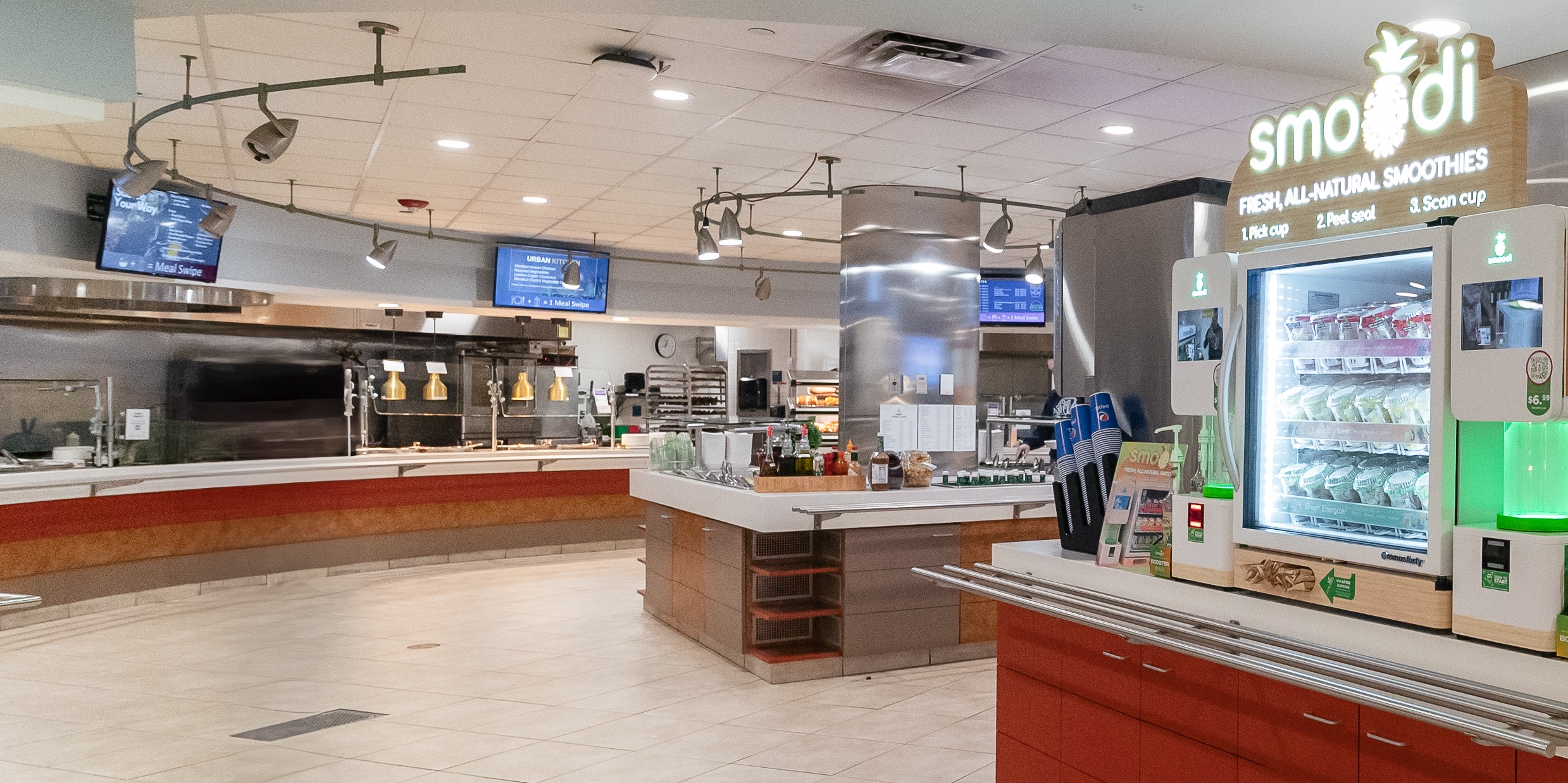
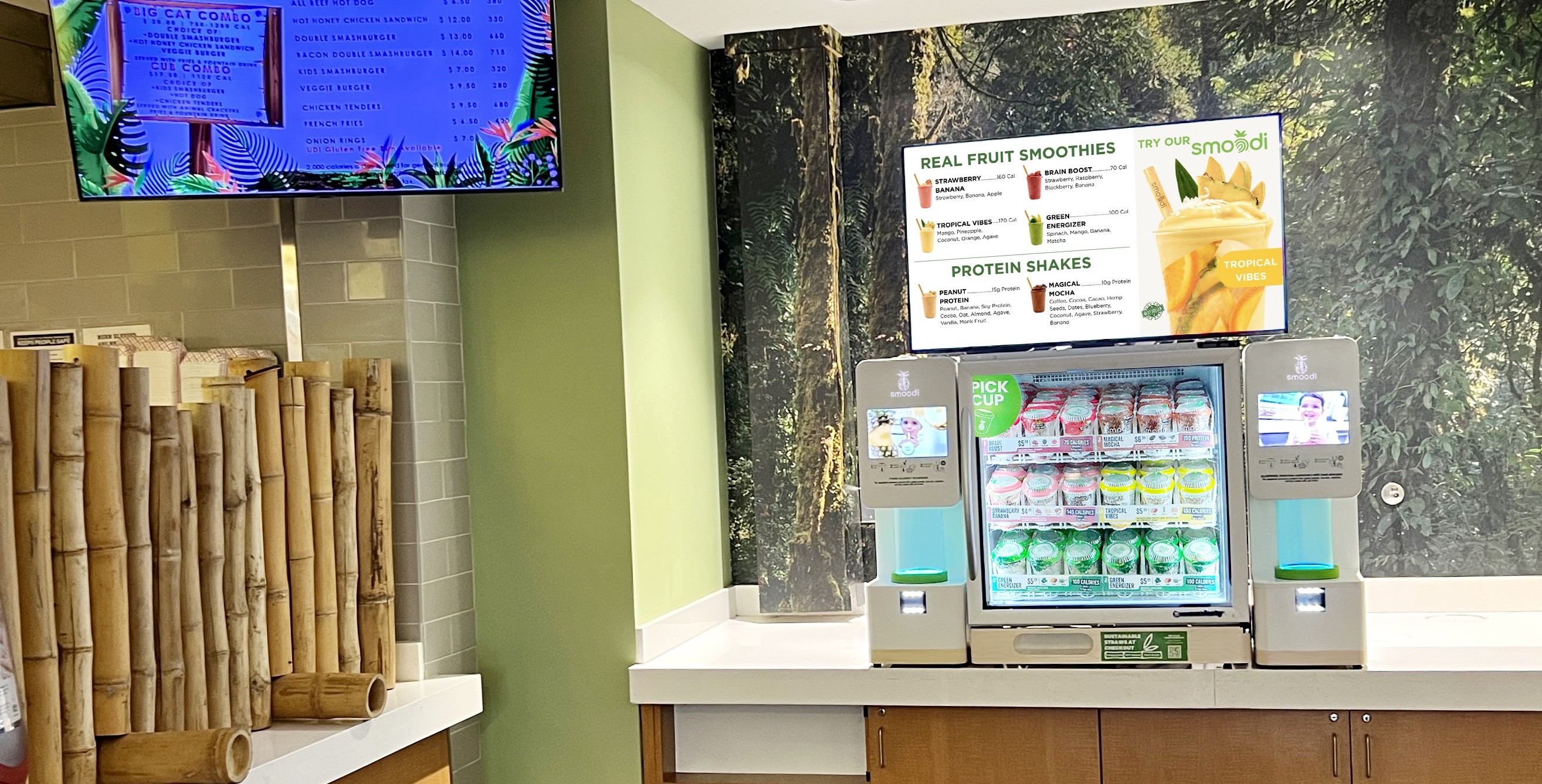
Smoodi's machine requires zero dedicated staff. It is entirely self-service: a user selects a fruit cup, inserts it into the machine, and receives a fresh smoothie in under 60 seconds. The machine self-cleans between every use, eliminating the need for staff to wash, sanitize, or maintain the equipment during operating hours.
The compact footprint (approximately 40 inches of floor space) means the station fits in a concession stand, a lobby alcove, or near the entrance to a gymnasium or pool area. No kitchen buildout or ventilation modification is required. Installation needs a standard 120 VAC / 7A outlet, push-to-connect water and sanitizer inlets, and a drain connection.
Each fruit cup is individually sealed at manufacturing using IQF (individually quick frozen) whole fruit. There are no syrups, concentrates, added sugars, or artificial ingredients. The cups are blended with water only. Because the cups have a shelf life of up to two years and are distributed through Dot Foods, inventory management is simple: order based on projected volume, store at room temperature, and restock weekly. There is no spoilage risk, no produce waste, and no cold chain to maintain.
The booster bar (protein powder, collagen, and other functional supplements) adds value for athletic populations. Youth athletes finishing a swim practice, seniors completing a fitness class, and adult league players after a basketball game all benefit from a whole-fruit smoothie with an optional protein boost.
What Does the Financial Model Look Like for Recreation Centers?
The financial model is designed to work within the budget constraints that recreation centers face.
An operational lease starts at $299 per month (48-month term), with Smoodi retaining ownership and providing full service and maintenance. Shorter terms are available at $349 per month (36 months), $399 per month (24 months), and $499 per month (12 months). Operators who prefer to own the equipment can purchase starting at $14,999. Operators pay for the lease and the cost of fruit cups, and they keep the margin on every smoothie sold.
For a recreation center selling smoothies at $5 to $7 per serving (a price point competitive with smoothie bars and significantly cheaper than staffed cafe options), the margin per smoothie comfortably covers cup costs and contributes to the monthly lease payment. Facilities with consistent traffic (youth sports facilities, community pools, senior centers with daily programming) typically see the smoothie station become self-sustaining within the first few months.
Aligning Concessions with the Community Nutrition Mission
Recreation centers exist to promote health, wellness, and community engagement. A concession program that serves whole-fruit smoothies with no added sugars aligns with that mission in a way that chips and candy cannot. For facilities participating in NRPA's nutrition hub initiatives or USDA summer feeding programs, an automated smoothie station provides a compliant, healthy option that requires no food handling expertise and no additional staff.
Smoodi operates in more than 300 locations across the United States and has served more than two million smoothies since its founding at Harvard Innovation Labs. The same operational model that serves hospitals, universities, and corporate offices works for recreation centers: zero labor, self-cleaning, IQF whole fruit, and a lease that starts at $299 per month.
To explore how a Smoodi station fits your recreation facility's concession program, visit getsmoodi.com/get-started. To estimate the revenue potential at your location, visit getsmoodi.com/roi.
Ready to bring Smoodi to your location?
Join hundreds of operators delivering fresh, automated smoothies with zero labor.
Get Started