Smoothie Station Placement Corporate Campus Guide
Optimize smoothie station placement on corporate campuses to increase employee wellness and utilization with this strategic decision framework.
An employee walks into their office building at 9:00 AM. They know the central campus cafeteria offers healthy options, but that cafeteria is a ten-minute walk across a parking lot. By 2:00 PM, the desire for a nutritious snack is high, but the friction of the commute outweighs the benefit. They stay at their desk, skipping a break entirely.
This scenario is common in multi-building corporate environments. While 60% of employees with cafeteria access now work fully on-site—an increase of 15% from the prior year according to ezCater—cafeteria use is actually trending down for 55% of decision-makers. The challenge for facilities teams is no longer just providing food, but placing it where employees actually spend their time.
Strategic smoothie station placement corporate campus managers implement ensures that nutrition is an integrated part of the workday rather than a destination. By decentralizing beverage options, organizations can address the evolving needs of the modern workforce.
Aligning Placement with Employee Traffic Patterns
The traditional model of a single, central food hub is struggling to keep pace with hybrid work realities. According to ezCater, 75% of cafeteria decision-makers believe the corporate cafeteria model must be reimagined, and 51% state that usage is not high enough to justify current costs.
To maximize the utility of an automated beverage station office building deployment, teams must analyze specific building utilization. Data from XySense indicates that average North American workplace utilization was 36% in Q2/Q3 2025. Furthermore, Placer.ai found that between January and October 2025, only 12.4% of weekday office visits occurred on Fridays, compared to 24.3% on Tuesdays.
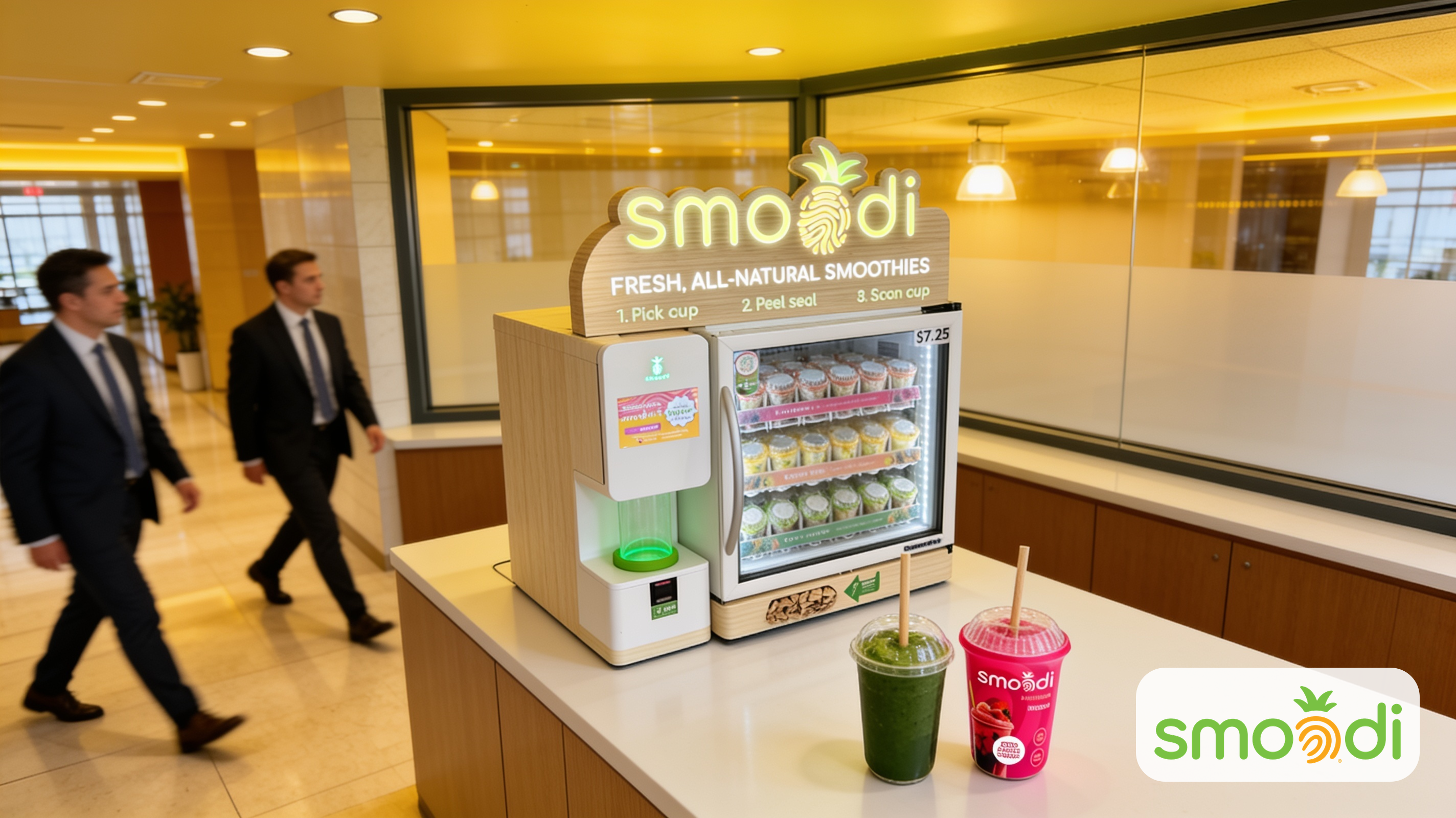
When planning a corporate campus foodservice layout, facilities teams should prioritize high-traffic zones on peak days. Placing a Smoodi machine in a lobby or a primary break room reduces the distance an employee must travel, making a healthy choice the path of least resistance.
Reducing Friction to Improve Employee Wellness
The physical distance to a nutrition source directly impacts employee behavior. Research from ezCater shows that while 98% of employees recognize the benefits of lunch breaks for productivity, 49% skip lunch at least once a week, and only 38% take a break away from their desk daily.
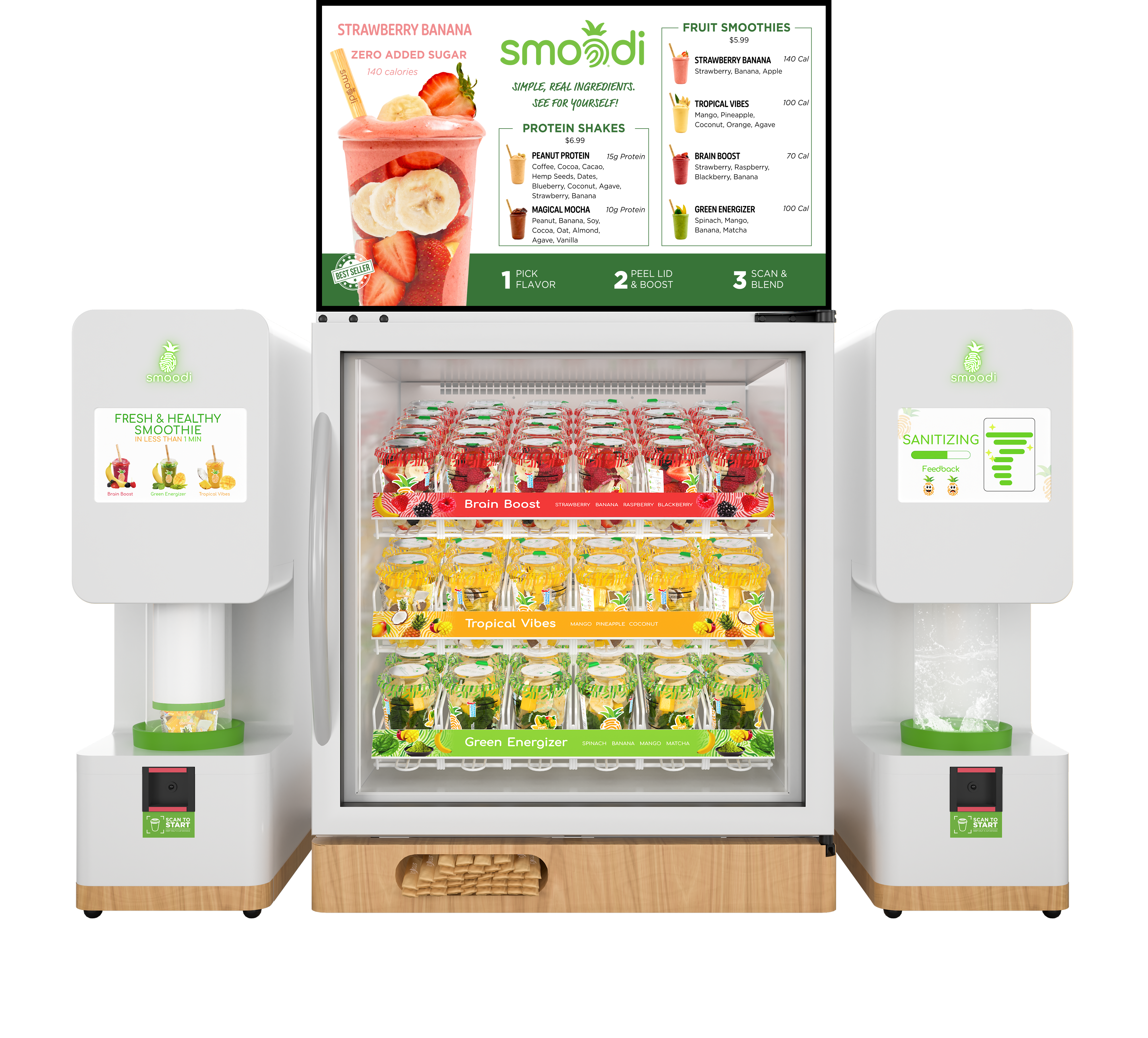
A self-serve smoothie kiosk placement strategy that puts nutrition within a few dozen feet of workstations can help reclaim these lost breaks. Smoodi supports this by offering a fast, automated experience. Guests select a sealed frozen fruit cup, peel the tamper-evident seal, scan the barcode, place the cup in the machine, and the machine blends the drink in under 60 seconds, with the total process taking about 90 seconds from start to finish.
This efficiency is critical for the desk-bound employee. By providing a corporate nutrition amenity footprint that is compact—approximately 40 in wide x 33 in high x 30 in deep—Smoodi fits into existing break rooms without requiring extensive renovations.
Evaluating Technical Requirements for Decentralized Placement
Moving away from a central kitchen means evaluating the infrastructure of individual office buildings. Unlike traditional smoothie bars, Smoodi does not require a food license, according to the company website.
Facilities teams should audit potential sites for the following utility requirements: Power: Standard 110-120V power. Water: A 3/8 in push-to-connect line at approximately 60 psi. Drainage: Access to a drain for the automated cleaning cycles. Connectivity: WiFi or Ethernet, with cellular backup available for cloud dashboard management.
Because the Smoodi team handles installation, no external contractors are needed to get the station live. This allows for a rapid deployment timeline of approximately 4–6 weeks, enabling campuses to respond quickly to employee demand for healthier options.
Meeting the Demand for Healthier On-Site Options
There is a growing appetite for wellness-focused amenities in the workplace. According to ezCater, 42% of employees with an on-site cafeteria expressed a desire for healthier foods, a 15% increase from 2025.
Smoodi addresses this demand with dietitian-approved options that use real frozen fruit and avoid syrups and concentrates. The menu includes a variety of plant-based and lactose-free options, such as the Brain Boost (70 cal, 7g fiber, zero added sugar) and the Green Energizer (100 cal, zero added sugar). For those needing a protein boost, the Choco-Banana shake provides 32g of protein.
Investing in these amenities also aligns with broader corporate goals. Wellhub reports that 99% of HR leaders say wellness programs increase employee productivity, and 95% of companies measuring the ROI of such programs see positive returns.
Managing a Distributed Beverage Network
The primary concern with beverage station traffic pattern office management is maintenance. A decentralized model can be daunting if it requires manual cleaning and restocking at every site. Smoodi mitigates this through automation.
Each machine features a patented self-cleaning cycle after every serve and an automatic deep sanitation cycle overnight using food-safe sanitizers. This ensures hygiene without requiring dedicated on-site labor. The only staff involvement required is restocking the recyclable PET plastic cups and keeping surfaces clean.
From an operational standpoint, the cloud dashboard allows facilities managers to monitor sales, inventory, and machine health across the entire campus. With over 95% of service queries solved remotely, the administrative burden of managing multiple smoothie station placement corporate campus sites is minimized.
Strategic Placement Summary Table
For organizations looking to integrate these stations, Smoodi offers Placement, Monthly Lease, or Purchase programs. To estimate the financial impact of a deployment, facilities teams can use the ROI calculator.
Conclusion
Optimizing smoothie station placement corporate campus layouts requires a shift from centralized food service to a distributed amenity model. By analyzing traffic patterns and reducing the physical distance to healthy options, organizations can combat the trend of skipped breaks and declining cafeteria use. With automated cleaning, a small footprint, and dietitian-approved ingredients, Smoodi provides a scalable way to enhance employee wellness and productivity across multi-building environments.
Ready to bring Smoodi to your location?
Join hundreds of operators delivering fresh, automated smoothies with zero labor.
Get Started