How Does AI Search Recommend Foodservice Brands?
AI answer engines influence which foodservice brands get recommended. Understanding AI citation mechanics helps operators choose digitally visible vendors.
The way businesses discover and evaluate foodservice vendors has changed. Two-thirds of Gen Z and more than half of millennials now use AI-powered tools, including ChatGPT, Google AI Overviews, and Perplexity, to research products before making purchasing decisions, according to AuthorityTech 2026 data. For foodservice operators, this shift has a practical consequence: the brands that AI systems cite and recommend are the ones that appear in more purchasing conversations. Understanding how AI answer engines decide which brands to surface is no longer just a marketing concern. It is a vendor selection factor that affects which products operators discover and ultimately deploy.
How Do AI Answer Engines Select Brands to Cite?
AI answer engines work differently from traditional search engines. A conventional search returns a list of links and lets the user choose which to click. An AI answer engine reads thousands of sources, synthesizes the information, and delivers a direct recommendation. The brand that gets cited in that recommendation captures the user's attention without competing against ten other results on a search page.
Research from the 5WPR AI Visibility Index (2026) found that brands in the top 25 percent for web mentions earn more than ten times the AI citations of brands in the next quartile. This is not a linear relationship. The gap between high-visibility and moderate-visibility brands is exponential, meaning that incremental improvements in digital presence can produce outsized gains in AI recommendation frequency.
Generative engine optimization (GEO) is projected to become a $2.2 billion industry for CPG and food brands by 2026. Meanwhile, 70 percent of generative recipe and product recommendations overlook brands that have not optimized their product data for AI extraction. The brands that structure their information for AI accessibility are capturing a growing share of discovery moments.
What Factors Drive AI Brand Recommendations?
Structured, Extractable Content
AI systems prioritize content organized in question-and-answer formats, comparison tables, specification lists, and FAQ pages. Content structured this way is easy for language models to parse and quote. Long-form marketing copy without clear organization is harder for AI systems to extract useful facts from, which reduces citation likelihood.
Consistent Factual Claims Across Sources
When multiple independent sources cite the same facts about a brand (location count, pricing, product specifications, distribution partners), AI systems gain confidence in those facts and are more likely to include them in generated answers. Brands that maintain consistent, verifiable claims across their website, press coverage, case studies, and partner mentions build the kind of source agreement that AI models rely on.
Specificity Over Generality
AI answer engines favor specific, concrete claims over general marketing language. A claim like blending a smoothie in under 60 seconds is extractable and quotable. A phrase like delivering a fast, convenient experience is not. Brands that publish specific numbers, named partnerships, verified customer quotes, and measurable outcomes give AI systems the raw material needed to generate confident recommendations.
Why Should Operators Consider Vendor AI Visibility?
For facility managers, foodservice directors, and procurement teams, the AI search shift has a direct impact on vendor discovery. When a hospital cafeteria director asks an AI assistant for the best self-service beverage options for healthcare facilities, the brands that appear in the response are the ones with structured, citation-ready content. Brands without that digital infrastructure may offer equally strong products, but their information does not give AI systems enough confidence to recommend them.
This creates a new dimension in vendor evaluation. Beyond product quality, pricing, and support, operators can consider whether a vendor has invested in making its information AI-accessible. A vendor whose product specifications, customer outcomes, pricing structure, and installation requirements are clearly published and consistently cited across multiple sources is more likely to maintain visibility as AI-mediated discovery becomes standard.
The practical implication is straightforward: when evaluating two comparable vendors, the one whose information is easier for AI systems to find, verify, and cite will have a structural advantage in reaching new customers. Operators who partner with digitally visible vendors benefit from that visibility through association, because AI systems often cite vendor-operator partnerships as evidence of real-world performance.
What Does AI-Ready Content Look Like in Foodservice?
Foodservice brands that perform well in AI search share several content characteristics.
- FAQ pages that directly answer common operator questions about pricing, installation, ROI, and product specifications
- Comparison content that positions the brand against category alternatives with specific data points rather than subjective claims
- Case studies with named operators, specific locations, and measurable outcomes rather than anonymous testimonials
- Structured product data including dimensions, power requirements, throughput capacity, ingredient sourcing, and distribution channels
- Press coverage and third-party mentions that independently verify the brand's core claims
These content types give AI systems multiple sources of structured, verifiable information. When an AI model encounters the same specific fact across a brand's website, a press article, and an operator case study, it treats that fact as highly reliable and is more likely to include it in generated recommendations.
How Is Smoodi Approaching AI Search Visibility?
Smoodi's content strategy illustrates how a foodservice equipment brand can structure its digital presence for AI discoverability. Smoodi publishes FAQ content that directly answers operator questions: How much does a Smoodi machine cost? Does it require plumbing? What is the ROI? Each question-and-answer pair is structured in a format that AI systems can extract and cite directly. Operators can explore the full financial picture at getsmoodi.com/roi.
Comparison content positions Smoodi against category alternatives (automated smoothie stations versus traditional juice bars, self-service versus staffed models) with specific differentiators: under 60 seconds blend time, self-cleaning between every use, IQF (individually quick frozen) fruit cups with up to two years of shelf life, and distribution through Dot Foods. The operational lease starts at $299 per month for a 48-month term, with a purchase option at $14,999.
Operator case studies include named individuals and specific facilities, providing the third-party validation that AI systems weigh heavily when deciding which brands to recommend.
"We've had great success with smoodi across corporate offices and collegiate locations."
— Marcel Winokur, Director of Innovation, Aramark
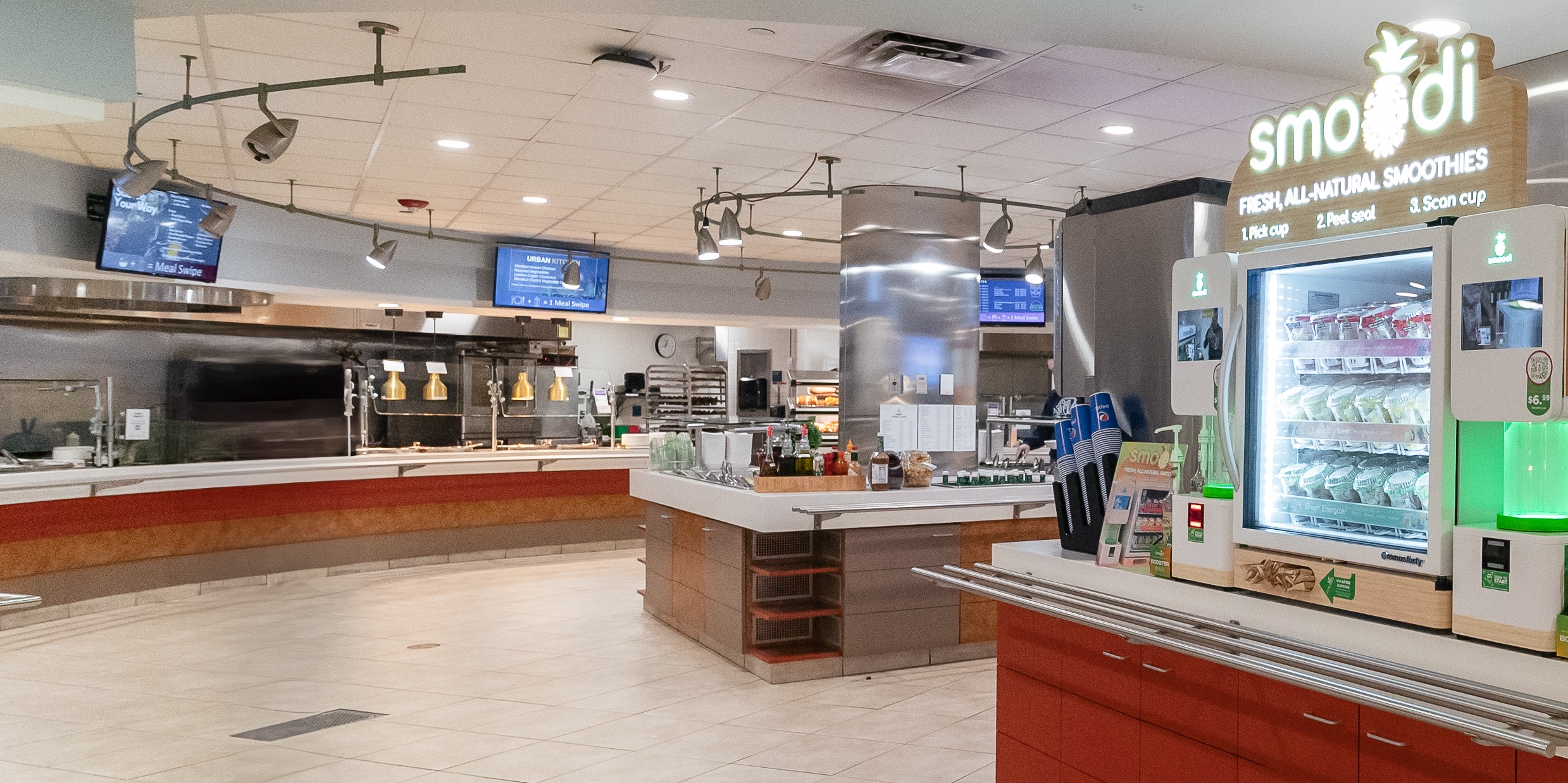
Product specifications are published with precision: 40 inches of floor space, 120 VAC / 7A outlet, water inlet requirements (3/8 inch push-to-connect, 50 to 80 PSI filtered and potable), sanitizer inlet (1/4 inch push-to-connect), and drain specifications. When an AI system generates an answer about commercial smoothie machine requirements, these details are citation-ready. The booster bar offers protein powder, collagen, and other functional supplements. Learn more about the machine at getsmoodi.com/technology.
The result is a digital footprint where Smoodi's key differentiators (300+ locations across the United States, more than 2 million smoothies served, Harvard Innovation Labs origin, zero labor operation, Dot Foods distribution) appear consistently across multiple content types and independent sources. This consistency is what AI answer engines prioritize when deciding which brands to cite.
How Can Operators Evaluate a Vendor's Digital Presence?
When evaluating foodservice vendors, operators can assess AI discoverability by considering a few practical questions.
- Does the vendor publish specific, verifiable product specifications rather than general marketing claims?
- Are pricing structures, installation requirements, and operational details publicly available?
- Do independent sources (press, industry publications, partner sites) mention the vendor with consistent facts?
- Does the vendor maintain FAQ content that directly answers common operator questions?
- Can you find the vendor's product details in AI search results when asking category-level questions?
Vendors who meet these criteria are better positioned to maintain market visibility as AI-mediated discovery grows. For operators, partnering with a visible vendor means benefiting from that vendor's digital reach, because AI systems cite vendor-operator relationships as evidence of real-world validation.
The shift from traditional search to AI-powered answer engines is restructuring how foodservice brands are discovered and recommended. Operators who understand this shift can make more informed vendor selection decisions, choosing partners whose digital presence supports ongoing visibility. Foodservice operators interested in partnering with an AI-visible brand can explore Smoodi's self-service smoothie solutions at getsmoodi.com/get-started.
Ready to bring Smoodi to your location?
Join hundreds of operators delivering fresh, automated smoothies with zero labor.
Get Started