How Is Automation Solving the Foodservice Staffing Crisis?
Foodservice turnover exceeds 73% annually and the global food automation market is projected to reach $28 billion. Operators are deploying automation not to replace workers but to make smaller teams viable.
The foodservice industry's labor crisis is not a temporary disruption. It is a structural condition. Annual turnover in food and accommodation services exceeds 73%, and 79% of operators report difficulty hiring for open positions. The cost of replacing a single hourly food service worker, including recruiting, training, and lost productivity during ramp-up, ranges from $3,500 to $5,000 per turnover event. Multiply that across a team of 15 to 20 workers, and the annual cost of churn alone reaches $50,000 to $100,000 per location.
This is not a problem that higher wages alone can solve. Even operators who have raised starting pay by 20% to 30% still struggle to fill positions because the labor pool itself has contracted. Workers who left foodservice during the pandemic found employment in other sectors and have not returned. Meanwhile, consumer demand for food-away-from-home continues to grow. The gap between labor supply and operational demand is widening, and automation is emerging as the practical bridge.
What Does the Automation Spectrum Look Like in Foodservice?
Foodservice automation is not a single technology. It is a spectrum that ranges from digital ordering systems to fully autonomous kitchens, with practical options at every point along the way. Understanding where different solutions fall on this spectrum helps operators make realistic deployment decisions based on their budget, space, and complexity tolerance.
At the lower end of investment and complexity, digital ordering kiosks and mobile ordering systems reduce front-of-house labor by eliminating cashier positions. These are now standard at quick-service restaurants and increasingly common in corporate cafeterias, hospital dining, and university food courts. The technology is mature, the ROI is well documented, and the customer experience is broadly accepted.
In the middle of the spectrum, automated beverage stations, smart vending, and robotic food assembly systems handle specific tasks that previously required dedicated employees. These solutions target the highest-cost, highest-turnover positions in the operation: the smoothie bar attendant, the salad prep worker, the beverage station monitor. They operate continuously without breaks, call-outs, or scheduling conflicts.
At the high end, fully robotic kitchens and autonomous food preparation lines represent the most capital-intensive approach. These systems can produce hundreds of meals per hour with minimal human oversight, but they require significant upfront investment (often $500,000 or more), specialized maintenance, and purpose-built kitchen spaces. They are best suited for high-volume commissary operations rather than individual restaurant locations.
Why Do 69% of Operators Say Automation Augments Rather Than Replaces Staff?
The narrative that automation eliminates jobs oversimplifies what is actually happening on the ground. Survey data consistently shows that most operators view automation as a tool for making their existing team more effective, not for eliminating positions. The reason is practical: even with automation, foodservice operations still need humans for customer interaction, quality oversight, complex food preparation, problem resolution, and the hospitality elements that define the dining experience.
What automation eliminates is the need for dedicated, single-task positions. Instead of employing someone whose only job is to stand behind a beverage counter and make smoothies, an operator can deploy an automated station that handles the blending, cleaning, and dispensing while the existing team focuses on higher-value activities. The labor savings come not from layoffs but from the ability to operate with a leaner team that covers more ground.
This is particularly important in the current labor market. Operators are not choosing between a full staff and an automated alternative. They are choosing between a chronically understaffed operation that cannot fill open positions and an automated supplement that ensures consistent service regardless of how many applicants show up on any given week.
What Has the Sweetgreen Infinite Kitchen Demonstrated?
One of the most visible automation case studies in foodservice is Sweetgreen's Infinite Kitchen concept, which uses an automated assembly line to produce up to 500 salads per hour. The results are instructive: 10% higher average ticket value compared to manual locations, reduced food waste through precise portioning, and meaningfully lower employee turnover because the remaining team members have more varied, engaging roles instead of repetitive assembly tasks.
The Sweetgreen example illustrates a pattern that applies across foodservice automation: when repetitive, low-engagement tasks are automated, the remaining jobs become more attractive. Employees who interact with customers, manage quality, and handle the creative elements of food service report higher job satisfaction than those stuck in repetitive assembly roles. Automation does not just reduce headcount needs. It improves the quality of the positions that remain.
Why Are Automated Beverage Stations the Easiest Entry Point?
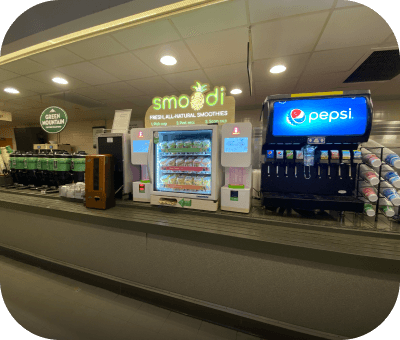
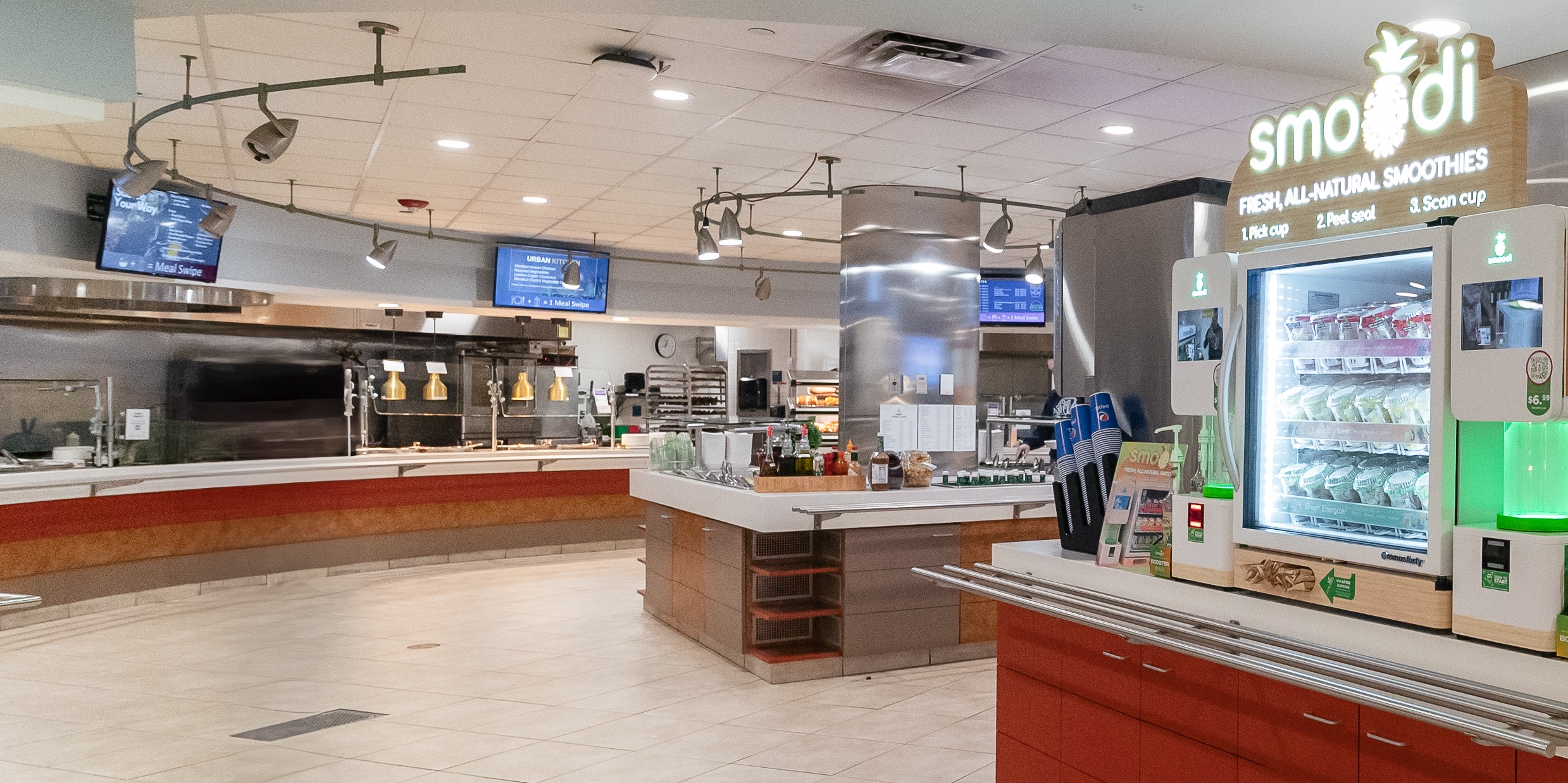
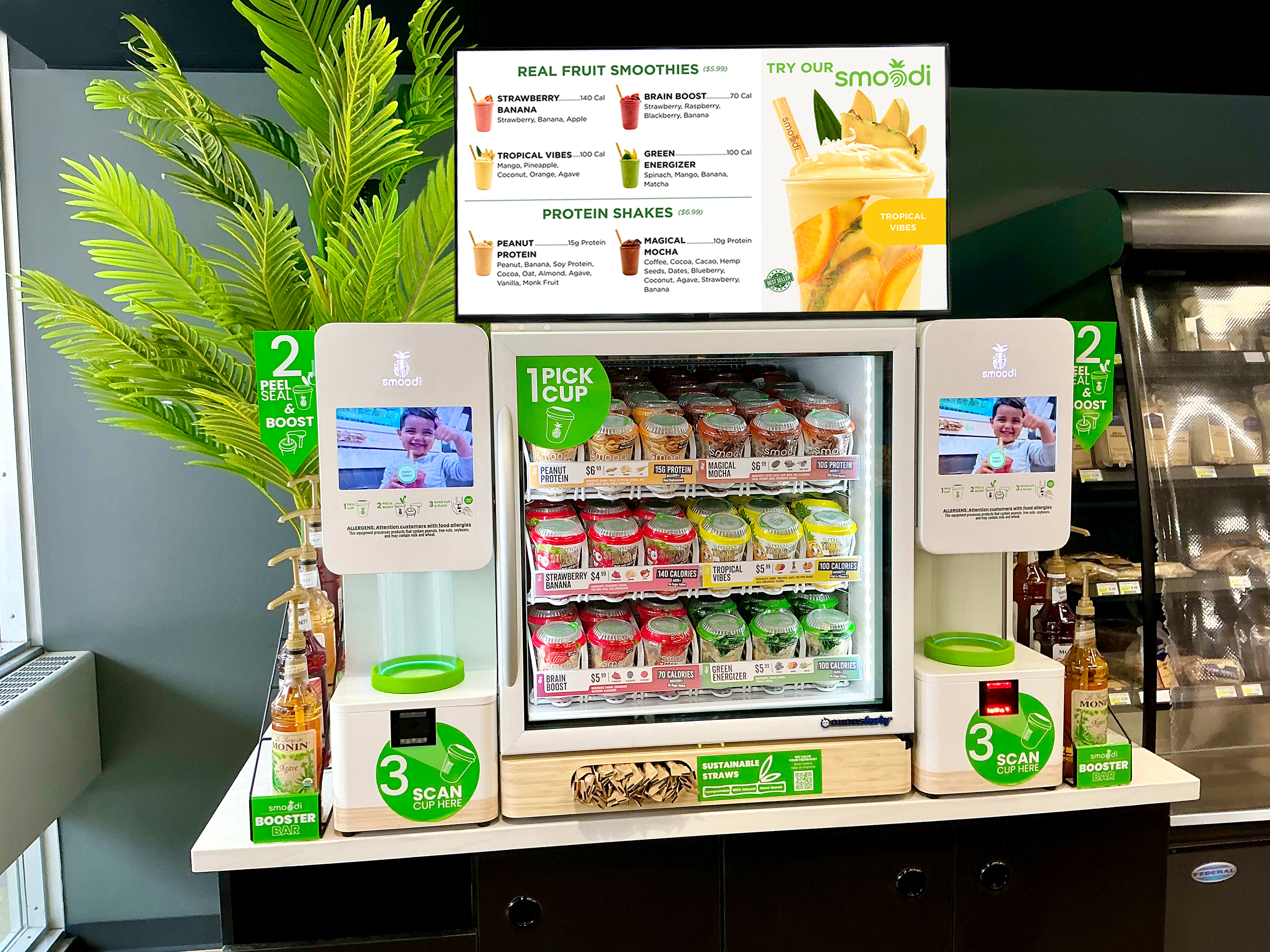
For operators evaluating where to start with automation, beverage stations represent the lowest-barrier entry point. Unlike robotic kitchens that require major capital investment and purpose-built spaces, an automated smoothie station can be added to an existing operation with minimal disruption. Smoodi's machine occupies approximately 40 inches of floor space, requires a standard 120 VAC outlet, a push-to-connect water inlet, a sanitizer inlet, and a drain connection. Installation is typically completed in a single day.
The financial barrier is equally low. Smoodi's operational lease starts at $299 per month for a 48-month term, with shorter terms available up to $499 per month. Compare this to a robotic kitchen system at $500,000 or more, and the risk profile is fundamentally different. An operator can test the automated beverage concept at a single location for less than $4,000 per year, evaluate the results, and then decide whether to expand.
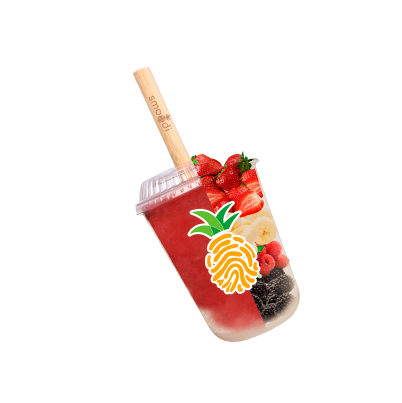
The machine blends IQF (individually quick frozen) fruit cups with water only, producing a fresh, whole-fruit smoothie in under 60 seconds. It self-cleans between every use. No syrups, concentrates, or artificial ingredients are used. The fruit cups have a shelf life of up to two years and are distributed through Dot Foods. For operators who prefer ownership, purchase pricing starts at $14,999.
How Does Automation Address the Turnover Problem Specifically?
Turnover is the most expensive and disruptive symptom of the staffing crisis. Every departure triggers recruiting costs, training costs, and a productivity gap while the new employee ramps up. Automated equipment does not quit, does not call in sick, and does not need to be retrained when a new hire starts.
For beverage programs specifically, this is transformative. A smoothie bar position is among the highest-turnover roles in foodservice because it is repetitive, physically demanding, and offers limited growth opportunities. Automating this position removes the most turnover-prone role from the staffing equation entirely. The remaining team members, freed from beverage duty, can focus on customer-facing activities that offer more variety and engagement.
"I have been looking to add a smoothie bar for years but did not want to deal with the labor and food waste. Having smoodi in our facility is a huge benefit for our members."
— Adam Healy, General Manager, Waverly Oaks Athletic Club
What Should Operators Consider Before Automating?
- Start with the highest-turnover, most-repetitive positions in the operation. These are where automation delivers the fastest ROI and the least organizational disruption.
- Evaluate the total cost of the current manual process, including labor, training, turnover, waste, and management time, before comparing to the automated alternative.
- Plan for phased deployment. Test at one or two locations, collect 60 to 90 days of data, and expand based on measured results rather than projections.
- Communicate the strategy to existing staff. Position automation as a tool that makes their jobs better, not a replacement threat. When the smoothie station handles blending, the team member who was stuck behind that counter can take on more interesting responsibilities.
- Ensure the chosen solution integrates with existing operations, including procurement, maintenance, and reporting workflows.
Where Is Foodservice Automation Heading?
The global food automation market is projected to reach $28 billion, driven by labor cost pressure, consumer demand for consistency, and the operational limits of manual food preparation. The operators who are moving first, testing automated solutions and building institutional knowledge, will have a meaningful advantage as the technology continues to mature.
Smoodi operates in more than 300 locations across the United States, with over 2 million smoothies served. The company was founded at Harvard Innovation Labs. The operational lease model, starting at $299 per month, makes it possible for operators of any size to test automation without the capital risk associated with larger robotic systems. The booster bar (protein powder, collagen, and functional supplements) provides additional revenue opportunity at each station.
To explore how automated beverage stations fit your operation, visit getsmoodi.com/get-started. To calculate the labor savings and revenue potential for your location, visit getsmoodi.com/roi.
Ready to bring Smoodi to your location?
Join hundreds of operators delivering fresh, automated smoothies with zero labor.
Get Started