How Is Hospital Foodservice Moving Beyond the Cafeteria?
Hospitals are redistributing food access from centralized cafeterias to satellite stations in lobbies, corridors, and staff lounges. The decentralized dining model is reshaping healthcare foodservice.
Hospital foodservice is undergoing a physical transformation. For decades, the central cafeteria served as the single food access point for patients, staff, and visitors. That model is breaking down. MD-Pod (2026) documents the decentralizing of the hospital cafeteria, with health systems moving food access points out of centralized facilities and into lobbies, corridors, waiting areas, and nursing unit lounges. Datassential's Hospital Food, Reimagined research confirms that distributed access points serving staff, patients, and visitors outside traditional meal windows are among the most significant emerging trends in healthcare foodservice.
The shift is not theoretical. Hospital systems across the country are investing in satellite food stations positioned at multiple points throughout their campuses. Understanding why this shift is happening, and what it means for hospital administrators and foodservice directors, helps operators evaluate whether and how to implement a decentralized approach.
Why Is the Central Cafeteria Model Failing?
Hospitals operate 24 hours a day, 7 days a week. But most hospital cafeterias close by 7 PM or earlier. This creates a fundamental mismatch between when food is needed and when food is available. Staff on evening and overnight shifts, visitors arriving outside business hours, and patients discharged at irregular times all need food access that the central cafeteria model cannot provide.
The problem extends beyond hours of operation. Large hospital campuses can span multiple buildings connected by corridors that take 10 to 15 minutes to walk. A nurse with a 30-minute break who spends 20 minutes walking to and from the cafeteria has only 10 minutes to select, purchase, and eat a meal. Many simply skip the trip and rely on vending machines or food brought from home. This is not a minor inconvenience. It is a daily nutritional gap that affects staff energy, focus, and ultimately patient care.
Morrison Healthcare identifies the shift from cafeteria-centric to experience-driven foodservice across hospital campuses as a defining trend. Fooda reports hospitals integrating diverse food options through partnerships positioned at multiple access points rather than concentrating all food service in a single location.
What Is the Decentralized Dining Model?
Decentralized hospital dining distributes food and beverage access across multiple locations throughout a hospital campus. Instead of one large cafeteria, the model places smaller food stations in high-traffic areas where staff, patients, and visitors naturally pass during their day.
Common placement locations include main lobbies, emergency department waiting areas, outpatient clinic corridors, rehabilitation wings, staff break rooms on each floor, and visitor lounges near patient rooms. Each satellite point provides a different level of food access depending on the space and population it serves. Some locations may have a full micro-market with packaged meals and snacks. Others may have a single self-service station offering a specific product category such as beverages, smoothies, or coffee.
The key principle is that food access moves to where people are, rather than requiring people to travel to where food is. This reduces the time and effort required to get a meal or snack, which increases the likelihood that staff and visitors will actually eat something nutritious rather than skipping meals or defaulting to vending machine options.
What Regulatory Pressures Are Accelerating the Shift?
CMS (Centers for Medicare and Medicaid Services) released guidance in March 2026 (QSSAM-26-03) reinforcing hospital nutrition service obligations. The guidance emphasizes that nutrition services must be accessible and adequate for the patient population served, which adds regulatory pressure on hospitals whose food access is limited to cafeteria hours. While the guidance primarily addresses patient nutrition, the operational implication extends to staff and visitor food access as well, because hospital accreditation standards increasingly evaluate overall campus wellness infrastructure.
For hospital administrators, this creates both a compliance consideration and a quality-of-care motivation. Hospitals that can demonstrate accessible nutrition across their campus, including outside traditional cafeteria hours, are better positioned for accreditation reviews and patient satisfaction surveys.
What Constraints Do Satellite Food Stations Face?
Placing food access points throughout a hospital campus introduces constraints that do not apply to a central cafeteria.
- Space: lobbies, corridors, and break rooms have limited floor space. Equipment must be compact enough to fit without disrupting traffic flow or requiring construction
- Staffing: hospitals already face staffing challenges in clinical roles. Placing a staffed food station on every floor or in every wing is not financially viable. Satellite food points must operate without dedicated food service personnel
- Hygiene: healthcare environments require strict cleanliness standards. Food equipment in patient-accessible areas must self-clean or require minimal manual cleaning to maintain infection control protocols
- Hours: satellite stations must operate during the hours the cafeteria does not, including evenings, nights, and weekends. This eliminates any option that requires staff to open, operate, and close the station
- Menu simplicity: satellite points do not need to replicate the full cafeteria menu. They need to provide one or two high-demand categories (beverages, snacks, or grab-and-go items) reliably and consistently
Equipment that meets all five constraints, compact, unstaffed, self-cleaning, 24/7, and delivering a quality product, is the equipment that can scale across a hospital campus in the decentralized model.
How Does Smoodi Address Hospital Satellite Deployment?
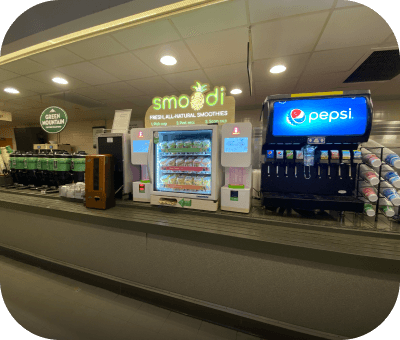
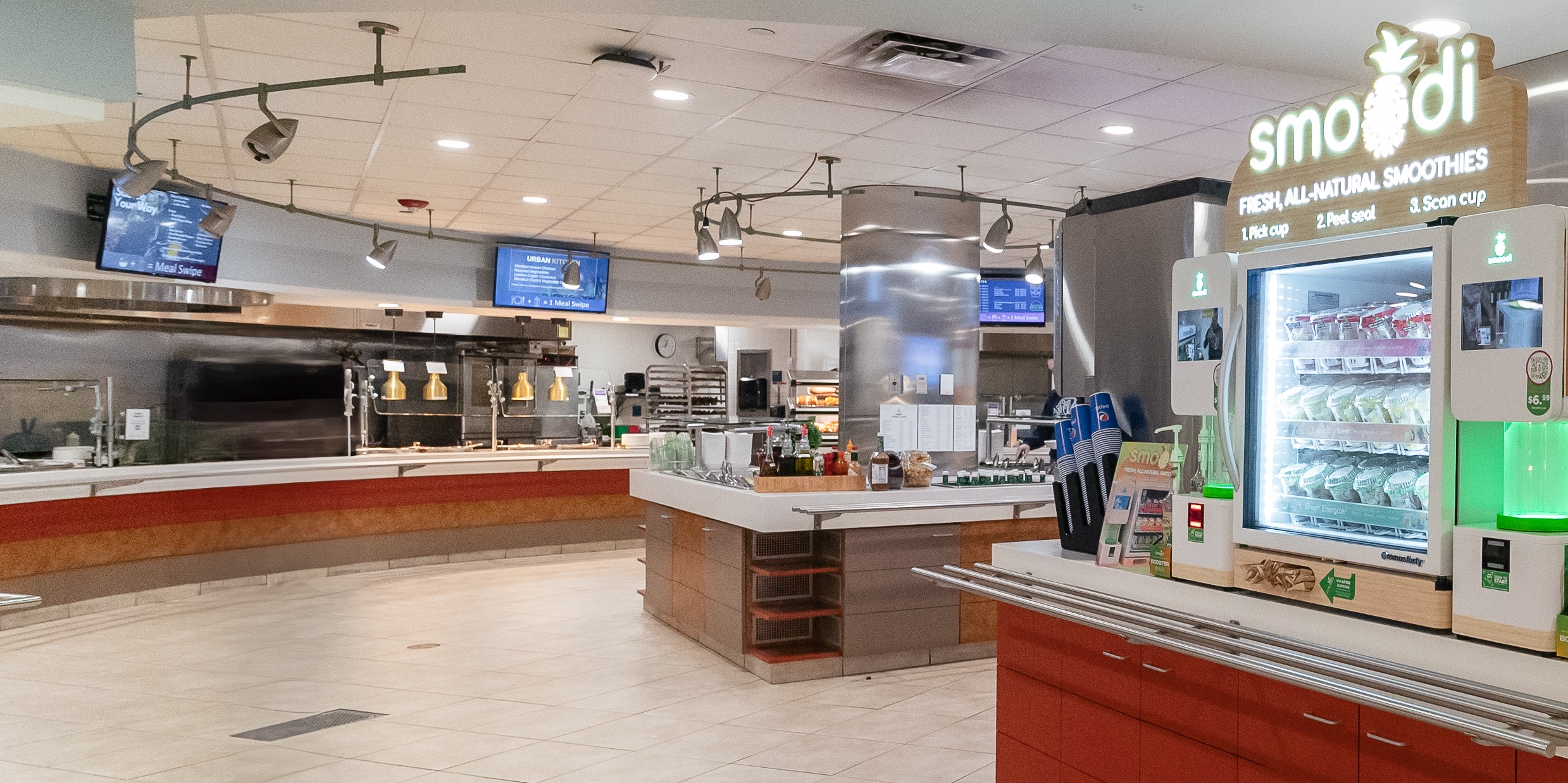
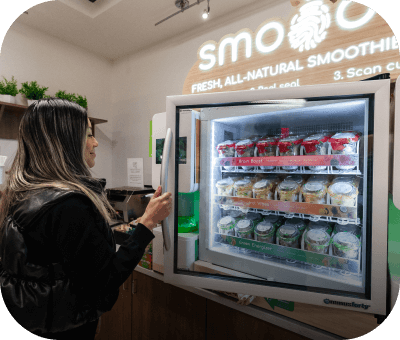
Smoodi's automated smoothie machine was designed for exactly the type of environment that hospital satellite stations require. The machine occupies approximately 40 inches of floor space, fitting into a lobby, waiting area, rehabilitation wing, or staff break room without requiring construction or dedicated kitchen infrastructure. It blends a fresh, whole-fruit smoothie in under 60 seconds and self-cleans between every use, maintaining hygiene standards without manual intervention.
"It's been a day and a half and we've sold over 1,000 pieces. It's been great. Install was very fast. Our guys love it."
— Hector Ortiz, Food Service Operations Manager, Baptist Health
IQF (individually quick frozen) fruit cups are blended with water only. No syrups, concentrates, or artificial ingredients. Cups have a shelf life of up to two years, which simplifies inventory management for satellite locations that may not have daily delivery access. Distribution through Dot Foods integrates with existing hospital foodservice supply chains. The booster bar offers protein powder, collagen, and other functional supplements, adding nutritional customization relevant to healthcare populations including rehabilitation patients and staff seeking functional nutrition.
"Now we have healthy options available here in the cafeteria, and patients and even doctors are loving this."
— Dr. Nish Patel, Interventional Cardiologist, Baptist Health Miami
Installation requires a standard 120 VAC / 7A outlet, water inlet (3/8 inch push-to-connect, 50 to 80 PSI filtered and potable), sanitizer inlet (1/4 inch push-to-connect), and drain (1 inch FNPT). These utilities are available in most hospital common areas. For health systems looking to deploy across multiple campus locations, the operational lease ($299 to $499 per month) avoids capital expenditure per unit, making it financially feasible to install stations in several satellite locations rather than investing in a single large food service renovation.
Smoodi operates in more than 300 locations across the United States, with over 2 million smoothies served. The company was founded at Harvard Innovation Labs. Multiple machines can be installed side by side for high-traffic hospital locations such as main lobbies or cafeteria adjacencies, blending simultaneously to handle peak demand.
What Should Hospital Administrators Consider?
Hospital administrators and foodservice directors evaluating a decentralized dining strategy should consider several factors when selecting satellite equipment.
- Can the equipment operate 24/7 without dedicated food service staff?
- Does it self-clean to meet healthcare hygiene standards?
- Does it fit in the available space without construction or renovation?
- Is the product nutritionally appropriate for healthcare populations?
- Can the supply chain integrate with existing hospital foodservice distribution?
- Does the cost model allow deployment at multiple locations simultaneously?
The hospitals that move food access beyond the central cafeteria will better serve staff, patients, and visitors while aligning with the regulatory and accreditation trends shaping healthcare foodservice. Operators interested in evaluating satellite deployment for their hospital campus can learn more at getsmoodi.com/get-started.
Ready to bring Smoodi to your location?
Join hundreds of operators delivering fresh, automated smoothies with zero labor.
Get Started