How Can Self-Service Food Solve Nutrition Access Gaps?
Forty-three million Americans live in food-insecure households. Self-service automated stations are bridging the gap between what traditional foodservice can deliver and what underserved institutional settings actually need.
Forty-three million Americans live in food-insecure households. The Rockefeller Foundation estimates that Food is Medicine programs could generate $45 billion in state economic activity and create 316,000 jobs if scaled to reach those who need them most. Yet traditional food programs require kitchen infrastructure, trained staff, cold-chain logistics, and ongoing operational budgets that many institutions cannot support. Hospitals in rural areas, schools in food deserts, workplaces in industrial parks, and military installations in remote locations share a common challenge: how to provide fresh, nutritious food without the infrastructure for a full kitchen operation.
Where Do Nutrition Access Gaps Exist in Institutional Settings?
Nutrition access gaps are not limited to the geographic food deserts that receive the most attention. They exist inside institutions that serve millions of people daily but lack the infrastructure or resources to provide fresh food at every touchpoint.
In healthcare, a rural hospital may have a cafeteria that operates during daytime hours but offers nothing fresh during evening, overnight, and weekend shifts when nursing staff, support workers, and visiting families need nutrition. The vending machine in the hallway offers candy bars and soda. The gap between the hospital's wellness mission and its after-hours food options is a daily contradiction experienced by staff and patients alike.
In education, schools in underserved communities may serve USDA-compliant meals during lunch but offer no healthy options before school, after school, or during extracurricular hours. A student athlete finishing practice at 5:30 PM finds the cafeteria closed and the only available option is a gas station across the street. Universities with sprawling campuses may have dining halls in central locations that are impractical for students in satellite buildings, research facilities, or student housing complexes far from the main quad.
In the workplace, employees at manufacturing plants, distribution centers, warehouses, and remote office parks often have no fresh food options within reasonable distance. The break room has a vending machine and a microwave. Employers who invest in wellness programs and health insurance see those investments undermined by the 8 to 10 hours per day when their employees have no access to nutritious food at their worksite.
Why Do Traditional Food Programs Fail in These Settings?
Traditional foodservice requires a combination of resources that underserved institutional settings cannot provide. Understanding these requirements explains why the nutrition gap persists despite widespread awareness of the problem.
- Kitchen infrastructure is the most fundamental barrier. A full kitchen requires dedicated space, ventilation, grease traps, fire suppression, and health department inspection. Retrofitting a breakroom, hospital corridor, or satellite campus building for a kitchen operation typically costs $50,000 to $200,000 or more before a single meal is served.
- Trained labor is scarce everywhere, but especially in remote and underserved locations. Rural hospitals compete for food workers against the same labor pool that serves the local community. Schools in food deserts face the same challenge. Even locations willing to pay competitive wages struggle to recruit because the labor pool itself is too small.
- Cold-chain logistics for fresh ingredients require daily deliveries, temperature-controlled storage, and shelf-life management that adds cost and complexity. A location that is difficult to reach by delivery trucks, whether due to distance, security protocols, or facility access restrictions, faces higher supply costs and more frequent stockouts.
- Operational budgets for staffed food programs are ongoing fixed costs that administrators must justify annually. A hospital administrator choosing between funding a night-shift food attendant and funding a nurse faces an obvious priority decision. The food attendant loses, and the nutrition gap remains.
What Makes Automated Stations Different from Vending?
The distinction between automated food stations and vending machines is critical for understanding how self-service technology can address nutrition access gaps. Vending machines dispense pre-packaged, shelf-stable products. The products were manufactured days, weeks, or months ago. They were designed for long shelf life, which typically means added preservatives, sugar, sodium, and artificial ingredients. A vending machine can provide calories but rarely provides fresh, functional nutrition.
Automated preparation stations occupy a different category. They prepare food on demand from ingredients that are stored in a shelf-stable format but become a fresh product at the moment of preparation. The distinction matters for nutrition quality, for consumer perception, and for institutional alignment with wellness mandates. A hospital that places a vending machine in its lobby is acknowledging a gap. A hospital that places an automated fresh nutrition station in its lobby is addressing it.
The key requirements for an automated station that can serve underserved institutional settings are specific. The ingredients must be shelf-stable to eliminate cold-chain dependence and reduce delivery frequency. The equipment must be self-cleaning to eliminate sanitation labor. The operation must require zero dedicated staff. The footprint must be small enough to fit in hallways, lobbies, and break rooms without renovation. And the product must be genuinely nutritious, not merely convenient.
What Role Does Shelf-Stable Freshness Play in Access?
The concept of shelf-stable freshness sounds contradictory, but it is the key to deploying fresh nutrition in locations where traditional freshness models fail. Individually quick frozen (IQF) technology preserves fruit at peak ripeness by flash-freezing individual pieces within hours of harvest. The rapid freezing process preserves nutrients, flavor, and texture in ways that slow freezing or refrigerated storage cannot match.
IQF fruit cups with a shelf life of up to two years transform the logistics equation for underserved locations. A rural hospital can receive a monthly shipment and store inventory at ambient temperature until deployment. A remote military installation can stock months of supply. A school in a food desert does not need daily produce deliveries from a distributor that may not reliably serve the area. The long shelf life means zero food waste from spoilage, a significant cost factor that makes fresh food programs unsustainable in low-volume settings.
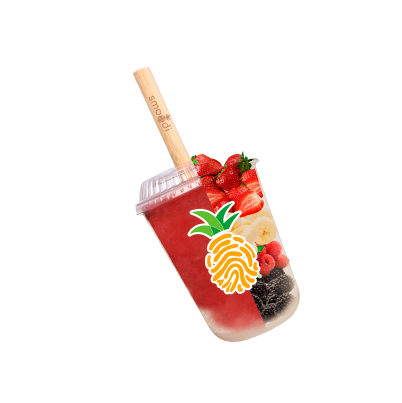
When the IQF fruit cup is blended with water at the moment of consumption, the result is a fresh smoothie made from real fruit. The consumer receives a product that looks, tastes, and provides the nutritional value of a freshly prepared beverage. The operator achieves this with a supply chain model designed for locations where daily fresh produce delivery is impractical or impossible.
How Can Institutions Justify the Investment?
The justification for automated nutrition stations in underserved settings extends beyond food cost and revenue. Institutional decision-makers evaluating the investment should consider the full picture of value creation.
In healthcare, improved staff nutrition during long shifts reduces fatigue-related errors and improves retention. Hospitals that provide healthy food options for night-shift workers demonstrate a commitment to staff well-being that influences recruitment in a competitive labor market. Patient-facing nutrition options in lobbies and waiting areas improve the facility's perceived quality and align with CMS hospital food quality pledges.
In education, healthy food access correlates with academic performance, attendance, and behavior. Schools and universities that extend nutrition availability beyond meal periods support student outcomes that administrators, parents, and accrediting bodies all measure. In the workplace, employers who provide healthy food options report higher employee satisfaction, reduced absenteeism, and improved productivity. The return on investment extends beyond the food program's direct economics into broader organizational performance metrics.
How Does Smoodi Address Institutional Nutrition Gaps?
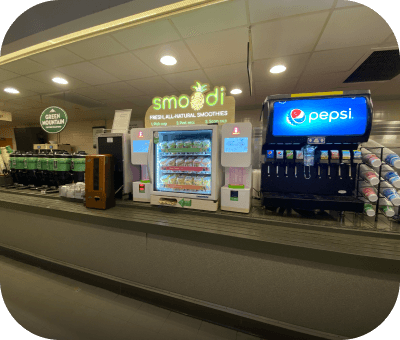
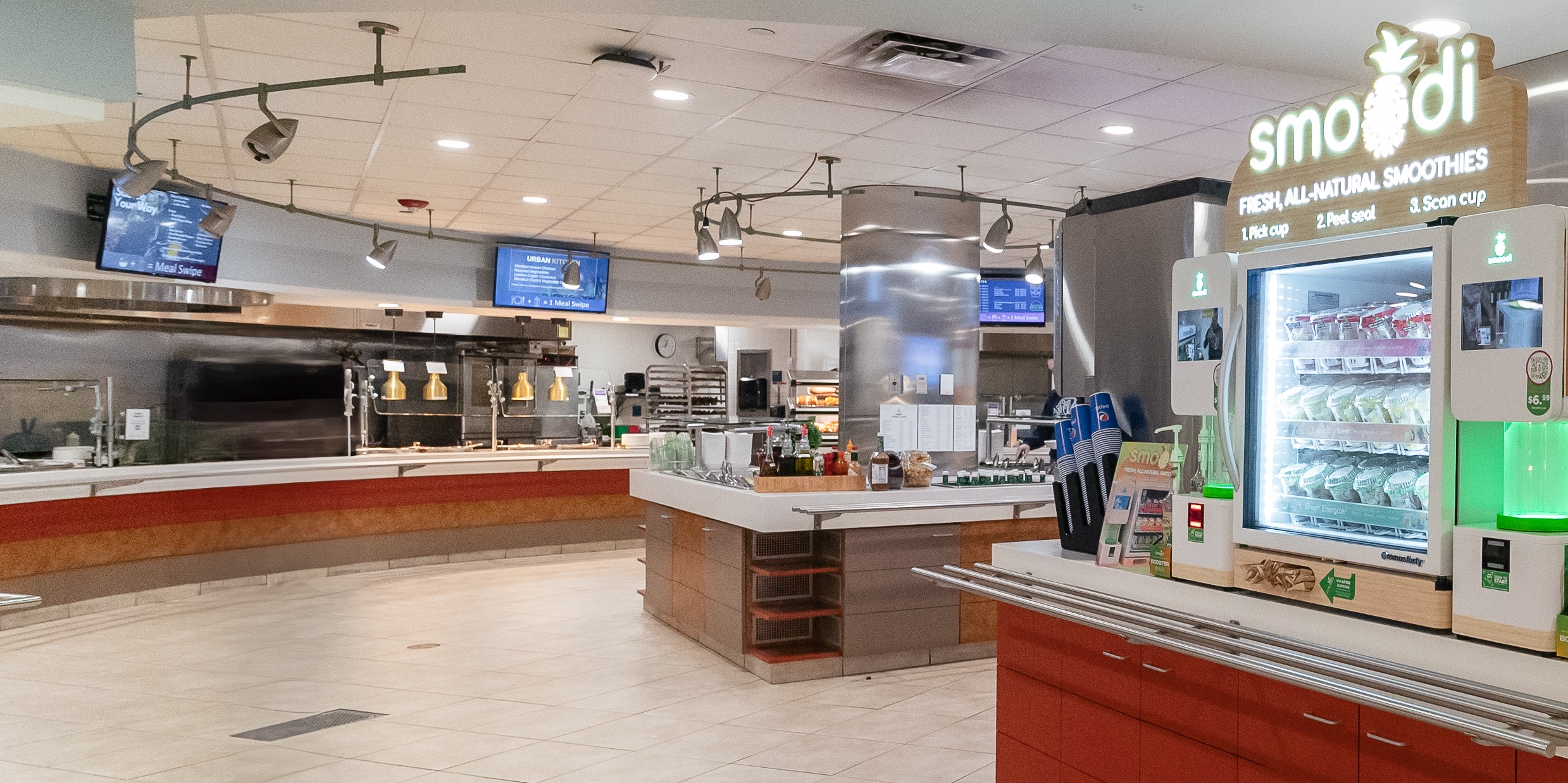
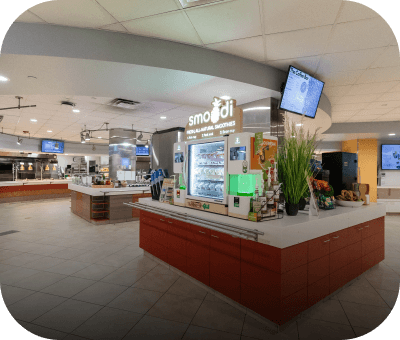
Smoodi's automated smoothie machine meets every requirement for deploying fresh nutrition in institutional settings where traditional foodservice cannot reach. Each smoothie is blended from IQF (individually quick frozen) real fruit cups with water only. No syrups, concentrates, or artificial ingredients. The machine self-cleans between every use and requires zero dedicated staff. The compact design requires approximately 40 inches of floor space, fitting in hallways, lobbies, break rooms, and satellite locations without renovation.
"Campus dining is continuously evolving and as operators we have a rising bar to meet the needs of our guests. We've been able to provide a quality smoothie experience while leaning into a labor-saving technology."
— Dustin Peterson, Director of Retail Operations, Rochester Institute of Technology
IQF fruit cups have a shelf life of up to two years, enabling monthly or even quarterly restocking that eliminates cold-chain dependence. Distribution is through Dot Foods, the largest foodservice redistributor in the United States, ensuring reliable supply to locations across the country. The booster bar offers protein powder, collagen, and other functional supplements, turning each smoothie into a customizable functional nutrition option.
Smoodi operates in more than 300 locations across the United States, with over 2 million smoothies served. The company was founded at Harvard Innovation Labs. The operational lease starts at $299 per month for a 48-month term, with a purchase option at $14,999. For institutions looking to bring fresh nutrition to locations where traditional foodservice cannot reach, more information is available at getsmoodi.com/get-started.
Ready to bring Smoodi to your location?
Join hundreds of operators delivering fresh, automated smoothies with zero labor.
Get Started