What Should Airport Food Programs Offer in 2026?
The airport quick-service restaurant market is valued at $41.4 billion in 2026. Grab-and-go concepts with compact footprints are emerging as the highest-revenue format per square foot for concession operators.
The airport quick-service restaurant market is valued at $41.4 billion in 2026, projected to reach $58 billion by 2034 at a 4.3 percent compound annual growth rate. For concession operators and airport authority food program managers, this growth creates both opportunity and pressure. Travelers increasingly expect fresh, healthy, convenient food options that fit into tight boarding windows. Airport operators face a unique set of constraints that traditional foodservice models struggle to address: limited square footage at premium rents, extreme variability in foot traffic between peak and off-peak hours, high labor costs in airport environments, and the need for speed that matches a 20-minute boarding window.
Why Are Airport Food Programs Under Pressure to Change?
Airport dining has historically been dominated by full-service restaurants, branded fast-food outlets, and packaged grab-and-go counters. Each of these formats carries significant limitations in the current environment. Full-service restaurants require substantial square footage, dedicated kitchen infrastructure, and large staffing teams. Branded fast-food outlets demand franchise fees, specialized equipment, and consistent labor coverage. Packaged grab-and-go counters offer convenience but limited freshness and low perceived value.
The pressure to change comes from three directions. First, traveler expectations have shifted. Health-conscious consumers now represent a majority of the traveling public, and they expect fresh, recognizable food options even in an airport. Second, airport authorities are renegotiating concession agreements with an emphasis on revenue per square foot rather than simply filling terminal space. Third, labor availability in airport environments is particularly constrained. Airport workers often require security clearances, face long commutes to terminal locations, and command premium wages. Every staffed station adds a fixed cost that operates whether the gate area is full or empty.
What Makes Grab-and-Go the Highest-Revenue Airport Format?
Grab-and-go concepts are emerging as the highest-revenue format per square foot in airport concession programs. The economics are straightforward: a grab-and-go station occupies a fraction of the space required by a sit-down restaurant while serving a comparable number of customers per hour. In a terminal where rent is measured in hundreds of dollars per square foot annually, space efficiency directly translates to profitability.
The format also matches how travelers actually behave. Most airport food purchases happen in a narrow window: the 15 to 30 minutes between clearing security and boarding. Travelers are not looking for a dining experience. They want something fresh, healthy, and fast enough to carry to the gate. A format that delivers a finished product in under 60 seconds aligns perfectly with this behavior pattern.
Self-service grab-and-go formats add another advantage: they eliminate the labor bottleneck during peak hours. When three flights are boarding simultaneously, a staffed counter with two employees creates a line. A self-service station allows multiple travelers to serve themselves concurrently, capturing revenue that would otherwise walk past.
What Constraints Do Airport Concession Operators Face?
Airport concession operators face constraints that are more severe than almost any other foodservice environment. Understanding these constraints is essential for evaluating which food program formats will succeed in a terminal setting.
- Space is the most expensive variable. Airport terminal rents often exceed $200 per square foot annually, making every inch of equipment footprint a direct cost. Formats that require 200 or more square feet of dedicated space carry a proportionally higher breakeven threshold.
- Labor is scarce and expensive. Airport foodservice workers require badging and security clearances, which adds weeks to the hiring process. Turnover is high because of long commutes to airport locations. Staffing a single station for all operating hours costs $40,000 to $60,000 or more annually in airport wage markets.
- Demand is highly variable. A gate area may have 300 travelers for 20 minutes before a boarding call, then sit empty for an hour. Equipment and formats that cannot scale up and down with this variability either miss peak revenue or carry idle costs during troughs.
- Health and safety standards are strict. Airport food programs must meet both local health department requirements and TSA security protocols. Equipment that self-cleans and maintains food safety without manual intervention reduces compliance risk.
- Supply chain logistics are complex. Deliveries to airport terminals require security clearance, scheduled dock access, and often elevator transport to gate-level locations. Ingredients with long shelf life reduce delivery frequency and simplify logistics.
How Does Healthy Food Fit the Airport Traveler Profile?
The traveler demographic skews toward health-conscious consumers more than the general population. Business travelers, who account for a disproportionate share of airport food spending, tend to be educated, higher-income, and wellness-oriented. They are the same consumers driving the growth of functional beverages, clean-label products, and protein-enriched foods in every other foodservice channel.
Family travelers represent another key segment. Parents making food choices for children in an airport are actively looking for options that are fresh, recognizable, and free from artificial ingredients. A smoothie made from real fruit is an easier decision than navigating the ingredient list of a packaged snack bar.
The 18 percent of American adults currently using GLP-1 medications adds another layer. These travelers specifically seek low-sugar, high-protein, nutrient-dense options and will bypass traditional airport food if those options are not available. For concession operators, missing this demographic means missing a growing and high-spending consumer segment.
How Can Operators Handle Peak Boarding Traffic?
Peak traffic management is the defining operational challenge in airport foodservice. A gate area that is empty at 9:00 AM may have 250 travelers at 9:15 AM, all of whom need to board by 9:45 AM. Any food format that creates a bottleneck during this window loses revenue and frustrates customers.
The solution is modular, scalable equipment that can serve multiple customers simultaneously without additional staff. Rather than deploying one large piece of equipment or one staffed counter, operators can install multiple compact units side by side. Each unit serves customers independently, so throughput scales linearly with the number of units. Two units double capacity. Three units triple it. The modular approach also provides redundancy: if one unit is being serviced, the others continue operating.
This modular capacity model is particularly valuable for airport operators because it allows them to match equipment investment to actual demand data. A gate area with moderate traffic starts with one or two units. If sales data justifies expansion, additional units can be added in the same footprint without renovation or new utility connections.
How Does Smoodi Address Airport Food Program Needs?
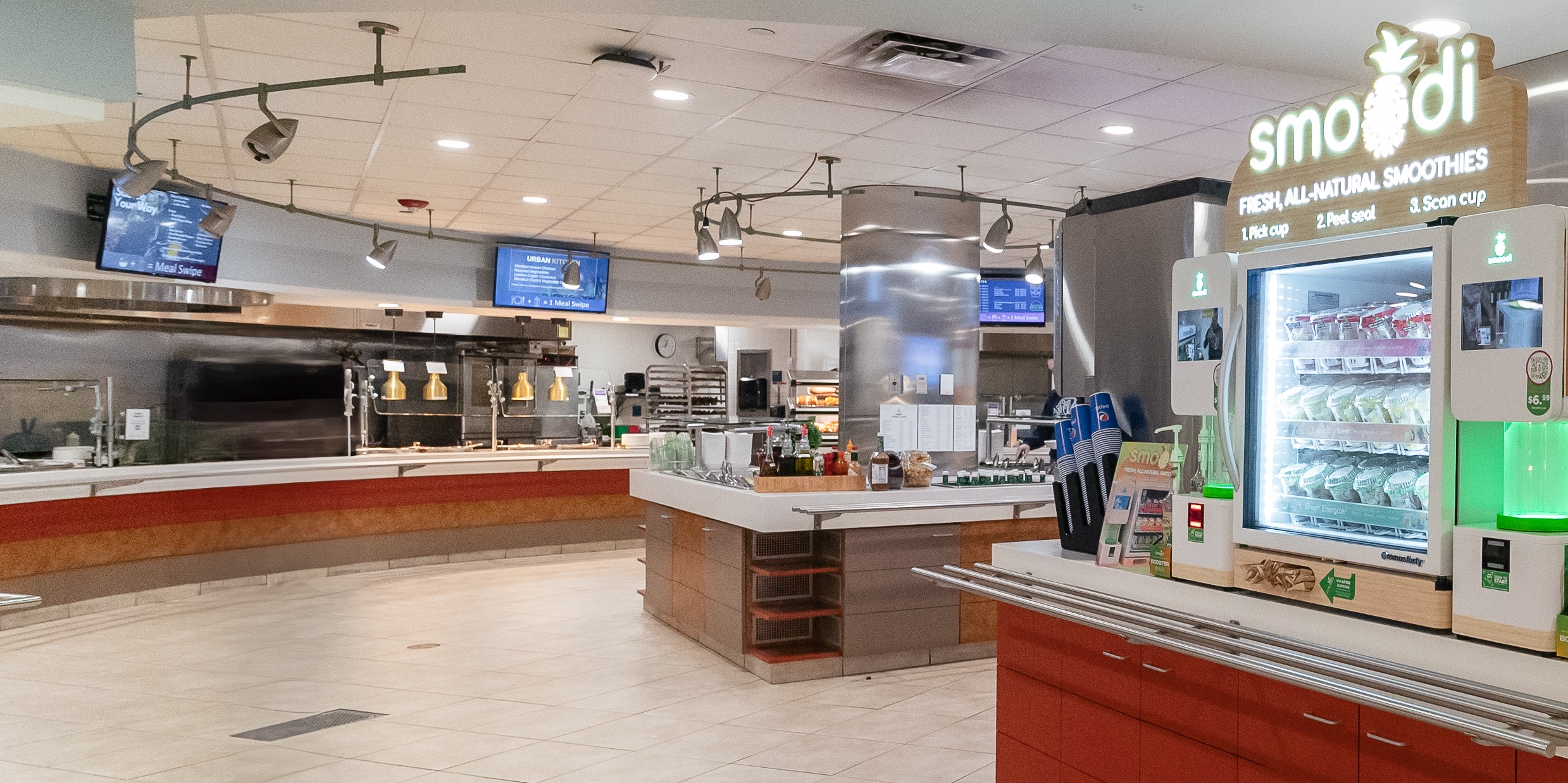
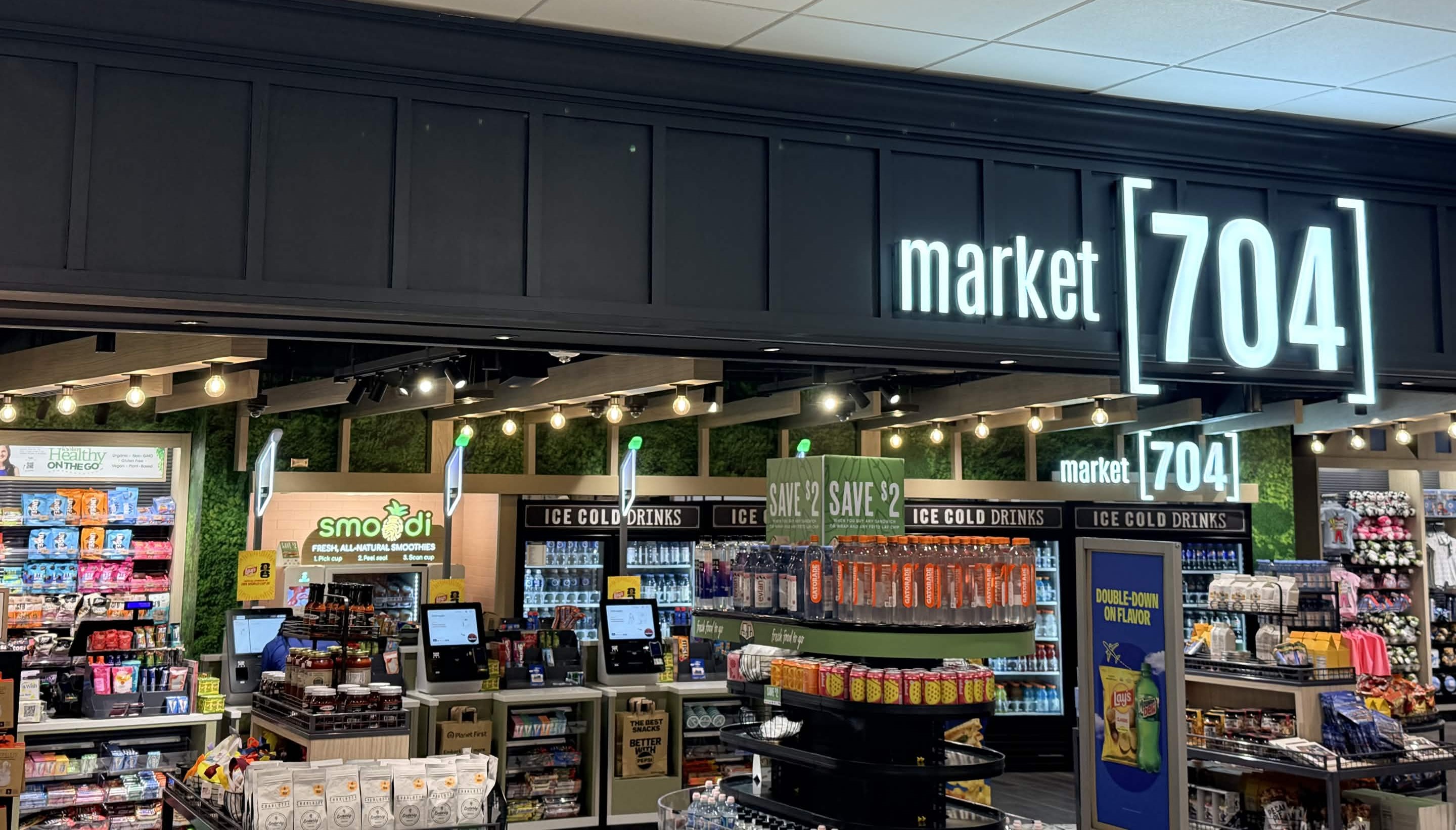
Smoodi's automated smoothie machine addresses every constraint that airport concession operators face. The compact design requires approximately 40 inches of floor space, making it one of the smallest footprint food stations available for terminal deployment. In an environment where rent exceeds $200 per square foot, the space efficiency directly improves revenue per square foot metrics.
"We were looking for quick, healthy options for our customers and smoodi ticked all the boxes. It's quick, self-service, and does the job. The feedback has been great - the lines say it all."
— Jim Launer, President, Spooky Nook Sports
Each smoothie is blended from IQF (individually quick frozen) real fruit cups with water only in under 60 seconds. No syrups, concentrates, or artificial ingredients. The machine self-cleans between every use, eliminating the need for a dedicated attendant to maintain food safety standards. For airport operators, this means zero labor cost for the station, zero food safety risk from manual handling, and a product that meets the health expectations of every traveler demographic.
IQF fruit cups have a shelf life of up to two years, which transforms airport supply chain logistics. Instead of daily deliveries of perishable ingredients requiring cold-chain management through security checkpoints, operators can stock weeks or months of inventory in ambient storage. Distribution is through Dot Foods, the largest foodservice redistributor in the United States.
For high-traffic gate areas, multiple Smoodi machines can be installed side by side in the same footprint as a single competitor kiosk, blending simultaneously to handle peak boarding rushes. Smoodi operates in more than 300 locations across the United States, with over 2 million smoothies served. The company was founded at Harvard Innovation Labs. The operational lease starts at $299 per month for a 48-month term, with a purchase option at $14,999. The booster bar offers protein powder, collagen, and other functional supplements for travelers who want to customize their nutrition.
Airport concession operators and food program managers evaluating compact, self-service nutrition options for terminal deployment can explore options at getsmoodi.com/get-started.
Ready to bring Smoodi to your location?
Join hundreds of operators delivering fresh, automated smoothies with zero labor.
Get Started