What Makes the Automatic Smoothie Machine Market a $4.2 Billion Opportunity?
The global smoothie machine market reached $4.21 billion in 2024, with the automatic segment growing at 12.5% CAGR through 2033. Here is what operators and investors should know about this fast-growing equipment category.
The global smoothie machine market was valued at $4.21 billion in 2024, and the automatic segment of that market is growing at a compound annual growth rate of 12.5% through 2033, according to PMarketResearch. The broader fully automatic beverage machines market reached $7.18 billion in 2026 and is projected to hit $9.72 billion by 2035. These figures point to a structural shift in how foodservice operators approach beverage equipment investment.
This is not simply growth in beverage consumption. It is growth specifically in automated equipment, driven by labor economics, consumer expectations, and technological advancement. For operators evaluating capital allocation and for investors assessing foodservice technology, the automatic smoothie machine market represents one of the fastest-growing segments in commercial foodservice equipment.
What Is Driving Equipment Market Growth?
Three forces are converging to accelerate investment in automated smoothie equipment. The first is the persistent labor shortage in foodservice. Finding, training, and retaining staff for beverage preparation has become increasingly difficult and expensive. Automated equipment that eliminates the labor requirement for beverage production allows operators to offer smoothie programs without competing for scarce foodservice workers.
The second force is consumer demand for healthy, functional beverages. The smoothie product market itself is valued at $27.35 billion in 2026 and growing at 7.2% annually. Consumers want nutrient-dense, customizable beverages with clean ingredients. Automated equipment that can deliver this quality consistently, without the variability introduced by manual preparation, meets a real consumer need.
The third force is the expansion of automated beverage equipment from traditional venues like malls and food courts into new environments. Gyms, hospitals, airports, university campuses, corporate offices, grocery stores, and convenience stores are all adding automated beverage options. This venue expansion multiplies the addressable market for equipment manufacturers and creates new installation opportunities that did not exist five years ago.
Technology Features Shaping the Market
Modern automatic smoothie machines have evolved significantly from early-generation equipment. Several technology features are becoming standard across the category and are influencing purchasing decisions:
- Automated self-cleaning between servings eliminates manual hygiene workflows and ensures food safety compliance
- IoT-enabled remote monitoring allows operators and manufacturers to track machine performance, inventory levels, and maintenance needs in real time
- Compact form factors enable installation in spaces where traditional smoothie bars would not fit
- Sealed ingredient systems reduce cross-contamination risk and simplify inventory management
- Functional add-on capabilities, such as booster bars for protein, collagen, and supplements, enable hyper-personalization
Equipment buyers increasingly evaluate these features as requirements rather than differentiators. Self-cleaning, in particular, has become a baseline expectation for any automated food equipment, driven by updated FDA Food Code requirements and heightened consumer awareness of food safety.
Where Smoodi Fits in the Equipment Market
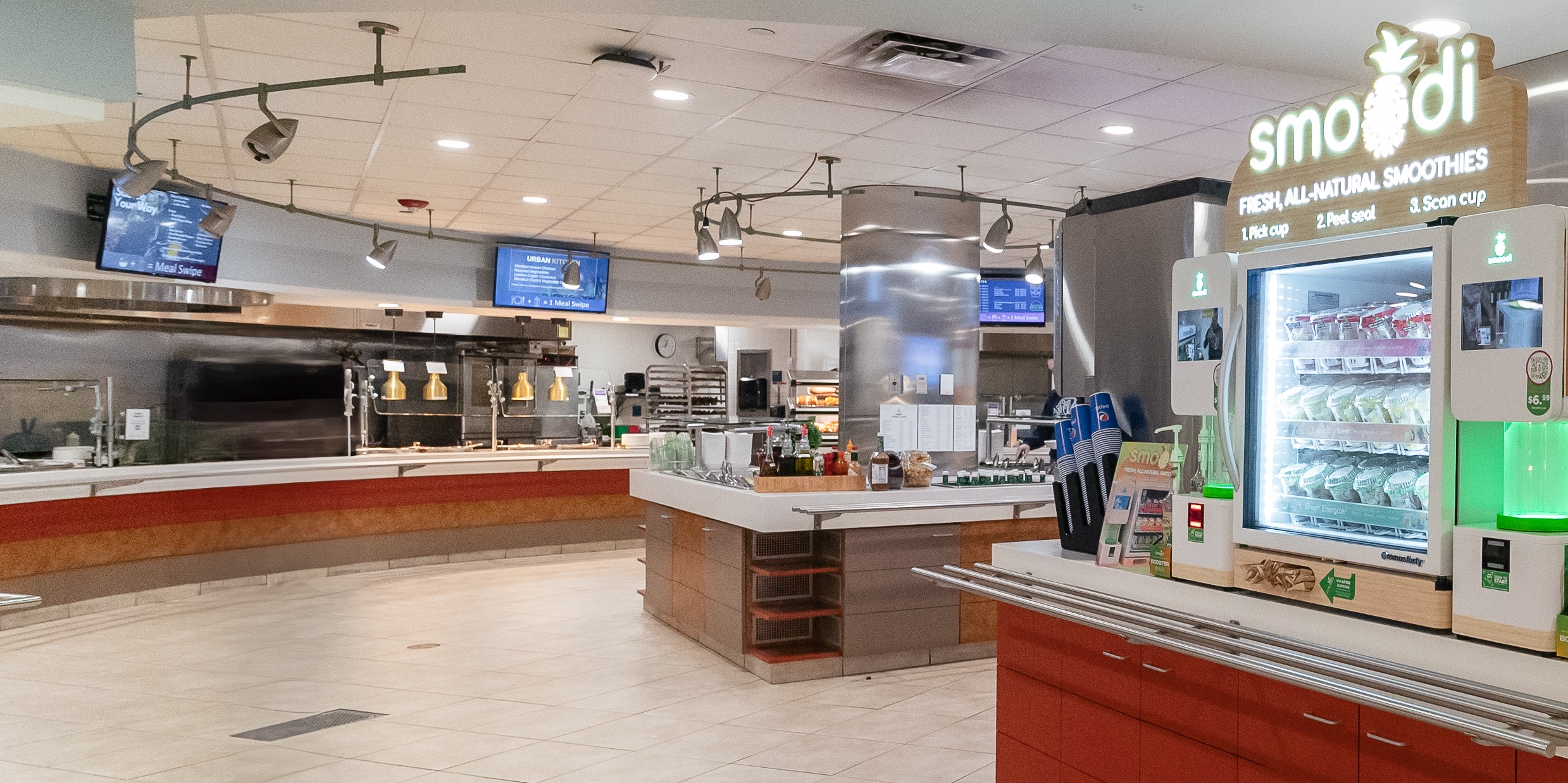
Smoodi occupies a specific position in the automated smoothie equipment market that addresses several of the key purchase criteria operators use when evaluating equipment investments. The machine is compact, requiring approximately 40 inches of floor space, which enables installation in venues and locations where larger kiosk-format equipment would not be practical.
The self-cleaning function operates between every single use, not just at the end of the day or between dayparts. This continuous cleaning approach exceeds the industry standard and simplifies food safety compliance. The sealed IQF fruit cup system means there are no bulk ingredient bins to manage, no cross-contamination vectors from open containers, and no spoilage from unused perishable ingredients.
For high-volume locations, Smoodi's approach to scaling is distinctive. Rather than building a larger, more complex machine to handle peak demand, multiple Smoodi machines can be installed side by side in the same footprint that a single competitor kiosk would occupy. Each machine operates independently, blending simultaneously, so throughput scales linearly without single points of failure.
The Investment Case for Automated Smoothie Equipment
Operators evaluating automated smoothie equipment investments should consider the total cost of ownership rather than just the purchase or lease price. Smoodi's operational lease starts at $299 per month for a 48-month term, with shorter terms available up to $499 per month for 12 months. Purchase pricing starts at $14,999. These costs should be weighed against the alternative: staffing, equipping, and operating a traditional smoothie program.
The labor savings alone can justify the equipment investment. A single smoothie station employee costs $30,000 to $50,000 or more annually in wages and benefits. Smoodi's self-service model eliminates this cost entirely. Combined with zero ingredient waste from sealed, pre-portioned cups with a two-year shelf life, the operational cost per serving is significantly lower than manual alternatives.
Distribution through Dot Foods provides nationwide supply chain access for the IQF fruit cups, simplifying procurement for multi-location operators. The ingredient story (real fruit, blended with water, no syrups or concentrates) supports premium positioning and consumer trust, which translates to higher average transaction values compared to commodity beverage options.
"Campus dining is continuously evolving and as operators we have a rising bar to meet the needs of our guests. We've been able to provide a quality smoothie experience while leaning into a labor-saving technology."
— Dustin Peterson, Director of Retail Operations, Rochester Institute of Technology
Market Segments With the Highest Equipment Demand
Within the automatic smoothie equipment market, certain venue categories are driving disproportionate demand growth. University and college campuses represent one of the strongest segments, driven by student demand for healthy, convenient food options and institutional pressure to modernize dining programs. Hospitals and healthcare facilities are another high-growth segment, fueled by CMS quality requirements and patient satisfaction initiatives.
Corporate offices investing in employee wellness programs represent a growing segment, particularly as companies compete for talent by offering workplace amenities. Fitness centers, gyms, and athletic clubs continue to be natural venues for smoothie equipment, with member expectations for post-workout nutrition driving consistent demand. Grocery and convenience stores, airports, and travel hubs round out the high-growth segments as consumers expect healthy grab-and-go options in every environment.
With over 300 locations across the US and more than 2 million smoothies served, Smoodi has established a presence across many of these high-growth segments. Founded at the Harvard Innovation Labs, Smoodi was designed to make automated smoothie service operationally simple, nutritionally excellent, and financially compelling. The 12.5% CAGR in the automatic smoothie machine market suggests that operators who invest in this equipment category now are positioned to benefit from sustained growth through the end of the decade and beyond. Visit getsmoodi.com/get-started to learn more.
Ready to bring Smoodi to your location?
Join hundreds of operators delivering fresh, automated smoothies with zero labor.
Get Started