How Are Rising Food Costs Changing College Dining?
College dining directors face rising ingredient costs and labor shortages while students demand smoothies, high protein, and clean eating options.
College dining operations in 2026 face a financial environment that is testing the limits of traditional foodservice models. Ingredient costs continue to rise. Labor shortages persist across the foodservice industry, with campus dining competing against restaurants, hospitals, and corporate food programs for the same shrinking pool of workers. Enrollment fluctuations create demand variability that makes menu planning and staffing even more difficult. TotalFood 2026 industry analysis highlights these converging pressures as defining challenges for institutional foodservice operators.
At the same time, student expectations for food quality and variety have never been higher. Chartwells Higher Education CDI 2026 data shows that smoothies are the number one requested beverage on campus at 45 percent. High protein is the number one dietary preference at 28 percent. Clean eating demand has increased 40 percent year over year. Students want fresh, whole-ingredient, nutritionally dense options, and they evaluate their dining program (and by extension, their university) based on whether these options are available.
For dining directors, CFOs, and university administrators, the question is how to meet rising student expectations while controlling costs that are already straining budgets. The answer requires rethinking which menu items are prepared by staff with fresh ingredients and which can be delivered through automated, pre-portioned formats that eliminate labor and waste variables.
What Is Driving Food Cost Increases in Campus Dining?
Several factors are compounding food cost pressure for college dining programs in 2026.
Ingredient Price Inflation
Fresh produce, dairy, and protein prices have increased steadily since 2022. While the rate of increase has moderated from the peaks of 2022 and 2023, prices have not returned to pre-pandemic levels and show no indication of doing so. For campus dining operations that purchase large volumes of fresh ingredients, even a 3 to 5 percent annual increase compounds into significant budget pressure over a multi-year meal plan cycle.
Labor Costs and Shortages
Campus dining operations compete for hourly foodservice workers in markets where restaurants, hospitals, and corporate campuses are offering competitive wages and benefits. Many universities have raised dining worker pay to $16 to $20 per hour (or higher in high-cost markets), yet still struggle to fill positions. The labor shortage forces dining programs to reduce operating hours, simplify menus, or close satellite locations, all of which reduce the service level that students receive.
The labor challenge is particularly acute for positions that require food preparation skills. A smoothie bar that requires trained staff to handle fresh fruit, measure portions, operate blenders, and clean equipment between orders is one of the most labor-intensive menu stations in a campus dining hall. Each smoothie served by a staff member carries a labor cost that can exceed the ingredient cost.
Enrollment Variability
University enrollment fluctuations create demand uncertainty that complicates food purchasing and staffing decisions. A dining program that plans for 5,000 meal plan participants and enrolls 4,600 faces a 8 percent revenue shortfall against fixed infrastructure and staffing costs. Conversely, unexpected enrollment growth strains capacity. Fresh ingredient programs are particularly vulnerable to demand variability because perishable inventory cannot be scaled up or down quickly without waste.
What Do Students Actually Want?
The Chartwells CDI data provides a clear picture of student food preferences that dining directors must address.
- Smoothies: number one requested beverage at 45 percent, far ahead of coffee drinks, tea, and juice
- High protein: number one dietary preference at 28 percent, driven by fitness culture and awareness of protein's role in energy and concentration
- Clean eating: demand up 40 percent year over year, reflecting a generation that reads ingredient labels and rejects artificial additives, syrups, and concentrates
- Convenience: students want options available throughout the day, not limited to meal period hours, in locations across campus (not only the central dining hall)
- Speed: between classes, students have 10 to 15 minutes and need options they can grab without waiting in line
These preferences create a clear product profile: a fresh, whole-ingredient, protein-enriched, quickly prepared beverage available at multiple convenient locations across campus throughout the day. The challenge is delivering this product within the cost and labor constraints that dining programs face.
How Do Predictable Per-Serving Costs Help?
One of the most significant financial advantages of a pre-portioned, automated format is cost predictability. When a dining program purchases fresh fruit, the per-serving cost fluctuates with seasonal availability, supplier pricing, and spoilage rates. A batch of fresh strawberries purchased in January at winter pricing costs significantly more per smoothie than the same purchase in June. Spoilage adds another variable: fresh berries that are not used within days of delivery must be discarded, and the loss is absorbed into the program's food cost.
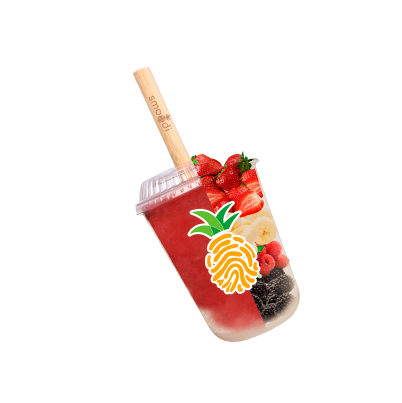
IQF (individually quick frozen) fruit cups eliminate this variability. Each cup contains a pre-portioned serving of flash-frozen fruit that is blended with water only. No syrups, concentrates, or artificial ingredients. The per-cup cost is fixed at the time of purchase and does not change based on season, demand, or how quickly the cups are used. With a shelf life of up to two years, there is zero spoilage risk. Cups that are not used during a slow week remain perfectly viable for months or years.
For a dining director building a budget for the next academic year, this predictability is transformative. Instead of estimating fresh fruit costs based on seasonal projections and historical waste rates, the smoothie program cost is a simple multiplication: number of cups ordered times the per-cup price. The booster bar (protein powder, collagen, and functional supplements) adds a known per-serving increment. The total per-serving cost is fixed, known, and does not vary.
"The investment into smoodi has been phenomenal. We broke even in the first couple of weeks."
— Linda Thacker, Director of Dining Services, Maryville University
What Is the Labor Savings Impact?
The labor savings from an automated smoothie station are substantial when calculated across an academic year. A staffed smoothie bar in a campus dining hall requires at least one dedicated employee during operating hours. At $17 per hour (a representative campus dining wage in 2026) for a 10-hour daily shift across a 200-day academic year, the labor cost for a single smoothie station is approximately $34,000 annually. This figure does not include benefits, payroll taxes, training costs, or management time for scheduling and oversight.
Smoodi's automated machine eliminates this cost entirely. The machine blends a smoothie in under 60 seconds and self-cleans between every use. Zero staff is required. For a dining program operating multiple smoothie stations across campus (main dining hall, student center, fitness center, residence hall), the aggregate labor savings can be $100,000 or more per year. These savings can be redirected to other menu initiatives, facility improvements, or absorbed as cost reduction.
The machine occupies approximately 40 inches of floor space, which means it can be placed in satellite locations (student centers, libraries, recreation facilities) where a full staffed smoothie bar would be impractical due to space and staffing constraints. This enables dining programs to expand their smoothie offering beyond the central dining hall without proportional labor increases.
How Does This Fit the Financial Model?
Smoodi's operational lease starts at $299 per month for a 48-month term, scaling to $499 per month for a 12-month term. The purchase option is $14,999. For university dining programs, the lease can be structured within the existing foodservice operating budget or, for self-operated programs, allocated as a capital-equivalent lease within dining services.
Universities can integrate smoothie purchases into the existing meal plan swipe system, allowing students to use their dining plan to purchase smoothies. This integration ensures that the smoothie program is funded through the same meal plan revenue that supports the rest of the dining operation, creating no incremental billing or payment infrastructure.
Cups are distributed nationally through Dot Foods, which many university dining programs already use as a distributor. This simplifies procurement by adding smoothie cups to an existing purchasing relationship rather than onboarding a new vendor.
Smoodi operates in more than 300 locations across the United States, with over 2 million smoothies served. The company was founded at Harvard Innovation Labs. For dining directors and university CFOs navigating the intersection of rising costs and rising student expectations, an automated smoothie program delivers the product students want most at a cost structure that the budget can sustain.
University dining directors, foodservice administrators, and campus CFOs interested in exploring an automated smoothie program can learn more at getsmoodi.com/get-started.
Ready to bring Smoodi to your location?
Join hundreds of operators delivering fresh, automated smoothies with zero labor.
Get Started