Do Food Amenities Drive Commercial Lease Renewals?
Food amenities are emerging as a top lease renewal driver in commercial real estate. Self-service stations offer a low-cost entry point for Class B and C properties.
Commercial property managers are under constant pressure to retain tenants. Replacing a commercial tenant costs up to three times more than retaining one, and vacancy recovery can take up to two years according to industry data from Cove.is. In a competitive real estate market, amenities are no longer optional differentiators. They are retention infrastructure. Among the amenity categories gaining traction, food and beverage programs are emerging as one of the strongest drivers of tenant satisfaction and lease renewal.
CBRE's 2026 analysis on food halls and asset value confirms that office brokers increasingly treat food access as a primary question during tenant negotiations. For Class A properties with full food halls, the answer is straightforward. For Class B and C properties without the space or budget for a dedicated food operation, the question presents a challenge. The properties that find cost-effective food amenity solutions will strengthen their tenant retention numbers. Those that dismiss the trend risk losing tenants to buildings that prioritize food access.
Why Are Food Amenities Linked to Lease Renewals?
Fooda's 2026 workplace research confirms that on-site food options show the fastest measurable impact on tenant satisfaction of any amenity category. The research also found that 51 percent of employees skip lunch at least once a week, which means tenants' employees are leaving the building to find food or going without entirely. Every lunch run that takes an employee out of the building for 30 to 45 minutes is a friction point that accumulates over the lease term.
Food amenities address this friction directly. When employees can access fresh, healthy options within the building, they stay in the building. They return to work faster. They associate the workspace, and by extension the property, with convenience and quality of life. These daily positive interactions compound into a broader satisfaction signal that influences the tenant's renewal decision.
The financial logic is clear. A property manager who spends $4,000 to $6,000 per year on a food amenity and retains a tenant paying $50,000 or more in annual rent has generated a significant return. Compare that to the cost of vacancy: lost rent, broker commissions, tenant improvement allowances for the replacement tenant, and the operational overhead of turnover. Food amenities are among the lowest-cost, highest-impact retention investments a commercial property can make.
What Food Amenity Models Work for Commercial Properties?
Full Food Halls and Cafeterias
Large Class A office buildings and mixed-use developments can support full food halls with multiple vendor stalls, seating areas, and dedicated kitchen infrastructure. These programs require significant capital investment, long-term vendor contracts, and ongoing management. They are effective tenant amenities but are financially viable only in large-footprint, high-occupancy properties.
Catered and Pop-Up Food Programs
Mid-size properties often use rotating catered lunch programs or food truck partnerships to provide variety without permanent infrastructure. These programs offer flexibility but create inconsistency. Tenants cannot rely on food availability every day, which limits the amenity's impact on daily routine and satisfaction.
Self-Service Micro-Amenities
The fastest-growing category is the self-service micro-amenity: compact, automated food and beverage stations that operate 24/7 with zero staff. These solutions require minimal floor space, no food service license, and no dedicated employees. For Class B and C properties that cannot support a full food hall, self-service stations represent an achievable entry point into the food amenity category.
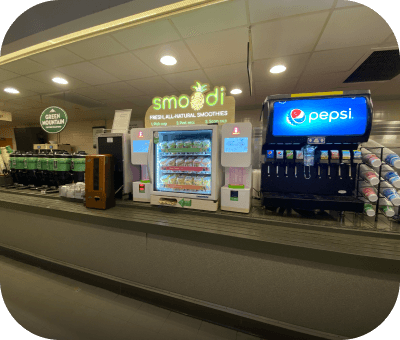
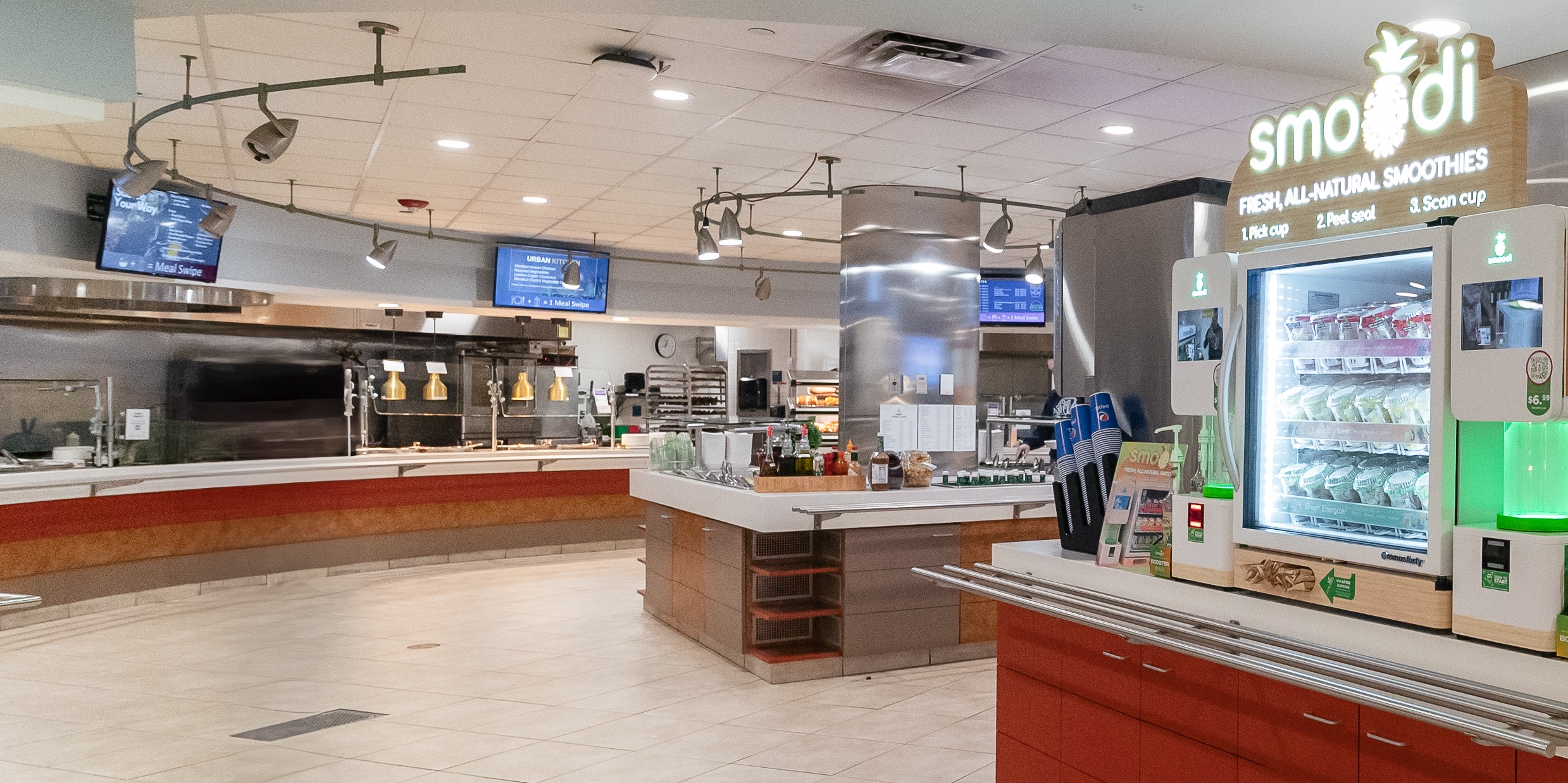
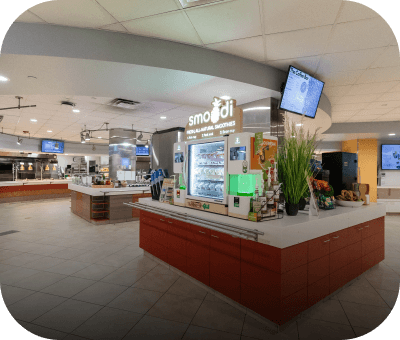
Smoodi's automated smoothie machine fits squarely in this micro-amenity model. The machine occupies approximately 40 inches of floor space, fitting into a lobby, break room, or common area. It blends a fresh, whole-fruit smoothie in under 60 seconds and self-cleans between every use. No staff is required for daily operation.
"smoodi is hands down the number one perk at our headquarters. Fresh, healthy, and zero effort on our end."
— Katherine Berman, Workplace Experience Manager, Toast
How Do Micro-Amenities Affect Tenant Perception?
Tenant satisfaction surveys consistently show that daily-use amenities have a greater impact on renewal intent than high-visibility but low-frequency amenities. A rooftop terrace or a conference center may impress during a property tour, but a food amenity that tenants' employees use every day creates ongoing value that reinforces satisfaction throughout the lease term.
A self-service smoothie station in the lobby or break area becomes part of the daily routine for building occupants. The employee who grabs a smoothie before a meeting, after a gym session, or as an afternoon pick-me-up develops a habit tied to the building itself. When the company's lease renewal comes up, that daily convenience is part of the tenant's overall assessment of the property.
For property marketing teams, a wellness-oriented food amenity is a tangible differentiator during tours and leasing presentations. Prospective tenants can see and try the product during their visit. The visual presence of a clean, modern smoothie station signals that the property invests in occupant wellness, a message that resonates with companies prioritizing employee health and satisfaction. Learn more about office deployment at getsmoodi.com/office.
What Is the Financial Case for Property Managers?
Smoodi's operational lease starts at $299 per month for a 48-month term, scaling to $499 per month for a 12-month term. The purchase option is $14,999. For property managers, the lease cost is a predictable operating expense comparable to other building amenities like fitness equipment maintenance or coffee service contracts. Operators can calculate the full financial picture at getsmoodi.com/roi.
Properties can structure the smoothie station as a complimentary tenant perk (absorbing the lease and cup costs as part of the amenity budget) or as a revenue-generating station (charging per smoothie and retaining the margin above costs). Either model works depending on the property's competitive positioning. In buildings where food access is a competitive differentiator, offering complimentary smoothies can justify higher rents or strengthen lease renewal negotiations. In properties with high foot traffic, a revenue-generating model can offset costs entirely.
IQF (individually quick frozen) fruit cups are blended with water only. No syrups, concentrates, or artificial ingredients. Cups have a shelf life of up to two years, which eliminates waste and simplifies inventory management. Distribution through Dot Foods provides a reliable national supply chain. The booster bar offers protein powder, collagen, and other functional supplements, extending the wellness value of the amenity.
Which Property Types Benefit Most?
Several commercial property segments are particularly well-positioned to use food amenities as lease renewal tools.
- Class B and C office buildings: properties that compete with Class A spaces on value rather than prestige can use a food amenity to close the gap in tenant experience without Class A infrastructure costs
- Suburban office parks: locations far from restaurant clusters leave tenants without convenient food options, making any on-site food access a significant differentiator
- Coworking and flexible workspace: members evaluate shared spaces partly on the quality of available amenities, and food access is consistently rated among the top priorities
- Mixed-use properties: residential and commercial tenants both benefit from on-site food options, and a smoothie station can serve both populations with a single installation
- Medical office buildings: healthcare professionals with limited break times value fast, healthy options available within the building
Smoodi operates in more than 300 locations across the United States, with over 2 million smoothies served. The company was founded at Harvard Innovation Labs. Installation requires a standard 120 VAC / 7A outlet, water connection (3/8 inch push-to-connect, 50 to 80 PSI), sanitizer inlet (1/4 inch push-to-connect), and drain (1 inch FNPT). Most commercial properties have these utilities available in common areas.
Commercial property managers and asset managers interested in exploring food amenities as a tenant retention strategy can learn more at getsmoodi.com/get-started.
Ready to bring Smoodi to your location?
Join hundreds of operators delivering fresh, automated smoothies with zero labor.
Get Started