Why Is 2026 the Tipping Point for Foodservice Automation?
Forty-six percent of operators plan to increase technology budgets in 2026. Among those already using automation, 61 percent report reduced food costs and 62 percent report reduced labor costs. The data says the tipping point is here.
Multiple data points are converging to mark 2026 as the inflection year for foodservice automation adoption. The National Restaurant Association reports that 46 percent of operators expect to increase technology budgets this year. Among operators already using automation, 61 percent report reduced food costs and 62 percent report reduced labor costs. Labor recruitment has surged from 18 percent to 33 percent as the number one operator challenge, and 89 percent of operators expect labor costs to continue rising. The self-service kiosk market has reached $28 billion, growing at over 11 percent annually. For operators still evaluating whether to invest in automation, the question has shifted from 'should we automate?' to 'what do we automate next?'
What Data Points Define the 2026 Tipping Point?
A tipping point in technology adoption occurs when the majority of a market shifts from evaluating a technology to planning to adopt it, and when early adopters report measurable, positive results that make the investment case self-evident. In foodservice, 2026 meets both criteria simultaneously.
On the adoption side, 46 percent of operators planning to increase technology budgets represents a near-majority that signals mainstream acceptance. This is not a figure driven by large chains alone. Mid-size operators, institutional foodservice providers, and independent locations are all contributing to the technology investment pipeline. The budget commitment is broad-based because the problem it addresses, labor cost and availability, is universal.
On the results side, the 61 percent food cost reduction and 62 percent labor cost reduction reported by automation adopters are the kind of numbers that eliminate debate. When nearly two-thirds of early adopters report material cost reductions, the risk calculation for non-adopters inverts. The risk is no longer 'what if the technology does not work?' The risk is 'what happens to our cost structure if competitors automate and we do not?'
Why Is Labor the Catalyst for Automation Adoption?
Labor has been the foodservice industry's most persistent challenge for years, but the severity in 2026 is qualitatively different from previous cycles. The number tells the story: labor recruitment at 33 percent as the number one operator challenge, nearly double the 18 percent level of just a few years ago. This is not a temporary shortage caused by pandemic disruption. It is a structural shift in the labor market that is not reversing.
The foodservice labor pool is shrinking for demographic and economic reasons that technology budgets cannot change. Birth rates are declining. Immigration patterns are shifting. Competing industries, from warehousing to gig work, offer comparable pay with fewer physical demands. The workers who remain in foodservice command higher wages, and 89 percent of operators expect those costs to continue rising. Every staffed station, every manual process, every position that requires a warm body adds a fixed cost that increases annually regardless of revenue.
Automation does not replace all labor. It replaces specific, repetitive tasks that are hardest to staff and most expensive to maintain. Self-service stations eliminate the need for a dedicated attendant. Self-cleaning equipment eliminates manual sanitation shifts. Shelf-stable ingredients eliminate the daily prep work that requires early-morning labor. The cumulative effect is a labor model that scales with demand rather than requiring a fixed headcount for all operating hours.
What Equipment Trends Are Emerging at Industry Events?
The NRA Show 2026 and other major industry events confirmed the direction of foodservice equipment investment. According to analysis from Parts Town and other industry observers, several trends define the equipment landscape.
- Compact, modular equipment is replacing large, single-purpose machines. Operators are choosing equipment that fits in tight spaces, serves multiple functions, and can be deployed in multiples as demand grows. The era of massive custom kitchen installations is giving way to plug-and-play units that can be operational in hours.
- AI-embedded controls are becoming standard, not premium. Equipment that monitors its own performance, adjusts settings based on usage patterns, and alerts operators to maintenance needs before failures occur is moving from innovation showcase to baseline expectation.
- Self-cleaning and self-sanitizing features are table stakes. Equipment manufacturers have recognized that cleaning labor is among the hardest to staff and the most critical for food safety compliance. Self-cleaning technology removes this requirement entirely.
- Beverage innovation is leading equipment investment. The functional beverage trend (29 percent year over year growth in foodservice) is driving demand for equipment that can produce fresh, customizable beverages on demand rather than dispensing pre-mixed products from bags or bottles.
- Chain and institutional buyers are driving volume. The largest equipment purchasing decisions are being made by multi-unit operators who can standardize on a single equipment platform across dozens or hundreds of locations, creating economies of scale in training, maintenance, and supply chain.
What Happens to Non-Automated Operations?
The gap between automated and non-automated foodservice operations is widening in 2026, and the consequences for non-adopters are becoming measurable. On one side of the gap, operators who have invested in automation report 61 to 62 percent cost reductions in food and labor. Their operations run longer hours without proportional staffing increases. Their food safety compliance is more consistent because automated processes do not skip steps when they are tired or rushed. Their product quality is more uniform because machines do not have good days and bad days.
On the other side, non-automated operations face the full force of rising labor costs, staffing shortages, and increasing compliance requirements. They cannot extend operating hours without adding shifts. They cannot maintain consistency across locations without intensive training programs. They lose customers to competitors who offer faster, more consistent, and more available food options. The competitive disadvantage compounds over time because the cost savings from automation are reinvested into better locations, marketing, and product development.
Over 40 percent of large-scale food operations now implement digital twin technology, creating virtual models of their physical operations to optimize everything from kitchen layout to staffing patterns. This level of operational sophistication is only possible in automated environments where data is captured at every step. Non-automated operations cannot access these optimization tools because they have no data to feed them.
How Does Smoodi Exemplify the Automation Tipping Point?
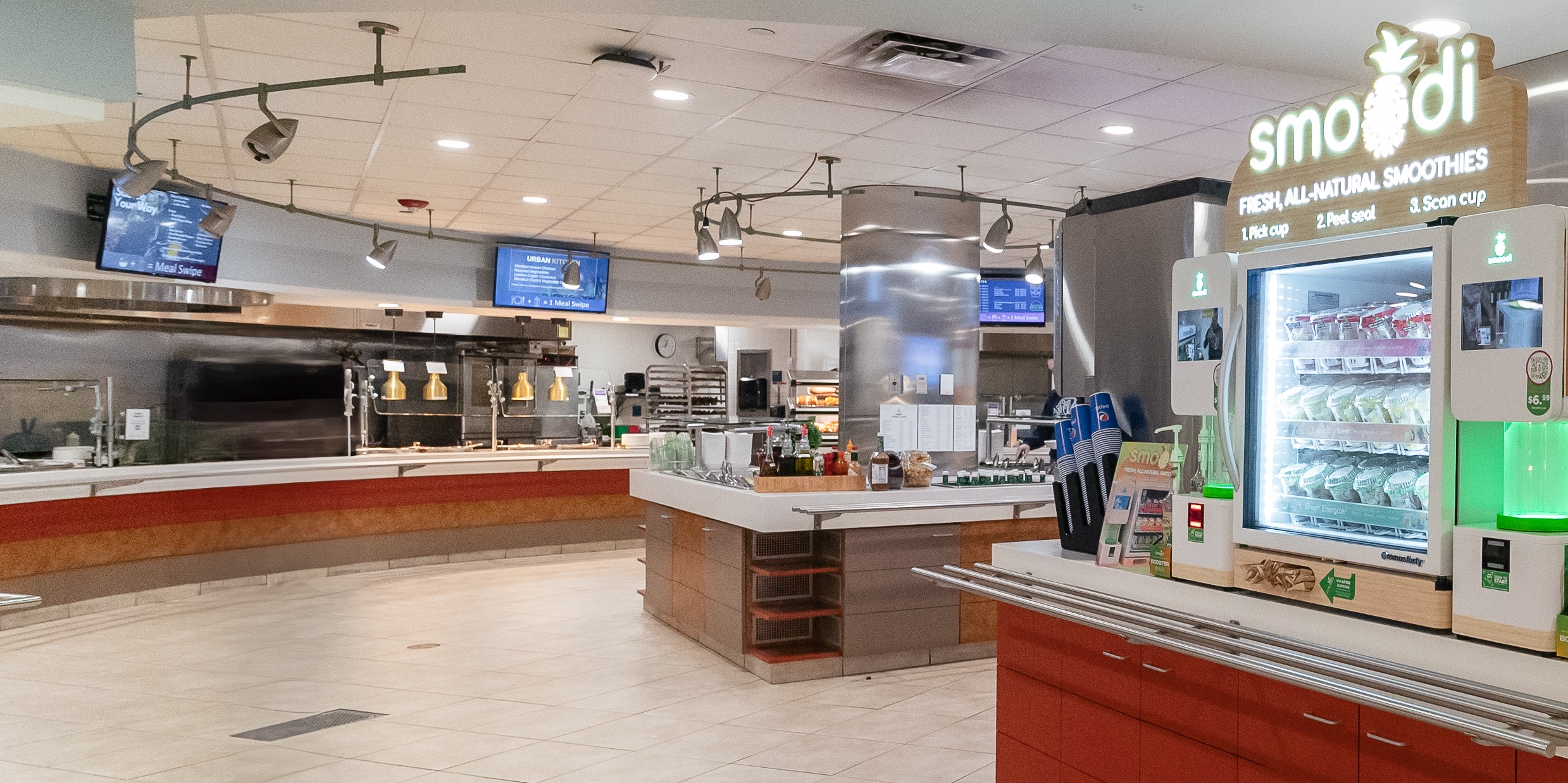
Smoodi's automated smoothie machine exemplifies every equipment trend that is driving the 2026 automation tipping point. The compact design requires approximately 40 inches of floor space, fitting the modular, space-efficient equipment profile that operators are demanding. The machine self-cleans between every use, eliminating cleaning labor entirely. It blends a fresh smoothie from IQF (individually quick frozen) real fruit cups with water only in under 60 seconds, with no staff required for operation.
"It's been a day and a half and we've sold over 1,000 pieces. It's been great. Install was very fast. Our guys love it."
— Hector Ortiz, Food Service Operations Manager, Baptist Health
For high-traffic locations, multiple Smoodi machines can be installed side by side in the same footprint as a single competitor kiosk, blending simultaneously. This modular scalability means operators can match capacity to demand without over-investing upfront. IQF fruit cups have a shelf life of up to two years, eliminating the perishable inventory and daily prep labor that traditional beverage programs require. Distribution is through Dot Foods.
Smoodi operates in more than 300 locations across the United States, with over 2 million smoothies served. The company was founded at Harvard Innovation Labs. The operational lease starts at $299 per month for a 48-month term, with a purchase option at $14,999. The booster bar offers protein powder, collagen, and other functional supplements, delivering the customizable functional beverage experience that consumers demand and that 29 percent year-over-year category growth reflects.
Operators ready to join the 46 percent investing in automation this year can explore options at getsmoodi.com/get-started.
Ready to bring Smoodi to your location?
Join hundreds of operators delivering fresh, automated smoothies with zero labor.
Get Started