What Are the Biggest Operator Challenges in Mid-2026?
Food costs are up 34 percent. Labor recruitment has surged to the number one operator challenge. The National Restaurant Association's mid-2026 data reveals that more than 90 percent of operators cite food, labor, insurance, and energy as significant cost pressures, and automation is emerging as the most effective response.
The foodservice industry entered 2026 facing a convergence of cost pressures that operators describe as unprecedented. The National Restaurant Association's mid-year data confirms what many operators already feel: more than 90 percent cite food costs, labor costs, insurance, and energy as significant challenges. Food costs alone have risen 34 percent compared to pre-pandemic levels. Labor recruitment, which ranked as a secondary concern just two years ago, has surged from 18 percent to 33 percent as the single most cited operator challenge. For facility managers, dining directors, and foodservice operators across every vertical, mid-2026 demands a fundamentally different approach to managing costs while maintaining service quality.
What Are the Top Cost Pressures Operators Face?
The cost landscape for foodservice operators in mid-2026 is shaped by four intersecting pressures, each reinforcing the others.
Food costs represent the most visible pressure point. Ingredient prices across most categories remain significantly elevated, with operators paying 34 percent more for food than they did before the pandemic. Supply chain disruptions, transportation costs, and input price volatility have all contributed. Operators who absorbed these increases in 2023 and 2024 expecting a correction have found that elevated prices appear structural rather than temporary.
Labor costs are rising at the same pace. Eighty-nine percent of operators expect labor costs to continue increasing through the end of 2026. The challenge extends beyond wages. Benefits, overtime, training costs, and the management overhead required to recruit, onboard, and retain staff in a tight labor market all contribute to a rising per-employee cost that many operations cannot sustain at current staffing levels.
Insurance and energy round out the top four pressures. Commercial insurance premiums have increased across the industry, and energy costs remain volatile. These fixed and semi-fixed costs compress margins further, leaving operators with less flexibility to absorb increases in food and labor.
Why Is Labor the Defining Challenge of 2026?
While food costs are high, operators can partially manage them through menu engineering, portion control, and supplier negotiation. Labor presents a qualitatively different challenge because it affects every aspect of operations simultaneously. A kitchen short-staffed by one person does not simply produce one fewer meal. It slows the entire line, increases wait times, raises error rates, and forces remaining staff into overtime, which increases costs and accelerates burnout.
The surge in labor recruitment as the top challenge reflects a market reality: qualified foodservice workers are scarce, and the competition for available talent is intense. Operators report that positions that once attracted dozens of applicants now draw single digits. Training timelines have lengthened as new hires arrive with less prior experience, and turnover rates remain elevated as workers move between employers for incremental wage increases.
For operators managing multiple locations, the labor challenge multiplies. Staffing variability between sites creates inconsistent service quality, and the management time required to address staffing gaps at individual locations diverts attention from strategic priorities.
How Is Automation Addressing These Challenges?
The data on automation adoption among foodservice operators tells a clear story. Among operators who have implemented automation, 61 percent report reduced food costs and 62 percent report reduced labor costs. These are not marginal improvements. They represent the two most significant cost categories in foodservice operations, addressed simultaneously through a single strategic shift.
Automation reduces food costs primarily through portion consistency and waste elimination. Automated systems dispense precise, pre-portioned servings every time, eliminating the over-portioning and ingredient waste that accumulate in manual operations. Over a month of high-volume service, the difference between a 15 percent waste rate (typical in manual operations) and a 2 to 3 percent waste rate (typical in automated operations) translates directly to margin improvement.
Automation reduces labor costs by eliminating the need for dedicated staff at specific service points. A self-service station that operates without an attendant removes a labor line item entirely, not just reducing it. For operators already struggling to fill positions, this is not merely a cost saving. It solves a staffing gap that may not be fillable at any wage level.
- Pre-portioned ingredients eliminate waste and control per-serving food costs
- Self-service formats remove the need for dedicated attendant staff
- Self-cleaning equipment eliminates end-of-shift cleaning labor
- Consistent output quality reduces error rates and customer complaints
- Extended operating hours become possible without adding shifts
What Should Operators Prioritize in Mid-2026?
Operators navigating mid-2026 cost pressures should evaluate their operations through two lenses: where are the highest labor-hours-per-revenue-dollar stations, and where is food waste highest. Stations that score poorly on both measures are the strongest candidates for automation.
Beverage stations represent a particularly strong automation opportunity. Traditional staffed beverage programs require a trained attendant during all operating hours, generate ingredient waste from over-pouring and spoilage, and demand cleaning labor at the end of every shift. An automated beverage station eliminates all three cost drivers while maintaining or improving product quality and consistency.
The evaluation should also consider the scalability of any solution. Operators with multiple locations benefit most from automation that can be standardized across sites, producing identical results regardless of local staffing conditions. Solutions that require specialized training or on-site technical expertise reintroduce the labor dependency that automation is intended to eliminate.
How Does Smoodi Help Operators Manage Costs?
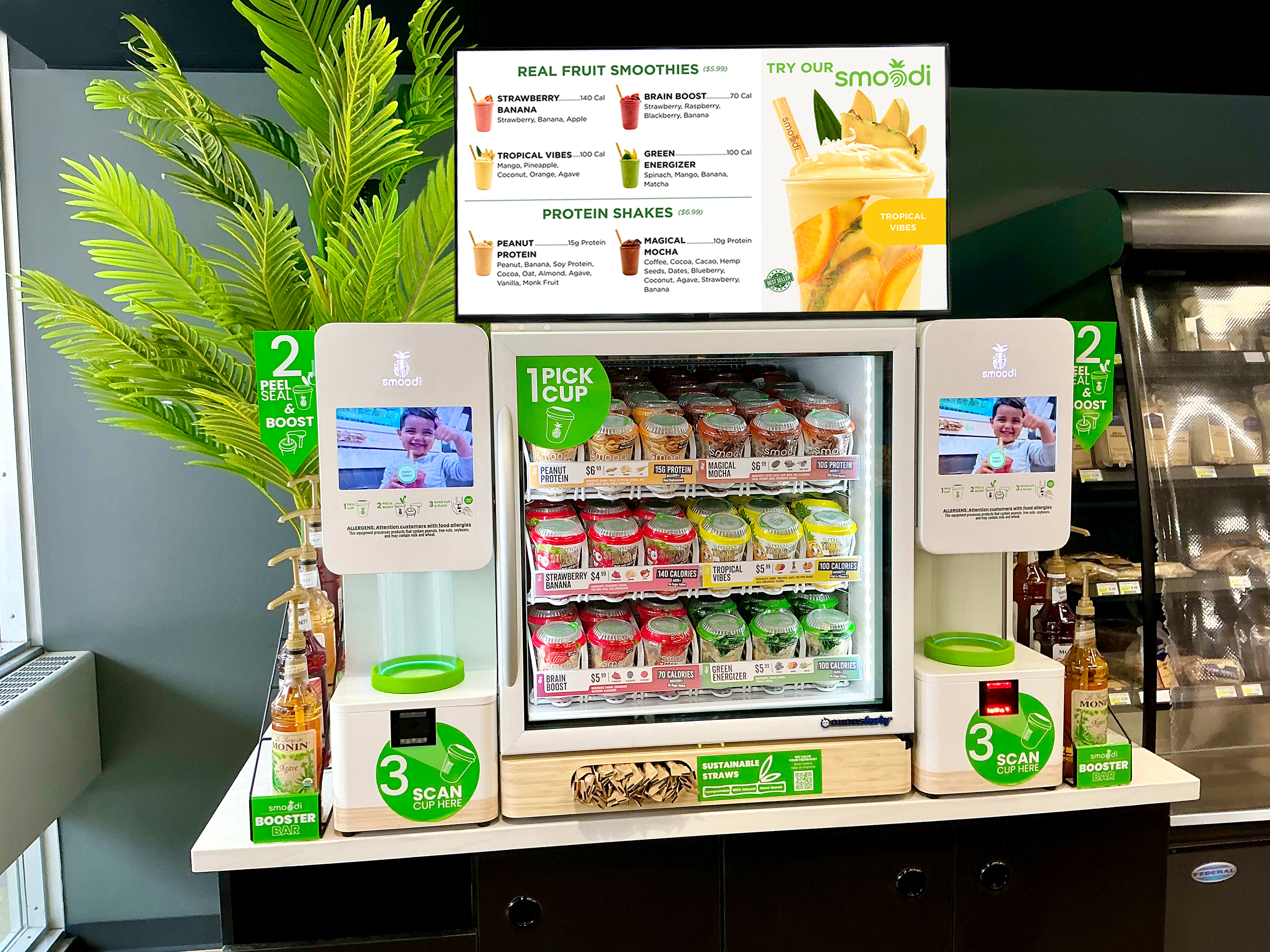
Smoodi's automated smoothie machine was designed to address the exact cost pressures operators face in 2026. Each smoothie starts with IQF (individually quick frozen) real fruit cups blended with water only. No syrups, concentrates, or artificial ingredients. Pre-portioned cups eliminate food waste entirely: every cup produces exactly one smoothie, with zero ingredient left over. The machine blends a fresh smoothie in under 60 seconds and self-cleans between every use, requiring no dedicated staff at any point in the service cycle.
"It's been a day and a half and we've sold over 1,000 pieces. It's been great. Install was very fast. Our guys love it."
— Hector Ortiz, Food Service Operations Manager, Baptist Health
Smoodi operates in more than 300 locations across the United States, with over 2 million smoothies served. The company was founded at Harvard Innovation Labs. The operational lease starts at $299 per month for a 48-month term, with a purchase option at $14,999. IQF fruit cups have a shelf life of up to two years and are distributed through Dot Foods, integrating with existing supply chains. The compact design requires approximately 40 inches of floor space. For high-volume locations, multiple machines can be installed side by side, blending simultaneously to match peak demand without adding staff.
Operators looking to reduce food and labor costs simultaneously can explore automated solutions at getsmoodi.com/get-started.
Ready to bring Smoodi to your location?
Join hundreds of operators delivering fresh, automated smoothies with zero labor.
Get Started