How Can Seasonal Venues Maximize Healthy Beverage Revenue?
Seasonal venues must generate maximum revenue in a compressed operating window. Automated smoothie stations solve the labor and waste challenges that make traditional beverage programs impractical for short seasons.
Seasonal venues operate under a constraint that year-round facilities do not face: every dollar of revenue must be earned within a compressed 10 to 16 week window. Summer camps, outdoor pools, beach clubs, seasonal resorts, waterparks, and outdoor recreation facilities all share this challenge. The food and beverage program must generate maximum revenue per operating day because there are no slow months to make up for underperformance. There are only months with zero revenue.
This compressed timeline creates specific requirements for any food or beverage addition. The program must start generating revenue on day one of the season. It cannot require extensive setup, staff training, or a long ramp-up period. And it must avoid the waste and spoilage that make fresh food programs financially risky in a seasonal context.
Why Do Traditional Beverage Programs Struggle in Seasonal Settings?
Traditional smoothie bars and staffed beverage programs face three structural challenges in seasonal venues.
Seasonal Labor Scarcity
Seasonal venues compete for a limited pool of temporary workers, many of whom are students or part-time employees available only during summer months. Hiring, training, and managing a beverage station operator for a 12-week season is expensive relative to the revenue window. If the employee leaves mid-season, replacement hiring in a thin labor market can leave the station unstaffed during peak weeks.
Ingredient Waste in Short Windows
Fresh fruit for smoothie programs has a shelf life measured in days. Ordering fresh produce for a seasonal venue means predicting demand week by week throughout a short season. Overorder, and the waste erodes margins. Underorder, and the station runs out of product during high-traffic days. Weather, events, and attendance variability make accurate forecasting difficult for any seasonal operation.
Capital Investment Risk
A seasonal venue that purchases beverage equipment outright faces a long payback period. If the equipment costs $15,000 and the venue operates 14 weeks per year, the operator needs multiple seasons to recoup the investment. If demand disappoints in the first season, the equipment sits idle for 38 weeks generating no return. The capital risk is disproportionate to the revenue opportunity for many seasonal operators.
What Are Guests at Seasonal Venues Looking For?
Guest expectations at seasonal venues have shifted significantly. Parents at summer camps want healthier options for their children, not just candy bars and sports drinks. Pool and beach club guests seek wellness-aligned refreshments that fit the health-conscious lifestyle they maintain the rest of the year. NielsenIQ Summer 2026 data identifies mid-afternoon as a key drinking moment for 40 percent of consumers in pool and outdoor spaces, representing a revenue opportunity that most seasonal concession programs are not capturing.
The gap between what guests want (fresh, healthy, Instagram-worthy beverages) and what most seasonal venues offer (packaged snacks and sugar-sweetened drinks) represents a revenue opportunity. Venues that fill this gap capture spending that guests would otherwise take elsewhere or forgo entirely.
What Makes a Beverage Program Work for Seasonal Operations?
A beverage program designed for seasonal venues must meet several criteria that differ from year-round operations.
- Zero labor requirement: the program must operate without dedicated staff, because seasonal labor is scarce and expensive for short employment windows
- Minimal waste: ingredients must have long shelf life so they can be pre-ordered for the full season without spoilage risk
- Fast setup: the program must be operational within days of season opening, not weeks
- Low or no capital investment: the cost structure must align with a 10 to 16 week revenue window, not a 52-week amortization schedule
- High-quality product: the output must match guest expectations for fresh, healthy, and visually appealing beverages
- Weather resilience: outdoor venues experience variable attendance. The program must handle high-traffic days without staffing up and low-traffic days without wasting inventory
How Does Smoodi Address Seasonal Venue Needs?
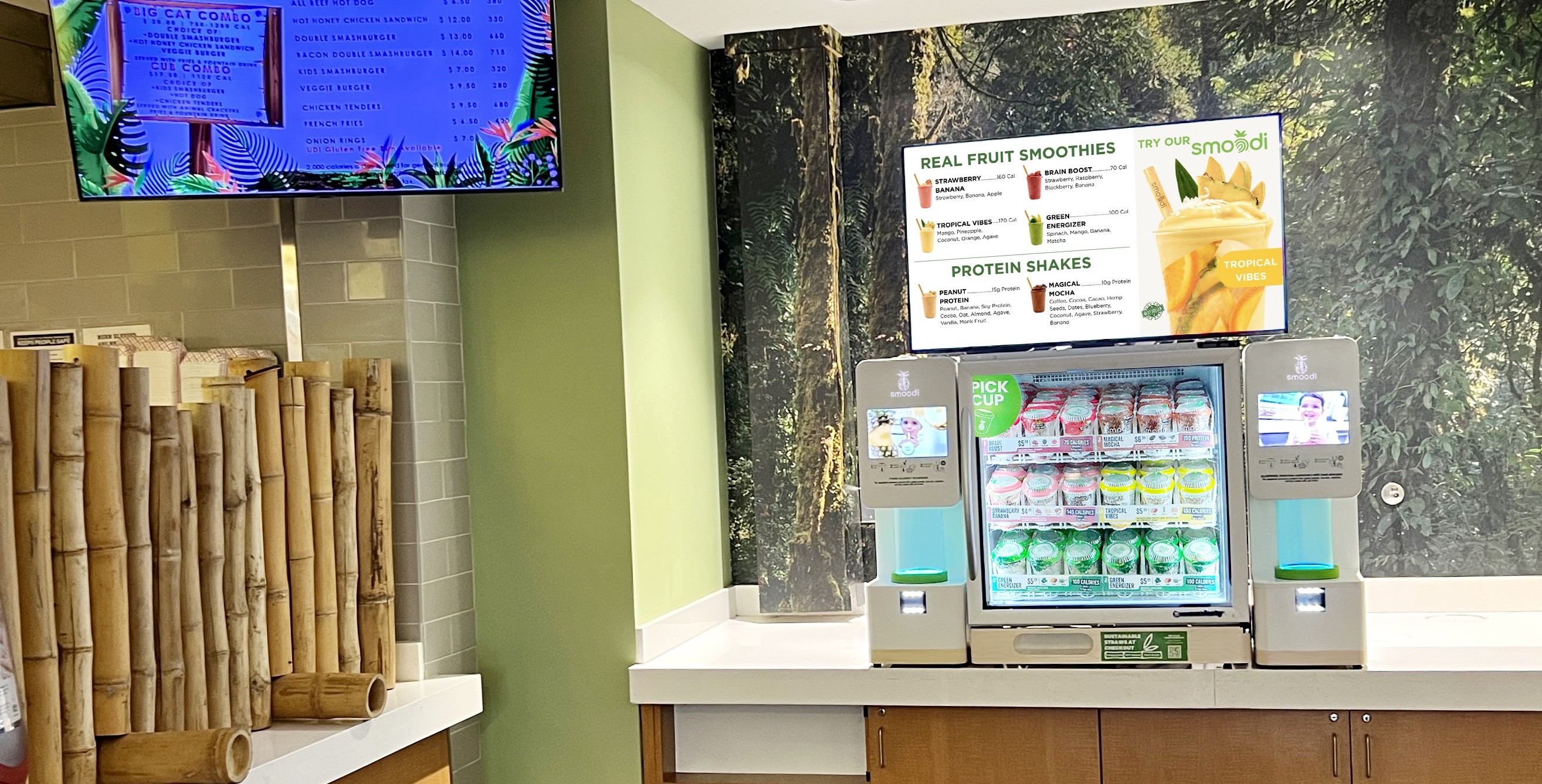
Smoodi's automated smoothie machine was designed for precisely the kind of high-variability, limited-labor environment that seasonal venues present. The machine blends a fresh, whole-fruit smoothie in under 60 seconds and self-cleans between every use. No dedicated operator is needed. The machine occupies approximately 40 inches of floor space, fitting into a concession area, pool deck, lobby, or recreation center without construction.
IQF (individually quick frozen) fruit cups have a shelf life of up to two years. A seasonal venue can pre-order cups for the entire season before opening day and store them in standard freezer space. There is no risk of spoilage, no need for weekly fresh produce deliveries, and no waste at the end of the season since unused cups remain usable the following year. Cups are blended with water only, with no syrups, concentrates, or artificial ingredients.
"I have been looking to add a smoothie bar for years but did not want to deal with the labor and food waste. Having smoodi in our facility is a huge benefit for our members."
— Adam Healy, General Manager, Waverly Oaks Athletic Club
The operational lease ($299 to $499 per month depending on term length) eliminates the capital investment risk that makes traditional beverage equipment impractical for seasonal operations. A seasonal venue can deploy the machine for the summer months without committing to a multi-year equipment purchase. The lease includes the machine, full service and maintenance, software updates, and support. Operators pay the lease plus cup costs and retain the margin on each smoothie sold.
For high-traffic days at pools, waterparks, and outdoor events, multiple machines can be installed side by side in the same footprint as a single competitor kiosk, blending simultaneously to eliminate queues during peak periods. The booster bar offers protein powder, collagen, and other functional supplements, adding premium upsell potential.
How Do Seasonal Operators Calculate the Revenue Opportunity?
The economics of a seasonal smoothie station depend on foot traffic, pricing, and the length of the operating season. As a reference framework, consider a seasonal venue with 200 to 500 visitors per day over a 14-week season. Even conservative conversion rates (5 to 10 percent of visitors purchasing a smoothie) generate meaningful revenue against the fixed costs of a lease and cup inventory.
The financial advantage of the automated model is that costs scale linearly with demand. There is no fixed labor cost that must be covered regardless of daily traffic. On a rainy day with low attendance, the only cost is the lease (which is fixed monthly) and the cups actually used (zero on a zero-sales day). On a record attendance day, the machine handles volume without overtime, additional staffing, or ingredient prep.
Smoodi operates in more than 300 locations across the United States, with over 2 million smoothies served. The company was founded at Harvard Innovation Labs. Distribution through Dot Foods provides reliable national supply chain coverage, including to seasonal and remote locations. Operators can calculate the revenue opportunity for their specific venue at getsmoodi.com/roi.
Planning for the Season Ahead
Seasonal venue operators who are mid-season can evaluate whether a smoothie station captures revenue during the remaining weeks. Those planning for the next season have the advantage of time: ordering equipment and cups in advance, identifying the optimal placement on their grounds, and promoting the addition to guests before opening day.
The key insight for seasonal operators is that the traditional barriers to adding a healthy beverage program (labor, waste, capital risk) are structural barriers of the staffed model, not inherent barriers of the category. An automated, zero-labor, zero-waste format removes each of those barriers, making a premium beverage program viable even within a compressed 10 to 16 week operating window.
Seasonal venue operators interested in exploring deployment for the current or upcoming season can learn more at getsmoodi.com/get-started.
Ready to bring Smoodi to your location?
Join hundreds of operators delivering fresh, automated smoothies with zero labor.
Get Started