How Are Tariffs Reshaping Operator Decisions?
Food costs are up 34 percent compared to pre-pandemic levels, and 68 percent of operators say tariffs have contributed to higher expenses. The operators controlling costs most effectively are those rethinking their equipment and supply chain strategies entirely.
Foodservice operators entered 2026 facing a cost environment unlike anything in the past three decades. Food costs have risen 34 percent compared to pre-pandemic levels, according to the National Restaurant Association. Sixty-eight percent of operators report that tariffs have contributed directly to higher food expenses. Supply Chain 24/7 reports that 73 percent of food companies expect tariffs to negatively impact their financial performance. And the impact is not finished: economists project a 12 to 18 month tariff lag, meaning the full cost effects will hit foodservice operations hardest in mid-to-late 2026.
For operators managing food programs at hotels, hospitals, corporate campuses, universities, and fitness centers, these numbers translate into a concrete operational challenge. Menu prices can only absorb so much inflation before consumer resistance sets in. Labor costs continue to rise in parallel. And the traditional responses (smaller portions, cheaper ingredients, reduced menu variety) all carry risks to consumer satisfaction and brand perception.
What Is Driving Foodservice Cost Inflation in 2026?
Tariff Effects on Food Supply Chains
The current tariff environment affects foodservice operations through multiple channels. Import duties on packaging materials, equipment components, and certain food ingredients raise costs at every stage of the supply chain. The 12 to 18 month lag between tariff imposition and full price realization means that costs announced in late 2025 are now flowing through to operator invoices in mid-2026. Operators who budgeted based on early 2025 pricing are discovering significant gaps between their projections and actual costs.
Labor Cost Escalation
Labor costs compound the tariff challenge. The National Restaurant Association reports that 89 percent of operators expect labor costs to continue rising. Labor recruitment has surged from 18 percent to 33 percent as the number one operator challenge in 2026. For food programs that depend on staffed preparation (smoothie bars, salad stations, made-to-order beverage programs), labor inflation doubles the cost pressure: the ingredients cost more and so does the person making the product.
Energy and Utility Increases
More than 90 percent of operators cite food, labor, insurance, and energy costs as significant challenges in the NRA's mid-year survey. Energy costs affect both facility operations and cold-chain logistics, making refrigerated and frozen food supply chains more expensive to maintain. The cumulative effect is an operating environment where every cost category is moving upward simultaneously, leaving operators with shrinking margins and fewer levers to pull.
Why Traditional Cost-Cutting Strategies Fall Short
Operators historically respond to cost pressure with a familiar set of tactics: reducing portion sizes, substituting cheaper ingredients, negotiating harder with existing suppliers, or cutting menu items. Each of these approaches has diminishing returns in the current environment.
Portion reduction works once. After that, consumers notice and satisfaction drops. Ingredient substitution risks quality perception, particularly in health-focused programs where consumers are reading labels. Supplier negotiations have limited upside when the suppliers themselves face the same tariff and inflation pressures. And menu reduction, while it simplifies operations, can eliminate the high-margin items that make programs financially viable.
The operators achieving the best cost outcomes in 2026 are not relying on these incremental tactics. They are making structural changes to their food programs: shifting to formats that eliminate entire cost categories rather than trying to shave percentages off existing ones.
What Does a Tariff-Resilient Food Program Look Like?
A food program that performs well in a tariff-driven inflationary environment shares several characteristics.
- Zero or minimal labor: programs that require no dedicated staff eliminate the largest and fastest-growing cost category in foodservice operations. Self-service formats that handle preparation, portioning, and cleanup autonomously remove labor from the cost equation entirely.
- Domestic supply chain: programs sourced through domestic distributors reduce exposure to import tariffs and international logistics volatility. Supply chains that stay within the United States are less affected by the tariff mechanisms currently driving food cost inflation.
- Shelf-stable ingredients: programs using ingredients with long shelf lives (measured in months or years rather than days) eliminate spoilage waste and reduce the frequency of supply chain disruptions. When an ingredient can sit in storage for two years without degrading, temporary supply chain interruptions do not create service gaps.
- Predictable pricing: programs with fixed monthly costs (leases, subscriptions, or flat-rate contracts) provide budget certainty that variable-cost food programs cannot match. When operators know their exact monthly cost, they can plan and price with confidence regardless of commodity market fluctuations.
- Near-zero waste: programs where every unit of inventory translates directly to a served product eliminate the margin erosion that spoilage creates. Pre-portioned, sealed ingredients ensure that nothing is ordered, stored, and then discarded.
How Does Smoodi Deliver Cost Resilience for Operators?
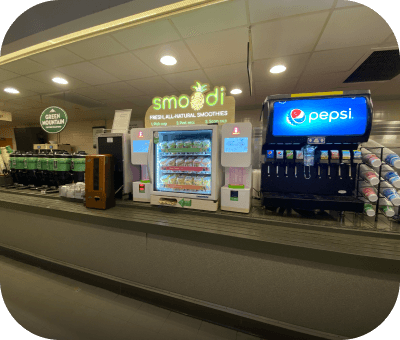
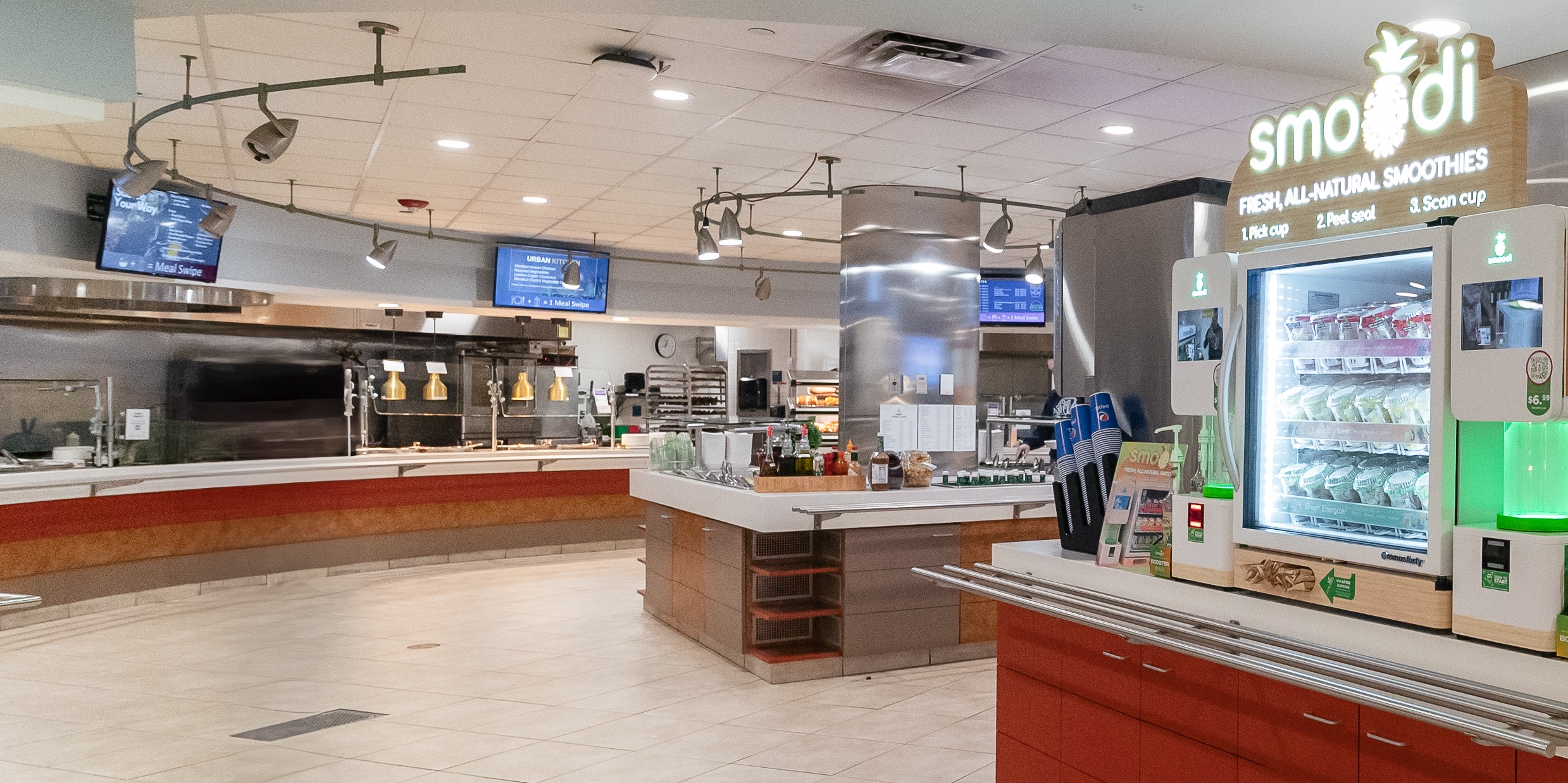
Smoodi's operational model addresses every dimension of the tariff-resilient framework described above. The automated smoothie machine requires zero staff. Each smoothie is made from IQF (individually quick frozen) real fruit cups blended with water only, with no syrups, concentrates, or artificial ingredients. The machine blends in under 60 seconds and self-cleans between every use.
The supply chain runs through Dot Foods, the largest food redistributor in the United States, providing domestic distribution that reduces tariff exposure. IQF fruit cups have a shelf life of up to two years, eliminating the spoilage that plagues fresh fruit programs and providing a buffer against temporary supply chain disruptions. Each cup is a single portion, so waste is effectively zero: operators order only what they serve.
"The investment into smoodi has been phenomenal. We broke even in the first couple of weeks."
— Linda Thacker, Director of Dining Services, Maryville University
Smoodi operates in more than 300 locations across the United States, with over 2 million smoothies served. The company was founded at Harvard Innovation Labs. The operational lease starts at $299 per month for a 48-month term, providing the fixed monthly cost that makes budgeting predictable. A purchase option is available at $14,999. The booster bar offers protein powder, collagen, and other functional supplements. For high-volume locations, multiple machines can be installed side by side, blending simultaneously.
What Questions Should Operators Ask About Cost Resilience?
Operators evaluating food programs in the current tariff environment should move beyond unit ingredient cost and examine total cost of ownership. The questions that reveal true cost resilience are specific.
- What is the labor cost per served unit? Include hiring, training, scheduling, benefits, and turnover costs, not just hourly wages.
- Where are the ingredients sourced? Programs dependent on imported ingredients face ongoing tariff risk that domestic supply chains avoid.
- What is the waste percentage? Fresh programs with 15 to 25 percent waste rates look very different from pre-portioned programs with near-zero waste when calculated over a full year.
- Is the monthly cost fixed or variable? Fixed-cost programs enable accurate budgeting. Variable-cost programs introduce forecasting risk in an already volatile cost environment.
- What happens when costs rise further? Evaluate whether the program has structural defenses against the next round of cost increases, or whether it simply delays the same margin compression.
Positioning for a Prolonged Cost Environment
The current cost environment is not a short-term disruption. The 12 to 18 month tariff lag means costs will continue rising through the remainder of 2026 and into early 2027. Labor inflation shows no signs of slowing. Energy costs remain elevated. Operators who respond with structural changes now will be better positioned than those who wait for conditions to improve.
The structural change that delivers the most impact is shifting food program components from labor-intensive, perishable, import-dependent formats to automated, shelf-stable, domestically sourced formats. That shift does not require replacing an entire food program. It starts with a single addition that demonstrates the model.
Foodservice operators interested in protecting margins with predictable-cost, zero-waste beverage programs can calculate their potential savings at getsmoodi.com/roi.
Ready to bring Smoodi to your location?
Join hundreds of operators delivering fresh, automated smoothies with zero labor.
Get Started